An attribute is also called a perfection. in some contexts. It is amazing. God can never improve or get worse. He is who he is, period.
Don’t feel frustrated if you have to read this post several times before it “clicks.”
I. Quick Definition
A. In general terms, an attribute, divine or otherwise, is a property, characteristic, proper quality.
B. “Proper” here means belonging particularly to someone or something, e.g. eternality belongs only to God; it is strictly limited or proper to God. In God the attributes are of a much greater magnitude than we humans have.
II. An Essential Attribute
A. It is a property, characteristic, or proper quality that is essential to God.
Many theologians do not use the term attribute, but prefer perfection. They have a point.
B. What it is not
The divine attributes or perfections are not accidents or incidental things that inhere in and are separable and can be withdrawn from God. Rather, the divine attributes or perfections are the essence of God himself.
C. Attributes are identical with his divine nature
God is not a composite being, as if he had a body, soul, and spirit, but he is pure spirit. Therefore the attributes are not parts of God. But since they are identical in their divine nature, they are also identical with each other. They are unified by God. So one attribute is not better or worse or more important than the other. All God’s attributes are his essence. Without one, he would not be God (but a demi-god or a pagan god).
D. God’s attributes and existence
Next, nothing is prior to God, and his essence and existence are inseparable, so his attributes are identical with his existence.
His attributes or perfections are not distinct from each other or from the divine essence. But they are predicated of God.
III. An Accidental Attribute
A. What it is
It is an incidental property of a thing. It is attached to a thing and can be withdrawn from it without substantial change or alteration. It is contingent.
B. Human example
What is the essential nature of a human? It cannot be this or that hair or eye color. If they vary, then his essence does not cease. They are “accidents.” He can exist without them.
C. Contrast with God
In contrast, in God, his attributes are not incidental, but essential. If an attribute like love or justice were withdrawn, then he would not be God (he would be a demi-god or something). His existence and attributes are identical to his existence.
IV. What Theologians Say
A. Herman Bavinck:
Every attribute is identical with God’s being. God is what he has. When we speak about creatures, we distinguish variously between what they are and what they have; e.g. a human being remains a human being even though he has lost the image of God and has become a sinner. But when we speak about God, we must maintain that each of his attributes is identical with his being. God is all light, all mind, all wisdom, all logos, all spirit, etc. … Whatever God is, he is completely and simultaneously. God has not properties but is merely is essence, God’s properties are really the same as his essence: they neither differ from his essence, nor do they differ materially [relationally] from one another (Doctrine, p. 121, emphasis original)
B. John Frame
“Nor is he [God] made up of substance and accidents, because there are no accidents in him. Since God has no accidents, everything in him is essential to his being, in a sense, his essence.” (Systematic, p. 429).
C. Millard Erickson
He is clear about God’s and man’s attributes:
The attributes are permanent and intrinsic qualities, which cannot be gained or lost. Thus, holiness is not in this sense an attribute (permanent, inseparable characteristic) of Adam, but it is of God. God’s attributes are essential and inherent dimensions of his very nature. (p. 236)
All of his attributes = his essence = his existence.
Erickson again:
It is better to conceive of God’s attributes as his nature, not a collection of separate parts or an addition to his essence. Thus, God is love, holiness, and power. These are simply different ways of viewing the unified being, God. God is richly complex, and these conceptions are merely attempts to grasp different objective aspects or facets of his being” (ibid.).
V. God’s Incommunicable Attributes
A. Brief intro.
Lutherans call this “negative attributes” because they are his attributes that no (negation) relation to the world or his creation or to humans. They are such attributes as eternity, simplicity, and infinity. They are God’s alone, with a caveat. He does not “communicate” or “share” them with us.
Positive attributes are those that God shares in a lesser sense with humans (omniscience, holiness, righteousness, truth, power. though God has these in greater magnitude. (Franz Pieper, Christian Dogmatics, vol. 1, pp. 428-37).
I will follow the classification that Wayne Grudem laid out, which apparently reflects Reform theology, since Lous Berkhof classifies in the same way.
Communicable and incommunicable (note the –in before communicable, which is a negation)..
Lutherans and the Reformed classifications are not far off.
B. Examples
Here are some that humans cannot have, but only God does:
Self-existence (God does not depend on or need anyone or anything)
Immutability (unchanging)
Simplicity (pure spirit, without parts)
Eternity (humans have a beginning; God does not. He transcends time; humans do not)
Omnipresence (he transcends space, and he is everywhere, but not confined to or in nature).
C. Why they are incommunicable
As noted, those attributes or perfections are called incommunicable because we do not share in them. However, we can still share these attributes in a small, faint sense, so the “incommunicable” attributes do not have a high wall built around them. That’s why some theologians don’t use the categories communicable or incommunicable. But we do here, just for convenience and to inform the reader that the idea of incommunicable attributes is taught by some theologians.
VI. God’s Communicable Attributes
A. He can communicate or share them
And then there are attributes that are communicable with us, since we are created in his image.
B. Here are samples:
Knowledge, wisdom and power;
Goodness, love, and mercy;
Holiness, righteousness, and justice.
VII. How do they differ in us than in God?
A. God’s attributes exist with absolute perfection.
If they did not, but he needed to improve, then he would not be God. He would be imperfect. (He would be a Greek god, for example.)
But his mercy shown to us when needed is perfect, unchanging, and complete.
B. Contrasts with humans attributes
We humans, on the other hand, can improve or get worse. Sometimes we are merciful, other times we are not, even though it may be needed.
C. The Trinity
As to the Trinity, the Father, Son, and Spirit have all these attributes, essentially, in their nature, not haphazardly or inconsistently or part-time (accidentally).
Frame:
So God’s attributes are not parts or divisions within the Godhead … but each attribute is necessarily to God’s being. But each attribute is necessary is necessary to God’s being. Each is essential to him, and therefore his essence includes all of them. God cannot be God without his goodness, his wisdom, his eternity. In other words, he is necessarily good, wise, and eternal. None of his attributes can be removed from him, and no new attribute can be added to him. (429).
D. Summary
In God, these attributes or perfections or characteristics are essential to his existence, and they are perfect, without diminishment or inconsistency.
In us humans they are parts; some attributes in some people are lacking, others strong, others weak—they are not essentially human.
VIII. Illustrations of God’s Attributes
A. Adapted from Grudem (pp. 212-13)
B.. Small circles represent attributes
Each small circle is an attribute like justice, eternity, love, holiness, omniscience (all knowing), wisdom, and so on. Here, God’s attributes are depicted as a mere collection:

That illustration does not work because they have no unity within one Being, God. They are not ingredients in a recipe.
B. A big circle and added-on attributes
In the next illustration, God is the big circle, and they are added and attached to God’s being:

This illustration falls short because God is all his attributes; they are not add-ons.
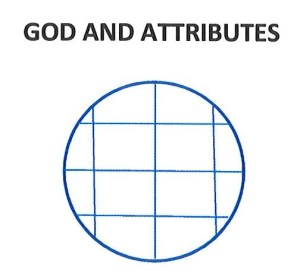
C. Better illustration
Let’s say the three horizontal lines represent God’s love. Why three? Father, Son and Holy spirit.

Next, let’s say the vertical lines represent God’s justice:
Let’s keep going. The diagonal lines represent wisdom:

Finally, the other set of diagonal lines represents his holiness:
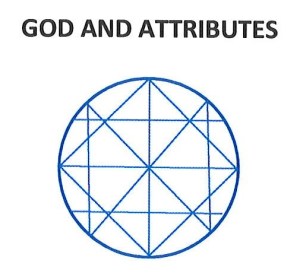
We could go on with the other attributes, but the point has been made.
Each one qualifies the other. God is completely and absolutely and simultaneously loving; he is completely and absolutely and simultaneously just; he is completely and absolutely and simultaneously wise; and he is completely and absolutely and simultaneously holy. He never sheds one or gains another. He is completely and absolutely and simultaneously all his attributes. And they are contained within the One or Unitary God.
The three lines remind us that the Son and the Spirit share the same divine attributes in their essence—but don’t take it too far, because two lines are shorter than the other! (A square would have worked better if that was the purpose of this post.)
D. Important Question
If God is one and indivisible, how can there be three?
Answer: God is one and indivisible in his being and essence, but he is three persons—”being and essence” and “persons” are different terms and realities. So there is no contradiction.
IX. Application
A. God is wholly Other
You can know him better because you can distinguish between him and you. You are filled with accidental properties—the colors of your hair, skin, and eyes; your height and girth (which changes!). You have many of his attributes, but in weak and imperfect forms or expressions.
B. He is who he is.
But God has no accidental properties in him. He is who he is. He does not change in his essence or being; you do. He is the Creator; you are the creature. You worship him; he does not worship you.
C. He shares some of his attributes.
You know God better because you need more of God to let his character grow and develop in you.
ARTICLES IN SERIES “DO I REALLY KNOW GOD?”
What a Divine Attribute Is
Do I Really Know God? He Is Self-Existent
Do I Really Know God? He Is Unchanging and Consistent
Do I Really Know God? He Is Simple
Do I Really Know God? He Is Eternal
Do I Really Know God? He Is Infinite and Personal
Do I Really Know God? He Is Spirit
Do I Really Know God? He Is Invisible
Do I Really Know God? He Is Omniscient
Do I Really Know God? He Is Everywhere
Do I Really Know God? He Is Omnipotent
Do I Really Know God? He Is Wise
Do I Really Know God? He Is Truth
Do I Really Know God? He Is Good
Do I Really Know God? He Is Compassionate and Merciful
Do I Really Know God? He Is Love
Do I Really Know God? He Is Gracious
Do I Really Know God? He Is Patient
Do I Really Know God? He Is the God of Peace
Do I Really Know God? He Is Holy
Do I Really Know God? He Is Righteous and Just
Do I Really Know God? He Shows Wrath
Do I Really Know God? He Is Jealous
Do I Really Know God? He Is Sovereign and Free
Do I Really Know God? He Is Blessed
Do I Really Know God? He Is Perfect
Do I Really Know God? He Is Majestic
Do I Really Know God? He Is Beautiful
Do I Really Know God? He Is Glorious
SOURCES
 Dr. Jim's Essential Bible Teaching