The Book of Genesis is the story of the families of earth, as the author narrows them down to one family in particular. This one major family, whose patriarch is declared righteous for his faith, will lead to the Messiah about 2000 to 1800 years later, about seventy years before the destruction of the temple in A.D. 70. Six tables of family charts are included here.
These tables illustrate the slow process of each generation fulfilling their calling and destiny. They are born, they live, do good and bad deeds, and then they pass away and let the next generation take over. The next one also does good and bad deeds. Eventually, through it all, their lineage points towards the Messiah.
The families in Genesis did not know that their family line would lead to the Messiah (unless God revealed this to them privately). But God interacted with them and led them to live in their world, which was contemporary for them but ancient to us.
Through it all, God carried this one family forward until Malachi, the last book of the Old Testament, then forward through the Intertestamental period, when God still watched over them. One royal lineage led to the birth of the Messiah in Matthew 1-2 and Luke 1-2, the offspring of Judah and David later.
This post focuses on the families in Genesis.
If the reader would like to copy and paste the tables into their own notes for their private study or Bible study groups, they are free to do so (though they may find neater ones elsewhere). Just give this website credit.
At the end of each table I include Luke’s genealogy and sometimes Matthew’s (beginning with Abraham).
Now let’s begin with the first table.
TABLE ONE

Luke’s Genealogy (in reverse order): Shem ─ son of Noah ─ son of Lamech ─ son of Methuselah ─ son of Enoch ─ son of Jared ─ son of Mahalalel ─ son of Kainan (variation of Kenan) ─ son of Enosh ─ son of Seth ─ son of Adam ─ son of God (Luke 3:36-38)
For my view on the really long ages of each character, please click here:
5. The Real Significance of Genealogies in Genesis 5-11
TABLE TWO
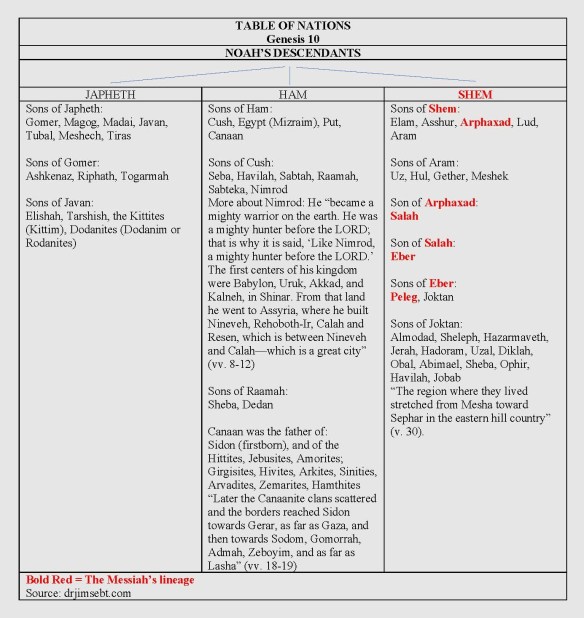
Luke’s genealogy (in reverse order): Peleg, the son of Eber ─ the son of Shela (spelling variation) ─ the son of Canain (it is acceptable practice for ancient genealogies to skip generations; see Gen. 5:9) ─ the son of Arphaxad ─ the son of Shem (Luke 3:35-36)
On some counts, the number of nations and sons come to seventy (the remark about the Philistines is an aside, so says Wenham 77, in Halton).
The number seventy again looks like artifice or is deliberate as a multiple of seven, an important number in the Hebrew Bible and the Revelation.
This genealogy is both vertical (linear) (son of, son of, direct heir) or segmented (this father and mother had these sons and daughters).
The genealogy of Japheth shows his seven sons and seven grandsons. Cush has five sons and two grandsons (seven). Mizraim (Egypt) has seven sons.
Column 1 = Sea People; Column 2 = Urban People; Column 3 = Nomadic People.
Eber in the third column is where “Hebrew” comes from, though some scholars say Eber is not related to “Hebrew.”
Names: individuals, locations, people groups; each is progenitor of other children not part of Israelite ancestry, in the known world.
The main goal is to relate (future) Israel to ancient peoples.
TABLE THREE

Luke’s genealogy (in reverse order): Terah, son of Nahor ⸺ son of Serug ⸺ son of Reu ⸺ son of Peleg ⸺ son of Eber ⸺ son of Shelah ⸺ son of Cainan (or Kenan; standard practice for ancient genealogies to skip generations; see Gen. 5:9) ⸺ son of Arphaxad ⸺ son of Shem (Luke 3:34-36)
NAHOR’S SONS:
20 Some time later Abraham was told, “Milkah is also a mother; she has borne sons to your brother Nahor: 21 Uz the firstborn, Buz his brother, Kemuel (the father of Aram), 22 Kesed, Hazo, Pildash, Jidlaph and Bethuel.” 23 Bethuel became the father of Rebekah. Milkah bore these eight sons to Abraham’s brother Nahor. 24 His concubine, whose name was Reumah, also had sons: Tebah, Gaham, Tahash and Maakah. (Gen. 22:20-24, NIV)
TABLE FOUR

Joseph’s name is in many-colors to reflect the biblical story, not because he was gay or I endorse this lifestyle. That’s taking the Bible out of context. Anachronism.
LOT’S DAUGHTERS AND GRANDCHILDREN
36 So both of Lot’s daughters became pregnant by their father. 37 The older daughter had a son, and she named him Moab[g]; he is the father of the Moabites of today. 38 The younger daughter also had a son, and she named him Ben-Ammi[h]; he is the father of the Ammonites[i] of today. (Gen. 19:37-38)
Matthew’s genealogy: Abraham → Isaac → Jacob → Judah (“and his brothers”) → Perez (and “Zerah and Tamar their mother”) → Hezron (Matt. 1:2-3)
Luke’s Genealogy (in reverse order): Hezron ─ son of Perez ─ son of Judah ─ son of Jacob ─ son of Isaac ─ son of Abraham (Luke 3:33-34)
TABLE FIVE
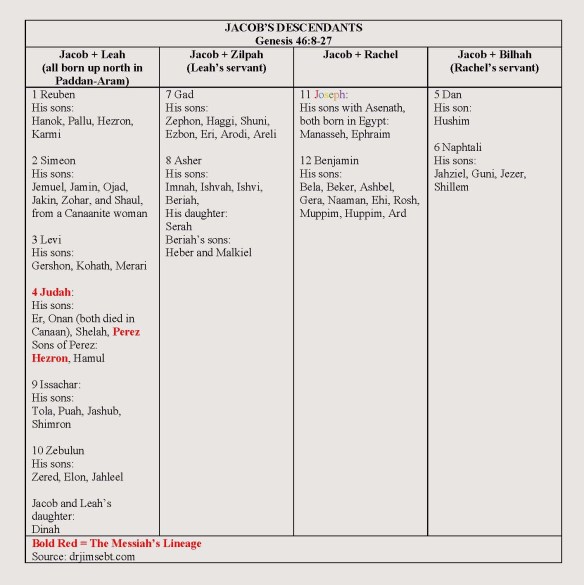
Matthew’s genealogy: Jacob → Judah (“and his brothers”) → Perez (and “Zerah and Tamar their mother”) → Hezron (Matt. 1:2-3)
Luke’s genealogy (in reverse order): Hezron ─ son of Perez ─ son of Judah ─ son of Jacob (Luke 3:33-34)
JACOB’S PROPHECY
Jacob is blessing and prophesying over his twelve sons. When he gets to Judah, Jacob speaks these words:
10 The scepter will not depart from Judah,
nor the ruler’s staff from between his feet,
until he to whom it belongs shall come
and the obedience of the nations shall be his. (Gen. 49:10, NIV)
Judah’s descendants will be royal kings who hold the scepter. The first fulfillment is David and his royal descendants, but the most significant and ultimate and final fulfillment is King Jesus. Jacob’s prophecy is now sustained and carried on and eternally true through Jesus, the forever king reigning in heaven.
TABLE SIX
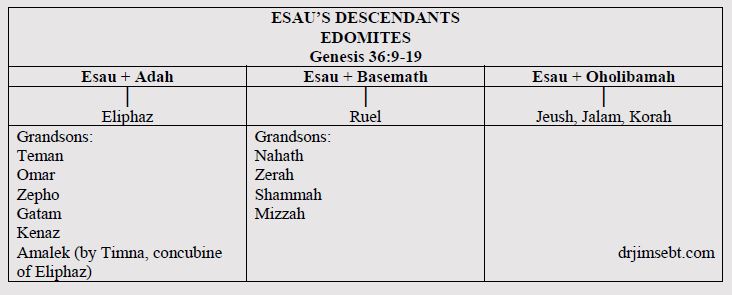
Esau does not fit in with Matthew’s and Luke’s genealogies. His brother Jacob was chosen to be the ancestor of the Messiah.
God still blessed Esau and his descendants, the Edomites, listed after the names in Table Six, as seen in these verses:
15 These were the chiefs among Esau’s descendants:
The sons of Eliphaz the firstborn of Esau:
Chiefs Teman, Omar, Zepho, Kenaz, 16 Korah,[a] Gatam and Amalek. These were the chiefs descended from Eliphaz in Edom; they were grandsons of Adah.
17 The sons of Esau’s son Reuel:
Chiefs Nahath, Zerah, Shammah and Mizzah. These were the chiefs descended from Reuel in Edom; they were grandsons of Esau’s wife Basemath.
18 The sons of Esau’s wife Oholibamah:
Chiefs Jeush, Jalam and Korah. These were the chiefs descended from Esau’s wife Oholibamah daughter of Anah.
19 These were the sons of Esau (that is, Edom), and these were their chiefs.
20 These were the sons of Seir the Horite, who were living in the region:
Lotan, Shobal, Zibeon, Anah, 21 Dishon, Ezer and Dishan. These sons of Seir in Edom were Horite chiefs.
22 The sons of Lotan:
Hori and Homam.[b] Timna was Lotan’s sister.
23 The sons of Shobal:
Alvan, Manahath, Ebal, Shepho and Onam.
24 The sons of Zibeon:
Aiah and Anah. This is the Anah who discovered the hot springs[c] in the desert while he was grazing the donkeys of his father Zibeon.
25 The children of Anah:
Dishon and Oholibamah daughter of Anah.
26 The sons of Dishon:
Hemdan, Eshban, Ithran and Keran.
27 The sons of Ezer:
Bilhan, Zaavan and Akan.
28 The sons of Dishan:
Uz and Aran.
29 These were the Horite chiefs:
Lotan, Shobal, Zibeon, Anah, 30 Dishon, Ezer and Dishan. These were the Horite chiefs, according to their divisions, in the land of Seir.
31 These were the kings who reigned in Edom before any Israelite king reigned:
32 Bela son of Beor became king of Edom. His city was named Dinhabah.
33 When Bela died, Jobab son of Zerah from Bozrah succeeded him as king.
34 When Jobab died, Husham from the land of the Temanites succeeded him as king.
35 When Husham died, Hadad son of Bedad, who defeated Midian in the country of Moab, succeeded him as king. His city was named Avith.
36 When Hadad died, Samlah from Masrekah succeeded him as king.
37 When Samlah died, Shaul from Rehoboth on the river succeeded him as king.
38 When Shaul died, Baal-Hanan son of Akbor succeeded him as king.
39 When Baal-Hanan son of Akbor died, Hadad[e] succeeded him as king. His city was named Pau, and his wife’s name was Mehetabel daughter of Matred, the daughter of Me-Zahab.
40 These were the chiefs descended from Esau, by name, according to their clans and regions:
Timna, Alvah, Jetheth, 41 Oholibamah, Elah, Pinon, 42 Kenaz, Teman, Mibzar, 43 Magdiel and Iram. These were the chiefs of Edom, according to their settlements in the land they occupied.
This is the family line of Esau, the father of the Edomites.(Gen. 36:15-43)
WE ARE ABRAHAM’S SPIRITUAL DESCENDANTS
Paul writes in his epistle to the Galatians:
7 Understand, then, that those who have faith are children of Abraham. 8 Scripture foresaw that God would justify the Gentiles by faith, and announced the gospel in advance to Abraham: “All nations will be blessed through you.” 9 So those who rely on faith are blessed along with Abraham, the man of faith. […] 14 He redeemed us in order that the blessing given to Abraham might come to the Gentiles through Christ Jesus, so that by faith we might receive the promise of the Spirit. 15 Brothers and sisters, let me take an example from everyday life. Just as no one can set aside or add to a human covenant that has been duly established, so it is in this case. 16 The promises were spoken to Abraham and to his seed. Scripture does not say “and to seeds,” meaning many people, but “and to your seed,”[i] meaning one person, who is Christ. 17 What I mean is this: The law, introduced 430 years later, does not set aside the covenant previously established by God and thus do away with the promise. 18 For if the inheritance depends on the law, then it no longer depends on the promise; but God in his grace gave it to Abraham through a promise. (Gal. 3:7-9, 14-18, NIV)
What this passage teaches us is that Christ is the fulfillment of God’s promise to Abraham that all the nations will be blessed through Abraham’s seed. Paul plays with the singular “seed,” and says it refers to the Ultimate Offspring of Abraham, Jesus, the Messiah, the Son of God. He and his gospel are the greatest blessing to the nations. Then Paul talks about the singular seed being a collective singular. Everyone who is in Christ is also in Abraham by the family lineage, spiritually speaking, not genetically speaking (unless they are Messianic Jews). Therefore together they are the blessing to all the nations, but only in Christ and his gospel, which only those in him can proclaim.
And this is why the genealogies in Genesis are so important. They express the fall of humankind through Adam, but they also speak of God’s redemption plan of humankind, beginning with Abraham’s, Isaac’s, and Jacob’s lineage. The other lines, like Ishmael’s or Esau’s, don’t qualify because Isaac was the child of promise through Sarah, not Hagar (or Keturah).
Bottom line: Christ alone is the blessing to the nations promised to Abraham and his seed in Galatians 3.
RELATED
5. The Real Significance of Genealogies in Genesis 5-11
Reconciling Matthew’s and Luke’s Genealogies: Mission: Impossible?
 Dr. Jim's Essential Bible Teaching