Normally I would not include a detailed exegesis (close reading) or discussion of the Olivet Discourse in Theology 101: the Basics. But maybe I can bring clarity to a complex issue, if not for popular Bible prophecy teachers, then maybe for a new generation of leaders. All by God’s grace and will.
The translations are mine, unless otherwise noted. If you would like to see other translations, please go to biblegateway.com.
This post has five major additional sections:
I. Introduction
II. The Destruction of Jerusalem and the Temple
III. The Second Coming
IV. The Arch of Titus
V. Main Conclusion
VI. Application
Here we go.
I. Introduction
A. Olivet Discourse
The Olivet Discourse refers to the parallel passages in Matthew 24, Mark 13, and Luke 21 (but not Luke 17). It is so named because it was delivered near the Mount of Olives.
B. Why parallel columns?
Let’s place these chapters in parallel columns, unit by unit. Sometimes the omissions clarify what this long section of Scripture really teaches, and so do additions. Sometimes Matthew guides us, and in other verses, Luke does.
In any case, clarity is the main goal here. Will I succeed?
C. Quoting Scriptures is important
Let’s look closely look at the actual quoted verses (and not just the references). Merely referring to the verse without quoting it depends too heavily on our memory.
D. The most “stubborn” verse in the synoptic Gospels
This one verse appears in all three Gospels and in the same context. It refers to the Son of Man coming in judgment on Jerusalem and its temple, Jesus’s generation. Later in the Olivet Discourse, Jesus will predict his Second Coming, which has not happened for two thousand years and counting.
Back to the Son of Man coming in judgment, using the Roman army.
What kind of prophetic powers would be absent in him, if he had not predicted such a monumental event, as the the destruction of Jerusalem and the temple? The temple religion of Moses was ended, which is the close out or end of one age and the beginning of a new age.
Matthew:
I tell you the truth: this generation will not pass away until all these things take place. (Matt. 24:34)
Mark:
I tell you the truth: this generation will not pass away until all these things take place (Mark 13:30)
Luke:
I tell you the truth: this generation will not pass away until all these things take place. (Luke 21:32)
The phrase “this generation” is used fifteen times in the synoptic Gospels (including those three verses). In every case, the phrase is used exclusively of Jesus’ generation while he lived. It does not refer to our generation, 2000 years later. And the word “generation” in the synoptics is very often used of his generation (except, for example, in genealogies). If “generation” were to be translated as “race,” as some propose, then Jesus was declaring something vapid. Of course Jews would not pass away at the time he spoke. Instead, his prediction is about the timing, so “generation” is the right translation, as it is in nearly all other verses where the Greek noun appears.
Here is a link to all the occurrences of the Greek noun genea (pronounced geh-neh-ah, and the “g” is hard as in “get”), in the synoptics. They confirm that he was talking to his or this generation:
Now, what are “all these things”? Everything that Jesus had predicted up to that verse. Luke 21:20-24 even says that armies will surround Jerusalem. This happened in A.D. 70, when the Roman armies sacked the city and destroyed the temple. The Roman pagans stomped all over the sacred place, committing the abomination of desolation.
Those three parallel verses are capstones about the destruction of the temple and Jerusalem. Jesus’s prediction came true–this (or his) generation, though he died young.
So, the three parallel verses seem stubborn only to those who insist that most or all of the verses before the one “stubborn” verse are about our times–the distant future to him. No, they are about the destruction of the temple in AD 70, as the rest of this post claims to demonstrate.
II. The Destruction of Jerusalem and the Temple
A. Brief intro
In Units 1-19, Jesus reveals many time markers before the destruction (“then,” “in those days,” “beginning of birth pangs,” “at that time,” the leafing fig and other trees, and so on). Jesus even said the destruction would happen before his generation had passed away, the clearest and most emphatic time marker of all (Unit 18). Further, Luke is clearest of either Matthew or Mark that Jesus was talking about the destruction of Jerusalem and the temple by the Roman army; Jesus was not predicting the Second Coming but his visitation. Finally, Luke has two clarifying additions (Units 7 and 9) and two clarifying omissions (Units 6 and 15).
B. Table
| Unit | Mt. 24:1-35 | Mk 13:1-31 | Lk 21:5-33 |
| 1 | 1 And Jesus, leaving the temple, was departing, and his disciples came up to him, to point out to him the buildings of the temple. 2 But in reply, he said to them, “You see all these things, don’t you? I tell you the truth: a stone will in no way be left here on another stone which shall not be thrown down!” | 1 And as he was leaving the temple, one of the disciples said to him, “Teacher, look at such stones and such buildings!” 2 Jesus said to him, “Do you see these great buildings? In no way will one stone be left on another stone which will not be thrown down!” | 5 Further, while some were speaking about the temple that it had been decorated beautifully with stones and votive offerings, he said: 6 “The things you see here—the days shall come when not one stone shall be left on another stone which shall not be torn down!”
|
| 2 | 3 As he was sitting on the Mount of Olives, his disciples came up to him privately, saying, “Tell us. When will these things be? And what will be the sign of your visitation and the close of the age?” | 3 While he was sitting on the Mount of Olives, opposite the temple, Peter and James and John and Andrew asked him privately: 4 “Tell us: When will these things be? And what will be the sign when all these things are to be completed?” | 7 So they asked him, saying, “Teacher, when therefore will these things be, and what is the sign when these things will happen?” |
| 3 | 4 And in reply, Jesus said to them, “See to it that no one leads you astray. 5 For many will come in my name saying, ‘I am the Christ!’ and will lead many astray. 6 You will hear of wars and reports of wars. Watch that you do not be alarmed, for this must happen. However, this is not yet the end [telos]. 7 For nations will rise up against nation and kingdom against kingdom, and there will be famines and earthquakes in various places. 8 But all these things are the beginning of birth pangs. | 5 Jesus began to say to them, “See to it that no one deceives you. 6 Many will come in my name, saying, ‘I am he!’ And they will deceive many. 7 When you hear of wars or reports of wars, do not be troubled; these things must be, but the end [telos] is not yet, 8 for nation will rise against nation and kingdom against kingdom; there will be earthquakes in various places, and there will be famines. These things are the beginning of birth pangs. | 8 And he said, “Watch that you are not deceived, for many shall come in my name, saying, ‘I am the one!’ and ‘The time is near!’ Don’t go after them. 9 When you hear of wars and uprisings, do not be terrified, for these things must happen first. However, the end [telos] is not immediate.”
10 Then he proceeded to tell them, “Nation will rise against nation and kingdom against kingdom. 11 There will be powerful earthquakes and famines and pestilences everywhere. [For 11b see unit 13] |
| 4 | 9 Then they will hand you over to tribulation and kill you, and you will be hated by all nations because of my name. 10 Then many will be caused to stumble and betray one another and hate one another. 11 And many false prophets will arise and deceive many. 12 Because lawlessness multiplies, the love of many will grow cold. | 9 “You see to yourselves! They will hand you over to local courts, and you will be beaten in the synagogues, and you will stand before governors and kings, for my sake, for a testimony to them.
[…… see unit 6] 11 And when they arrest you to hand you over, do not worry ahead of time about what you should say, but speak that which is given you at that time, for you are not the ones speaking, but the Holy Spirit. 12 Brother will betray brother to death and father a child and children will rise up defiantly against parents and have them put to death. 13a You will be hated by everyone because of my name, |
12 “But before all these things, they will arrest you with their hands and persecute you, handing you over to the synagogues and prisons, bringing you before kings and governors because of my name. 13 The result will be your testimony. 14 Put it in your heart not to prepare ahead to defend yourselves, 15 for I will give you speaking ability with words and wisdom which your opponents will not be able to withstand or contradict. 16 Indeed, you will be handed over even by parents and siblings and relatives and friends, and they will execute some of you. 17 You shall be hated by everyone because of my name. 18 Not even a hair on your head will be lost. |
| 5 | 13 But he who endures to the end [telos]—this one will be saved. | 13b but the one who endures to the end [telos] —this one will be saved. | 19 By your endurance you shall gain your lives.” |
| 6 | 14 And this gospel of the kingdom will be preached to the whole world as a witness to every nation, and then the end [telos] will come. | ………….
[See unit 4] 10 And the gospel of the kingdom must first be proclaimed to all nations. |
|
| 7 | 15 Then, when you see the abomination of desolation spoken through Daniel the prophet, standing in the holy place”—let the reader understand!— | 14 “When you see the abomination of desolation standing where it must not”—let the reader understand!— | 20 When you see Jerusalem surrounded by armies, then you know that its desolation is near. [See unit 9] |
| 8 | 16 “then let those who are in Judea flee to the mountains, 17 and let the one on the roof not go down and take things from his house, 18 and let the one in the field not turn back to get his cloak. 19 Woe to those who are pregnant and are nursing in those days! 20 Pray that your flight might not happen in the winter or on the Sabbath. 21 For at that time there will be great tribulation which has never happened from the beginning of the world until now, and nor will surely ever happen again. | “then those in Judea must flee to the mountains. 15 And the one on the housetop must not go back down nor go back in to pick up anything from his house! 16 And the one in the field should not return to the things behind, to pick up his cloak! 17 But woe to pregnant women and to the ones nursing in those days! 18 Pray that it may not happen in the winter, 19 for there will be tribulation in those days such as has not happened from the beginning of creation which God created until now and will never be. | 21 Then those in Judea must flee to the mountains and those inside it must get out and those in the countryside must not enter it, 22 because these are the days of judgment, fulfilling everything that has been written. 23 Woe to those who are pregnant and are nursing in those days! For there will be great distress upon the country and wrath upon this people.
[See Unit 24, below] |
| 9 | 24 And they will fall by the edge of the sword and be taken captive into all nations, and Jerusalem will be trampled on by the nations until the times of the nations will be completed.
[See unit 7] |
||
| 10 | 22 And unless those days were shortened, nobody would be saved. But because of the elect, those days will be shortened. | 20 And unless the Lord shorten the days, no flesh will be saved, but because of the elect who has been elected, he will shorten the days. | |
| 11 | 23 At that time if someone says to you, ‘Look!’ Here is the christ!’ or ‘Here he is!’ do not believe it. 24 For false christs and false prophets will arise and produce great signs and wonders in order to deceive many, and if possible, even the elect. 25 See! I have told you in advance. | 21 And then if anyone says, ‘Look! The christ is over here! Look! There!’ Do not believe him, 22 for false christs and false prophets will arise and produce signs and wonders to deceive, if possible, the elect. 23 But you watch! I have told you all these things in advance. | |
| 12 | 26 If therefore they tell you, ‘Look, he is in the desert!’ do not go out. ‘Look! He is in the storeroom!’ do not believe it. 27 For just as the lightning comes out from the east and shines to the west, in this way will the visitation of the Son of Man be. 28 For where the carcass is, the vultures also gather. | See Luke 17:22-25, 37, below in the commentary on Unit 12 | |
| 13 | 29 But immediately after the tribulation of those days,
The sun shall darken And the moon shall not give off its light [Is. 13:10; Ezek. 32:7; Joel 2:10, 31; 3:15] And the stars shall fall from the heaven, And the powers of the heaven shall be shaken. [Is. 34:4; Haggai 2:6; 21] |
24 But in those days, after that tribulation,
The sun shall be darkened, And the moon shall not give its light 25 And stars shall fall from the sky And the powers in the sky shall be shaken. [Is. 13:10; 34:4; Ezek. 32:7-8; Joel 2:10, 31; 3:15]
|
11b There will be both frightening events and great signs in the heaven.
[or keep 11b in unit 3] 25 Further, there will be great signs in the sun and moon and stars and upon the earth distress of the nations and in the perplexity of the noise of the sea and rough waves, 26 so that people will faint from fear and the expectation of what is coming on the world, for the powers of the heavens will be shaken.
|
| 14 | 30 And at that time the sign of the Son of Man will appear in the heaven, and then all the tribes of the land will mourn and ‘see the Son of Man coming on clouds of heaven’ [Isaiah 19:1-4] | 26 And then they will see ‘the Son of Man coming in clouds’ [Isaiah 19:1-4] with much power and glory. | 27 And then they will see the Son of Man coming in clouds with great power and glory. [Isaiah 19:1-4] |
| 15 | 31 And he will send out his angels with a great trumpet and gather together his elect from the four winds, from one end of heaven to the other. Deut. 30:4; Zech. 2:6, 10] | 27 And then he will send the angels and gather his elect from the four winds, from one end of the earth to the end of heaven. [Deut. 30:4; Zech. 2:6, 10] | |
| 16 | 28 When these things begin to happen, stand up straight and lift up your head because your redemption is near! | ||
| 17 | 32 From the fig tree, learn the parable: when its branch becomes already tender and produces leaves, you recognize that summer is near. 33 In this way, you also, when you see all these things, recognize that it is near, at the doors. | 28 From the fig tree, learn this illustration: when its branch has become tender and it is sprouting leaves, you know that summer is near, at the door. | 29 Further, he spoke an illustration to them: “Look at the fig and all the trees. 30 When they have already grown leaves, you see for yourselves and know that the summer is already near. 31 Likewise, you also, when you see these things happening, know that the kingdom of God is near. |
| 18 | 34 I tell you the truth: this generation will not pass away until all these things take place. | 30 I tell you the truth: This generation will not pay away until all these things take place. | 32 I tell you the truth: This generation will not pass away until all these things take place. |
| 19 | 35 Heaven and earth will pass away, but my words will certainly not pass away.” | 31 Heaven and earth will pass away, but my words will never pass away.” | 33 Heaven and earth will pass away, but my words will certainly not pass away.”
|
C. Commentary
Unit 1 (Temple is awesome! say disciples; it shall be destroyed! replies Jesus.)
The disciples intend for Jesus to admire the temple, but he predicts its destruction. All three Synoptics agree. He is answering their question, in his / their generation. He is not talking about the destruction of the temple two thousand years later. The Romans destroyed it in A.D 70. The Roman generals stomped all over the holy of holies. They committed the abomination of desolation in their generation, about two thousand years ago.
Unit 2 (Two questions: When? And what sign?)
Let’s allow Matthew to guide us in this unit, since he has a more detailed plan.
(1). When will these things be? In context, this refers to the question in vv. 1-2 about the destruction of the temple.
(2) And what is the sign of the Second Coming and close of the age?
Jesus answers the first question in vv. 4-35, and he answers the second question in 24:36-25:46.
Matthew employs different Greek nouns for the end of the temple: telos (pronounced teh-loss).and synteleia (pronounced sin-teh-lay-ah). They clearly mean the end of the age. Synteleia is used throughout the entire NT six times, five times in Matthew’s Gospel (13:39, 40, 49; 24:3; 28:20) and once in the epistle to the Hebrews (9:26). It seems to have taken on a specialized sense in Matthew’s Gospel to close out our age, though it is also used in Hebrews 9:26 as the end of the age. In this context, both terms mean the end of the temple system. We could call it the end of the Age of Moses, which went back as far as 1300 years B.C.
In sum, telos and synteleia happens to the temple and Jerusalem, that is, the entire age of Moses, so to speak. Mark uses the verb synteleō, which adds up to the same thing.
This is monumental. A new era begins.
Unit 3 (Don’t be deceived or frightened; nations will rise against nation; wars and reports of war)
All three Synoptics agree on this. In my comments on Matthew 24:4-35, I have examples of these rivalries and wars and reports of war (with secondary sources):
Matthew 24:4-35 Predicts Destruction of Jerusalem and Temple (scroll down to vv. 4-8)
When kingdom rises against kingdom, Matthew is using the language that looks like that of Isaiah 19:2, which appears in the context of judgment on Egypt:
… and they will fight, each against another
and each against his neighbor,
city against city, kingdom against kingdom (Is. 19:2, ESV)
Just as God uses apocalyptic imagery for his judgment of Egypt by the Assyrians, so God will use the Roman army for his judgment on Jerusalem and the temple.
Here’s a summary passage in the Roman historian Tacitus (lived A.D. 56-120) Histories about kingdoms against kingdoms and general mayhem:
The history which I am entering is that of a period rich in disasters, terrible with battles, torn by civil struggles, hostile even in peace. Four emperors fell by the sword, there were three civil wars, more foreign wars, and often both at the same time … Italy was distressed by disasters unknown before or returning after the lapse of the ages … Beside the manifold misfortunes that befell mankind there were prodigies in the sky and on the earth, warnings given by thunderbolts, and prophecies of the future, both joyful and gloomy, uncertain and clear (Histories, 1.2, 3, qtd. in David E. Garland, Reading Matthew: A Literary and Theological Commentary, [Smyth and Helwys, 2001], p. 242)
Unit 4 (you will be betrayed to local authorities and put on trial)
Matthew uses the Greek noun thlipsis, which is usually translated as “tribulation” or “hardship,” but Mark and Luke clarify it: court trials. Matthew again mentions the emergence of false prophets. This can happen at any time, but particularly during monumental events, like before the destruction of the temple. Jeremiah had to put up with them, just before the first destruction (e.g. Jer. 23:9-39).
F.. F. Bruce, in his 1990 commentary on the book of Acts, writes of Jewish messianism and nationalism:
There were outbreaks of Jewish unrest around this time [AD 40-50s] not only in Judaea where the national resistance movement gathered force under the governors who held office after the death of Herod Agrippa I in AD 44, but throughout the empire–at Alexandria early in Claudius’ principate–[Bruce now cites a reference] and at Rome both then and more recently [….] Now, it was implied, the same troublemakers had turned up in Thessalonica. The authorities could not be expected to distinguish the militant messianism of the Jewish nationalists from the messianism proclaimed by Paul and Silas. (The Acts of the Apostles: The Greek Text with Introduction and Commentary, 3rd, ed. Eerdmans, 1990), p. 371
In other words false messiahs emerged around the Roman empire.
But some principles will appear from one generation to the next, like this one in Matthew 24:12: “Because lawlessness multiplies, the love of many will grow cold.”
Unit 5 (he who endures to the end will be saved)
Luke mentions endurance and gaining their lives. What does “end” (telos) mean here in this unit in Matthew and Mark? To combine them with Luke, the noun telos means possible martyrdom—the end of one’s life. But it can also mean to stand true and not apostatize during extreme hardship, without martyrdom, until the hardship stops or ends.
Unit 6 (this gospel must first be preached to all nations of whole world)
Matthew has “whole world,” while Mark has “all nations.” They mean the same thing in this context (for my purposes here).
Revealingly and significantly, Luke does not include this verse. He eliminates it as a time and event marker.
But since Matthew and Mark have this time and event marker, let’s look at it. The standard interpretation is that this unit must be lifted out of its textual and historical context and applied to the global missionary effort today. Some teach that bringing the gospel to the world will cause or speed up the “end.” Or the proclamation does not cause the end but is a preliminary to it.
First, in reply, however, in Matthew 28:20, Jesus promises the synteleia or the closing out of the age, which, as noted, is a fitting capstone on Matthew’s Gospel. “And remember this: I am with you every day, until the end [synteleia] of the age” (Matt. 28:20b). So the commission to preach goes on even to our day, in that verse. (And it is a sure thing that Jesus, in his ascended state, when he commissioned his disciples at the end of Matthew, knew about Australia and North America, but let’s not push too hard or far about this deeper theology in this post.) This verse is not the end of the entire age, but in Unit 6, the telos end means the end of the temple and the Old Religious Order. It is the end of the Age of Moses and the Sinai covenant.
Second, as the first-century Christians understood it, “the whole world” did not include North and South America or Australia, about which the first-century Christian communities knew nothing. The whole world encompassed the Romans Empire and the surrounding Mediterranean world and some points east of Israel. The Greek term world, oikoumenē (pronounced oi-koo-meh-nay), means the inhabited world. The term can describe the famine that impacted the oikoumenē or the world (Acts 11:28). The worship of Artemis is said to have spread around the oikoumenē (Acts 19:27). Colossians 1:6 says the gospel is bearing fruit around the whole world (see also Col. 1:23). Romans 16:26 says the gospel has been known to all the nations (also see Rom. 10:18). Paul was planning to go to Spain (Rom. 15:18-24). All the way back to Homer (a Greek poet, whose poems were composed in late 8th to early 7th centuries, BC), Ethiopia was considered the end of the world. The gospel reached the Ethiopian eunuch, and later tradition says the nation was powerfully influenced by the gospel (Acts 8:26-40). So let’s not insist on a clunky, wooden interpretation of oikoumenē or all nations in Unit 6. The point is that the gospel will go outside Jerusalem and Judea, where Jesus was speaking.
Boiled down: Matthew and Mark knew nothing of North and South America and Australia, but in their minds, the gospel was in fact going around the whole (known) world.
In any case, Luke’s omission clearly means that Jesus had in mind the destruction of the temple, not his Second Coming, in these nineteen units.
Unit 7 (abomination of desolation)
Luke interprets this event as the Roman armies encircling Jerusalem, which they did in A.D. 66, and they finally conquered it in A.D. 70 and stomped all over the temple. The sacrilege or abomination was actually committed. See Unit 9. Also see photos of the Arch of Titus, below.
Clearly, these nineteen units speak of the destruction of Jerusalem and the temple, not his Second Coming.
Unit 8 (flee to the mountains and don’t return to pack your belongings)
Matthew uses the phrase “great tribulation,” which has been interpreted by certain Bible teachers today as the “Great Tribulation.” However, this interpretation lifts the phrase out of context. With the destruction of the temple, Judaism was never the same, from the religion Moses set up to the destruction. Jews today don’t sacrifice animals at the temple, for example.
It was a great tribulation to be surrounded by Roman armies and watch the end of the temple and the religion of Moses. Monumental. Horrific.
This unit has to speak of the destruction of the temple, because people can flee from it; no one can run and hide from the Second Coming and judgment.
Jewish Christians did flee up north to Pella, church historian Eusebius tells us.
Luke connects the destruction to the wrath / judgment of God because the Jerusalem establishment rejected the Messiah and his Son whom God had sent to them, though many individual Jews did accept him (Acts 2:41, 47; 4:4; 6:7 [priests]; 21:20).
Incidentally, God’s wrath is judicial, not an uncontrolled outburst of rage. See my posts:
The Wrath of God in the Old Testament
The Wrath of God in the New Testament
Unit 9 (Jerusalem will be trampled underfoot until time of Gentiles)
Luke is the only one that has this unit, and it connects with Unit 7. Some interpreters say that this verse corresponds to Romans 11:25:
I do not want you to be ignorant of this mystery, brothers and sisters, so that you may not be conceited: Israel has experienced a hardening in part until the full number of the Gentiles has come in (Rom. 11:25, NIV)
This means that Gentiles will dominate Jerusalem, and the temple would never be the same ever since, until God intervenes and says otherwise.
Clearly, Luke’s version is about the destruction of Jerusalem and the temple, and he guides us in interpreting Matthew and Mark—and sometimes Matthew guides us in interpreting Mark and Luke.
Unit 10 (the days will be shortened for the elect)
The days were shortened. The Roman conquest of Jerusalem did not eliminate all Jews (and converted or Messianic Jews). The war did not last forever, but only three and a half years.
Unit 11 (prediction of false messiahs and prophets, who may deceive even the elect, if possible)
This danger emerges in every generation, but particularly in tense times, as it happened before the destruction of Jerusalem. Matthew and Mark include it, while Luke omits this verse. See Unit 4, for a long paragraph by F. F. Bruce.
Some elements to the Olivet Discourse will be repeated from one generation to the next, like false christs and prophets. But the Discourse is about Jesus’s generation and the destruction of the temple.
Unit 12 (see the verses in the table, below)
Matthew 24:26-28 and the parousia refer to the visitation of judgment on the holy city and its temple, and that’s why these apocalyptic signs appear in Unit 13.
| 12 | 26 If therefore they tell you, ‘Look, he is in the desert!’ do not go out. ‘Look! He is in the storeroom!’ do not believe it. 27 For just as the lightning comes out from the east and shines to the west, in this way will the visitation of the Son of Man be. 28 For where the carcass is, the vultures also gather. | Luke 17:22-25, 37
22 He said to the disciples, “The days will come when you will yearn to see one of the days of the Son of man, but you will not see it. 23 And they will say to you, ‘Look there!’ or “Look here!’ But don’t leave, nor pursue it. 24 For just as flashing lightning shines from one end of the sky to the other end of the sky, so will be the Son of Man in his day. 25 But first he must suffer many things and be rejected by this generation. …… [see Unit 22] 37 And in reply, they said to him, “Where, Lord?” And he said to them, “Where the body will be, there the vultures will also gather. |
Unit 12 refers to the Son of Man coming in judgment on Jerusalem and its temple. Units 13-14 makes this interpretation the most likely.
Then why does Luke 17, which teaches the Second Coming, have the same signs as the ones about the destruction of Jerusalem and the temple? Because the repertoire of OT passages about judgment imagery can refer to destruction of nations and then be extension the end of the world at the Second Coming.
With this clarifying interlude completed, Matthew will resume the events that will happen before his generation passes away in Units 13-17.
Unit 13 (cosmic disasters)
Units 13 and 14 belong together.
These signs are not to be taken literally; otherwise the cosmos (earth, moon, sun, stars and so on) would have been shredded millennia ago.
To illustrate the symbolism in apocalyptic pronouncements, this verse refers to the overthrow of ancient Babylon:
For the stars of the heavens and their constellations
will not give their light;
the sun will be dark at its rising,
and the moon will not shed its light. (Is. 13:10, ESV)
Next, this passage is God’s coming judgment on Egypt, using the Assyrian army as the instrument or agency of judgment. Note the riding or coming on clouds, which looks like Matthew 24:30 and Mark 13:26, quoted above:
An oracle concerning Egypt.
Behold, the Lord is riding on a swift cloud
and comes to Egypt; and the idols of Egypt will tremble at his presence,
and the heart of the Egyptians will melt within them.
2 And I will stir up Egyptians against Egyptians,
and they will fight, each against another
and each against his neighbor,
city against city, kingdom against kingdom; …
And the waters of the sea will be dried up … (Is. 19:1-2, 5, NIV)
The people in conflict reflects these verses in Luke’s version of the Olivet Discourse: “Then he said to them, ‘Nation will rise against nation, and kingdom against kingdom. … You will be delivered up even by parents and brothers and relatives and friends, and some of you they will put to death.'” (Luke 21:10, 16).
And this verse refers to the judgment on Edom:
All the host of heaven shall rot away,
and the skies roll up like a scroll.
All their host shall fall …. (Is. 34:4. ESV)
Since those verses in both Unit 13 and the OT are about judgment on a nation, it is natural to conclude that Jesus’s words likewise refer to judgment on Jerusalem and on Judea by extension. Those cosmic disasters symbolize political and national disasters here on earth. As noted, if those cosmic disasters happened literally, then nature would not be the same from then to now. Jesus’s words about these cosmic reactions are not literal, either.
See my post for many other OT Scriptures about cosmic disasters in the context of national judgment:
Cosmic Disasters = Apocalyptic Imagery for Judgment and Major Change (in that post I cite many passages in the OT that describe the earth splitting in two, the sun not shining, and stars falling from the sky–those gigantic stars, many of which are galaxies. No, those things did not happen literally, but are cosmic images signifying judgment.)
In Luke 21:26, Luke uses the Greek noun world, oikoumenē, which means the “inhabited world.” See Unit 6 for the use of the word. Once again, from a biblical perspective the whole world is the one the first-century writers (and OT writers) knew about. When judgment hit Jerusalem and the temple, it is easy to imagine that the whole inhabited world, particularly wherever Jewish communities settled, was shaken and fearful. Jerusalem was a major city, their major holy city, after all.
Unit 14 (the Son of Man coming in clouds of glory; all the land will mourn him)
Units 13 and 14 belong together.
Unit 14 refers to Isaiah 19:1 (quoted above), a prophecy of judgment against Egypt by the Assyrian armies, and the Son of Man coming in judgment on Jerusalem and the temple by the Roman armies. The tribes of the land”: most translations have “earth” because of the noun gē (pronounced gay), but the word is versatile and can mean “country,” “region,” “land,” or even “ground” or “soil” (BDAG, a thick Greek lexicon).
The allusion is to Zechariah 12:10-14:
10 “And I will pour out on the house of David and the inhabitants of Jerusalem a spirit of grace and pleas for mercy, so that, when they look on me, on him whom they have pierced, they shall mourn for him, as one mourns for an only child, and weep bitterly over him, as one weeps over a firstborn. 11 On that day the mourning in Jerusalem will be as great as the mourning for Hadad-rimmon in the plain of Megiddo. 12 The land shall mourn, each family by itself: the family of the house of David by itself, and their wives by themselves; the family of the house of Nathan by itself, and their wives by themselves; 13 the family of the house of Levi by itself, and their wives by themselves; the family of the Shimeites by itself, and their wives by themselves; 14 and all the families that are left, each by itself, and their wives by themselves. (Zech. 12:10-14 ESV, emphasis added).
In those verses the mourners are the house of David and the inhabitants of Jerusalem. The Septuagint (pronounced sep-TOO-ah-gent) is the third to second century B.C translation of the Hebrew Bible into Greek. The noun gē (pronounced gay) often means “the land of Israel” and not “the earth.” In connection to Unit 14, the noun tribes clearly means the tribes of Israel who inhabit the land. This translation makes the most sense in the context. The tribes in the NT most often means the tribes of Israel (Matt. 19:28; Luke 2:36; Acts 13:21; Rom. 11:1; Heb. 7:13-14, and so on). Therefore “the tribes of the land” means that the tribes of Israel will look on him and mourn, if they have eyes to see and wisdom to connect the events.
Or “tribes” could refer to the Jewish communities beyond Israel, wherever they were found (Paul reached out to them as far as Rome and probably in Spain). However, the passage in Zechariah seems decisive. So the term means the tribes of the land [gē] of Israel.
Acts 2:37 says the Jews of Jerusalem did grieve or were cut to the quick because of the crucifixion.
Unit 15 (he will send out angels to gather elect)
Luke omits these verses. However, let’s discuss Matthew and Mark’s longer versions, in their historical and generic (genre) context.
The Son of Man will send out his angels to gather the elect from the four winds, from one end of heaven to another. How can this mean a local judgment on Jerusalem?
This verse refers back to Deuteronomy 30:4, which speaks of the ingathering of the scattered people:
If your outcasts are in the uttermost parts of heaven, from there the Lord your God will gather you, and from there he will take you. (Deut. 30:4, ESV)
For I have spread you abroad as the four winds of the heavens, declares the Lord. (Zech 2:6, ESV; LXX 2:10).
The angels denote heavenly beings and refers to the supernatural power undergirding evangelism, under the heavenly authority of the Son of Man.
Alternative translation and meaning: The Greek word for angels in angelos. Five times in the synoptic Gospels it is best to translate the noun as messengers (Matt. 11:10; Mark 1:2; Luke 7:24, 27; 9:52). One Bible teacher says therefore that the “angels” who gather the elect are really human messengers or witnesses. Perhaps, but I see no reason why angels cannot assist the preachers of the gospel to gather in the elect.
Jesus explains that angels will gather in the elect and unelect in the Parable of the Weeds (tares): First he says missionaries or workers should not pull out the weeds:
“The servants asked him, ‘Do you want us to go and pull them up?’
29 “‘No,’ he answered, ‘because while you are pulling the weeds, you may uproot the wheat with them. […] (Matt. 13:28-29)
Then only the angels should gather up both plants and sort them out.
37 He answered, “The one who sowed the good seed is the Son of Man. 38 The field is the world, and the good seed stands for the people of the kingdom. The weeds are the people of the evil one, 39 and the enemy who sows them is the devil. The harvest is the end of the age, and the harvesters are angels.
40 “As the weeds are pulled up and burned in the fire, so it will be at the end of the age. 41 The Son of Man will send out his angels, and they will weed out of his kingdom everything that causes sin and all who do evil. 42 They will throw them into the blazing furnace, where there will be weeping and gnashing of teeth. 43 Then the righteous will shine like the sun in the kingdom of their Father. Whoever has ears, let them hear. (Matt. 13:37-43)
I think that’s what happening here in Unit 15. The main point is that angels will have to help missionaries to gather in the elect, though the missionaries are not to cut down the weeds or tell people they are elect or not elect. They don’t really know who is saved or not, in the aggregate. Leave this job to the angels.
The trumpet blast reflects Isaiah 27:13:
And in that day a great trumpet will be blown, and those who were lost in the land of Assyria and those who were driven out to the land of Egypt will come and worship the Lord on the holy mountain at Jerusalem. (Is. 27:13, ESV)
Is it too much to claim that the trumpet could have been literally fulfilled by the Roman trumpets as the army conquered Jerusalem, much like the trumpet blast about Assyria and Egypt? Probably, but let’s move on, though it is worth exploring in another post, one day.
Further, the trumpet blast, which Matthew alone includes, has to happen before Jesus’s generation passes away, the “stubborn” verse (see Introduction, above), which does not allow an end-time scenario in our days (unless certain general themes carry forward). So interpreting the trumpet in light of Isaiah 27:13 is reasonable and solves the problem that the “stubborn” verse (Unit 18) poses.
And so the great trumpet blast also suits a more supernatural dimension to this ingathering. See this post for the secondary sources:
Matthew 24:4-35 Predicts Destruction of Jerusalem and Temple
Thus, the interpretation of Matthew’s and Mark’s versions depend on the OT, which is always a wise interpretive move, in apocalyptical passages, and depend on their historical context, another wise move. Jesus will gather a new and inclusive people through the evangelization of the (known) world with the power of angels behind the scenes or undergirding the whole gospel witness (Heb. 1:14).
This is not the gathering in of everyone from Australia and New Zealand to North and South America, but the mission of the gospels and the angelic help in carrying out the mission to the first-century Christians’ known world.
For more information, click on this article and scroll down to vv. 29-31:
Matthew 24:4-35 Predicts Destruction of Jerusalem and Temple
However, the mission goes on, so maybe interpreters and Christians can take these verses and run with them, though I believe Matthew 28:18-20 are better because those verses are open-ended.
Unit 16 (Stand up straight and lift up your head; your redemption draws near)
Luke alone includes this verse simply to encourage his community. Don’t fear; your rescue is coming closer.
Unit 17 (the illustration of the fig tree and other trees)
Some interpreters say that the fig tree represents Israel, but Luke says all other trees. This illustration simply means that the trees produce leaves, and you can draw the conclusion that summer is near. In the same way, look out for these signs, because the end of Jerusalem and the temple is near. Luke adds the kingdom is near, which simply teaches, in context, that the kingdom coming in judgment on Jerusalem and the temple is almost here, during the time when this first generation of Christians lived, as the next unit confirms.
Unit 18 (this generation will not pass away until all these things take place)
I have called this the most “stubborn” verse in the synoptic Gospels, because it is the clearest time marker and event of all the other time markers in Units 1-17 (“then,” “in those days,” “at that time,” “beginning of birth pangs,” and so on).
As noted, the phrase “this generation” is used fifteen times in the synoptic Gospels (including those three verses). In every case, the phrase is used exclusively of Jesus’ generation while he lived. It does not refer to our generation, 2000 years later. And the word “generation” in the synoptics is used of his generation (except in genealogies). Therefore, everything Jesus taught before this “stubborn” verse had to be done before his generation passed away. And they did. Jerusalem was conquered and the temple destroyed. His prediction came true.
Unit 19 (heaven and earth will pass away, but my words will never pass away)
Jesus is saying you can absolutely trust his prediction. He was right; we can indeed absolutely trust his prediction, because it happened in AD 70.
D. Conclusion
The most “stubborn” verse in the synoptic Gospels, repeated in each one, teaches us that everything that he predicted was going to take place before Jesus’s generation passed away, and they did happen. Luke removes the time and event markers in Unit 6 (this gospel must first be preached to all nations) and in Unit 15 (angels will be sent out to gather elect from four winds). Now all interpretive stumbling blocks have been removed. And those verses in Matthew and Mark can also be interpreted more clearly in their historical, original contexts. Luke also inserts two clarifying verses about armies surrounding Jerusalem and committing the great sacrilege, the abomination of desolation (Units 7 and 9).
Some terrible things will reappear from one generation to the next, like false messiahs and prophets in Matthew 24:24 and Mark 13:22 (Unit 11). Or this one in Matthew 24:12: “Because lawlessness multiplies, the love of many will grow cold” (Unit 4).
However, when we combine all synoptic Gospels, Units 1-19 are clearly about the destruction of Jerusalem and the temple, not the Second Coming.
III. The Second Coming
A. Brief intro.
Beginning in this major section, in Matthew and Mark, with Luke following along in Chapter 21, but also in Luke 17 and some verses in Luke 12, Jesus said he did not know the day or the hour of his Second Coming. In contrast, in the section about the destruction of Jerusalem (the previous major section), Jesus left behind many time markers. Now they drop out, in this section. Clearly, we have rounded a corner and begin a new vision, way beyond the destruction in AD 70, and we are now looking at his Second Coming (see Matt. 24:37, 39. This has not happened for the last 2000 years (and counting).
| Unit | Mt. 24:36-44 | Mk 13:32-37 | Lk 21:34-36 |
| 20 | 36 But concerning that Day and hour, no one knows, neither the angels in heaven nor the Son, except the Father alone. | 32 “But concerning that day or hour—no one knows, neither the angels of heaven nor the Son, except the Father. | |
| 21 | 34 Watch yourselves that your hearts are not weighed down with partying, drunkenness, and the anxieties of ordinary life. Yes, that day will come upon you suddenly 35 like a trap. For it shall come on everyone inhabiting the face of the whole earth. 36 Stay awake in every season, asking that you can prevail to escape all these things that will happen and to stand before the Son of Man. | ||
| Luke 17:22-37 | |||
| 12 (repea-ted) |
Matt. 24:26-28 26 If therefore they tell you, ‘Look, he is in the desert!’ do not go out. ‘Look! He is in the storeroom!’ do not believe it. 27 For just as the lightning comes out from the east and shines to the west, in this way will the visitation of the Son of Man be. 28 For where the carcass is, the vultures also gather. |
Luke 17:22-25, 37 22 He said to the disciples, “The days will come when you will yearn to see one of the days of the Son of Man, but you will not see it. 23 And they will say to you, ‘Look there!’ or “Look here!’ But don’t leave, nor pursue it. 24 For just as flashing lightning shines from one end of the sky to the other end of the sky, so will be the Son of Man in his day. 25 But first he must suffer many things and be rejected by this generation. …… 37 And in reply, they said to him, “Where, Lord?” And he said to them, “Where the body will be, there the vultures will also gather. |
|
| 22 | 37 For just as the days of Noah were, in this way the visitation of the Son of Man will be. 38 For as just as they were in the days were before the flood, munching and drinking, marrying and giving in marriage until the days Noah entered the ark, 39 they also did not know until the flood came and took everyone away, and in this way will the visitation of the Son of Man be. | 26 And just as it happened in the days of Noah, so also will it be in the days of the Son of Man: 27 They were eating, drinking, marrying, and married off, until the day Noah went into the ark and the flood came and destroyed everyone. | |
| 23 | 28 Likewise, just as it happened in days of Lot: they were eating, drinking, buying, selling, planting, and building. 29 And one day Lot left Sodom, and fire and sulfur rained down from heaven and destroyed everyone. 30 And in accordance with those things it will be on the day when the Son of Man will be revealed [apokalyptō]. | ||
| 24 | 31 In that day, whoever will be on the roof and his equipment is in the house, let him not come down to get them; and the one who is in the field let him likewise not turn back to the things behind him. 32 Remember Lot’s wife! 33 Whoever seeks to preserve his life will lose it; whoever would lose his life will preserve it. | ||
| 25 | 40 Then two men will be in the field, and one will be taken and one left. 41 Two women will be grinding grain at the mill, and one will be taken and one left. | 34 I say to you: On that night two will be in one bed, and the one will be taken, and the other will be left behind. 35 Two women will be grinding at the same place, and one will be taken, and the other will be left.” | |
| 12:35-40 | |||
| 26 | 42 Watch therefore because you don’t know which day your Lord comes. 43 But this you do know that if the head of household knew at which watch the thief was coming, he would have watched and not permitted his house to be broken into. 44 For this reason, you also be prepared because at the hour you don’t expect, the Son of Man is coming. | 33 Watch! Stay alert! For you do not know when the time is. 34 It is like man away on a journey who had left his house and given to his servants, each one, authority for his task and commanded the doorkeeper that he keep awake. 35 Keep awake therefore! For you do not know when the master of the house is coming, whether in the evening, or in the middle of the night or at the crowing of the rooster or in the morning, 36 so that when he comes he does not find you sleeping. 37 But what I tell you I tell everyone: Keep awake!” | 35 “Tighten your belt around your waist and keep your lamps burning. 36 Indeed, you are like people waiting for their master when he returns from the wedding feast, so that when he comes and knocks, they might open the door to him immediately. 37 Those servants are blessed, when the master comes and finds them watching. I tell you the truth: he will tighten his belt and have them recline at table and come and serve them! 38 If he should come either in the second hour or third hour of the watch and find them doing thus, those servants are blessed.
39 Know this: if the master of the house knew which hour the thief would come, he would not have allowed his house to be broken into. 40 You also be prepared because you don’t know which hour the Son of Man comes.” |
B. Commentary
Unit 20 (No one knows the day or hour)
“But concerning”: This phrase is translated as follows: concerning is peri and is pronounced PEH-ree and it is often used to introduce a new topic, when peri begins the sentence or clause (Matt. 22:31; Mark 12:26; 13:32; John 16:9, 10, 11; 17:20; Acts 21:25; 25:18, 26; 1 Cor. 7:25; 8:1, 4; 12:1; 16:1, 12; 2 Cor. 9:1; 1 Thess. 4:9; 5:1; Heb. 5:11; 1 Pet. 1:10). This use of peri is also reinforced with the tiny connector de (pronounced deh). It is an elusive particle, but in this case, “but” is used to contrast this topic with the previous long one.
Here’s Paul using peri de in 1 Cor. 8:1, in his change of subject from marriage in 1 Corinthians 7 to food sacrificed to idols in 1 Corinthians 8:1 “Now about [peri de] food sacrificed to idols” … (NIV). Similarly, using peri de, Jesus is shifting topics from the destruction of Jerusalem to his Second Coming–two distinct events at widely different times.
Bottom line: clearly in Unit 20, Matthew and Mark are changing the topic from the coming-in-judgment on the temple to the Second Coming or visitation to judge the world and put things right (cf. Matt. 24:36-25:46). In Units 1-19 (except Unit 12), the temporal connections were clear: “then,” “in those days,” “immediately after,” and “it is near” (and so on). In contrast, in this second eschatological section there is no such temporal connections. In fact, Jesus said the disciples would not know when the time of his return was going to happen. It will come when people do not expect it. This absence of time markers in Unit 20 stands in stark contrast to the conspicuous time markers in Units 1-19 (except Unit 12).
Not even the Son knew when his return would happen, but he predicted when the destruction would happen–within his generation.
For an answer to the question of why Jesus did not know the day or the hour, click on this post:
Why Didn’t Jesus Know the Day or the Hour of His Return?
“that day”: it is often used in both the OT and NT of the final day leading to judgment: you can look up the verses online but here are some references: Isaiah 10:20; Joel 1:15; 3:18; Amos 8:9; 9:11; Zephaniah 1:10, 14; Zechariah 14:4; Malachi 3:17-18. This is the first mention of a singular day or hour, in contrast to “those days” (vv. 17, 19, and 24) or the timeframe of the Roman war.
I go into a longer treatment / analysis / exegesis of the Second Coming by Matthew’s Gospel, since he greatly expands on Mark’s short finish to his thirteenth chapter and Luke’s short finish in his twenty-first chapter. Once again, please see this post:
Matt. 24:36 to 25:46–From Second Coming to New Messianic Age
Unit 21 (Watch yourselves, for that day will come on you like a trap)
This unit appears only in Luke, but the concepts are found elsewhere: partying and drinking until that day comes. Luke uses “that day” (see the comments just above, in Unit 20). “Like a trap” feels like the phrase “like a thief.” But see Unit 26, where Luke does use “like a thief.” In any case, in this unit we are covering the Second Coming and the day of judgment, afterwards.
Incidentally, the phrase “whole earth” in context could be understood as their whole earth as they understood it (not North or South America or Australia). But the Second Coming, as we now know, will be planet-shattering and people-shaking (so to speak).
Unit 22 (Comparison with the days of Noah)
Luke and Matthew make this comparison. Once again, this large section is about the Second Coming.
The days of Noah are one “sign” that the Second Coming is near—social and moral degradation. Apart from this “sign,” there is no “Big Event” that will herald in the Second Coming, in Matthew, Mark or Luke. Instead, the “sign” is the low-grade moral climate. Incidentally, however, Units 1-11 and 13-19 do not teach “the sign,” but many signs of the destruction of Jerusalem. And as for the Second Coming, there is no “the sign” except for the moral climate during the times of Noah and Lot.
We should note that 2 Thessalonians 2:1-12 teach the great apostasy and the appearing of the man of lawlessness, so those two signs need to be inserted into our watchfulness.
Unit 23 (comparison to the days of Lot and Sodom and Gomorrah)
Only Luke has this unit. It is of the same theme as the days of Noah: moral degradation. Luke uses the verb “reveal,” which probably is a synonym for the glorious appearing of the Lord Jesus Christ (see Titus 2:13).
Unit 24 (don’t bother packing your belongings or going back to get them)
He says on “that day,” which again refers to the day of judgment, after the Second Coming.
Here Luke applies the saying to not packing or going back to get your belongings because at the Second Coming, you will have no need of those worldly things. He is talking about people wistfully longing for one’s old way of life: Remember Lot’s wife, who turned into a pillar of salt. When judgment happens, looking back on the old days will be useless and too late.
On the other hand Luke 17 may refer to the judgment on the temple and Jerusalem. Luke displaces his section to the seventeenth chapter.
Unit 25 (Two men, two women, one in each pair taken, the other left)
This unit follows right after Units 22-24, which are about the Second Coming. Over the decades, many Bible interpreters have said this taking and leaving refers to the separate rapture distinct from the Second Coming. However, this taking and leaving refers to some who are taken or hauled off to judgment, while the others who are left behind remain down here on earth and welcome the king.
Luke 17:22-37: Taken Away = Rapture? (it also looks at Matthew’s version)
This taking and being left happens after the Second Coming, while those who teach a separate rapture say the taking away in a rapture happens before the Second Coming. So those interpreters are wrong.
Rapture = Second Coming and Happens at Same Time, on Last Day
Unit 26 (watch, because the thief comes when no one expects)
I combined these three passages from Matthew, Mark, and Luke because of the common theme of the servants of the house watching or not watching for the return or coming of the master. It could happen at any hour—which brings more focus than the usual term day.
Maybe Luke’s version does not fit exactly, and I thought of including only vv. 39-40 because of the thief imagery, but I supplied the whole pericope for the context.
Anyway, the warning is clear: the servants have to be watchful for the coming of their lord—the coming of our Lord–at an hour least expected
C. Conclusion
Matthew and Mark clearly round the corner from the destruction of Jerusalem and the temple to the glorious Second Coming. They round the corner by dropping the time markers (e.g. “in those days” and “the beginning of birth pangs,” “at that time,” and leafing fig and other trees), and especially the ultimate time marker (“this generation will not pass away until all these things take place”). And then they show the change of topic by the phrase peri de. Finally, all three Gospels—Matthew, Mark, and Luke—often use the phrase “the day” or “the hour,” and this specificity refers to the day of the Lord or judgment. Judgment happens after the Second Coming.
There is no warning “sign” (or “signs”) of his Second Coming; rather, it could happen at any time, and we all have to watch carefully. The one possible “sign” is the moral degradation during the times of Noah and Lot, but it is not the sign, which the disciples had asked for (Unit 2). (Recall that we will also see the man of lawlessness and a great apostasy, in 2 Thess. 2.)
Finally, Matthew spends the rest of Chapter 24 and all of Chapter 25 discussing the Second Coming and the necessity of being watchful, because the Lord delays. In Matt. 25:31-46, a majestic and stark passage, he then talks about the aftermath of the Second Coming: judgment. We don’t have the space to cover it here. You can click on this post to read more:
Matthew 24:36 to 25:46–From Second Coming to New Messianic Age
IV. The Arch of Titus
A. Brief intro
Luke 21:20, 24 clearly connects the abomination of desolation prophesied in Daniel 9:21, 11:31, 12:11 with the Roman armies surrounding Jerusalem and stomping all over the temple, which they did.
The Arch of Titus was built in A.D. 81 by Domitian (ruled 81-96), to honor his deceased brother Titus and their father Vespasian’s victory over the Jews and Jerusalem in A.D. 70.
I took these photos on my trip to Rome in June 2001.
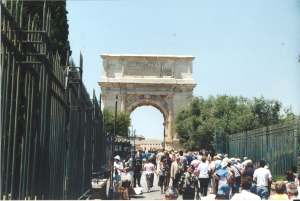
Crowds of tourists, but at least we can now get the scale of the arch.

It is made of Pentelic marble from Mt. Pentelicon in Attica, near Athens, Greece. High quality marble!

It is difficult to read, but it says: “The Senate and the Roman People, to the Divine Titus, Son of Divine Vespasian, to Vespasian Augustus.
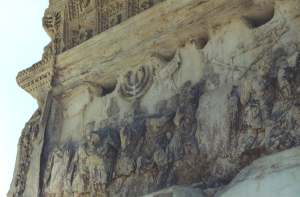
Note the Menorah and the other implements or tools of the temple.

From a slightly different angle. History come to life! Real places. Real people. Real lives.
B. Conclusion
The Roman generals really did stand in the Holy Place in the temple, where the Menorah and other tools were kept. The abomination of desolation already happened within Jesus’s generation, just as he had predicted.
V. Main Conclusion
A. Clarity
Placing all of the important verses side by side finally brought clarity (to me at least). It would be unrealistic to expect that Jesus would not make a major prediction about the destruction of Jerusalem and the temple. There were many signs of this nation-shattering event. After he finished this prediction, he then turns to the Second Coming. Here, the only “sign” is the moral climate.
B. Some events are repeatable
Some terrible things will reappear from one generation to the next, like false messiahs and prophets in Matthew 24:24 and Mark 13:22 (Unit 11). Or this one in Matthew 24:12: “Because lawlessness multiplies, the love of many will grow cold” (Unit 4). Or these things: 2011 earthquake and tsunami in Japan, and worldwide Covid in 2020-2021; bubonic plague in Europe in the mid-1300’s, which wiped out one-fourth to one-third of Europe in a few years. But Units 1-19 are about the destruction of the temple and Jerusalem.
Rather, we are back to the moral climate: as it was in the days of Noah and Sodom, so it will be right before the Lord returns. We are called to be watchful. The temptation will be to fall asleep, both morally and spiritually. We have to be watchful of our souls and bodies. We must not let that day, the return of the Lord, catch us like a trap or a thief.
C. Two questions from disciples
I have concluded in other posts:
In Units 1 and 2, the disciples ask two questions (let’s follow Matthew here).
1. “When will these things be?” The context indicates that this question pertains to the destruction of the temple, which they had just admired. But he predicts its destruction.
2. “And what will be the sign of your visitation and the close [synteleia] of the age?”
In Units 3-19, Jesus answered the first question, and his second answer will go from Units 20-26.
As for the timing (“when”) and signs before the destruction of Jerusalem and temple (the first question), Jesus gave them many. He also revealed many time markers, notably this / his generation.
As to the sign of his asked in the second question, there is no one major warning sign; rather, it could happen at any time, when we least expect it. So we really have to be on our guard and watch. The one possible “sign,” which is really not the sign, is the moral degradation, as it was in the days of Noah and Lot. The disciples had asked for the sign of his Second Coming and synteleia, but Jesus gave them none.
If Jesus had not predicted the destruction of the temple and the city, he would not be much of a prophet! This conquest was monumental, for it ended the Age of the Mosaic Law. Judaism was forever changed.
D. Diagram of the end of the temple
Here’s a short diagram to illustrate the first question and answer in Units 2-19 (except Unit 12):
First Coming → Resurrection → Coming to His Throne → Judgment →Telos (End) of the Old Temple and the Judaism of Moses
The telos end happened in A.D. 70, the generation that was living when Jesus taught in Units 1-19. His prediction came true.
E. Diagram of the end of this (entire) age
Here’s a diagram of the second question and answer in Units 20-26:
________________← This Age ⸻→| Synteleia of This Age
First Coming ⸻⸻⸻⸻→ Second Coming → New Messianic Age
In this diagram, representing Units 20-26, the First Coming begins the movement towards the Second Coming. At the Second Coming, the synteleia (closing) of This Age occurs and the New Messianic or Kingdom Age begins in full manifestation. After the synteleia, a New Messianic Age begins, and you can certainly insert the judgment on the temple in This Age. But that is not the synteleia end. It’s the telos end. In Matthew 28:20b, Jesus promises the synteleia, the closing out of the age, which is a fitting capstone on Matthew’s Gospel in this verse: “And remember this: I am with you every day, until the end [synteleia] of the age” (Matt. 28:20b).
F. Fuller diagram
For a fuller perspective from the beginning of the three synoptic Gospels (and John’s Gospel), here’s a diagram that lays out the Second Coming:
________________← This Age ⸻→| End of This Age
First Coming ⸻⸻⸻⸻→ Second Coming → New Messianic Age / Eternal Kingdom Age
In the second diagram, the First Coming (Jesus’s birth and ministry and crucifixion and resurrection begins the movement towards the Second Coming. At the Second Coming the end of This Age occurs and the New Messianic or Kingdom Age begins in full manifestation. And you can certainly insert the judgment on the temple in This Age, a mere seventy years after the First Coming, his birth in Bethlehem.
VI. Application
A. Purify ourselves
First John 3:2b-3 says:
[…] But we know that when Christ appears, we shall be like him, for we shall see him as he is. 3 All who have this hope in him purify themselves, just as he is pure. (1 John 3:2b-3)
B. Be watchful
Moral decline is happening all around, just as it did in the time of Noah and Lot. Don’t take the bait.
C. Unity and love
But in these eschatological (end-time) discussions:
“In essentials, unity; in nonessentials, liberty; in all things, charity (love).”
We should not break fellowship with those with whom we differ in eschatological matters.
RELATED
Cosmic Disasters = Apocalyptic Imagery for Judgment and Major Change
Luke 17:22-37: Taken Away = Rapture? (I also briefly look at Matthew’s version)
Rapture = Second Coming and Happen at Same Time on Last Day
BIBLIOGRAPHY
 Dr. Jim's Essential Bible Teaching