There are five main views on the millennium (thousand-year reign of Christ), in relation to the “rapture” and the great tribulation. Then let’s examine the Second Coming. We also very briefly look into dispensationalism.
Let’s begin.
I. Introduction
A. Etymology (word origins or roots)
Understanding the word roots helps me a lot to understand the topic, so maybe etymology will help you too.
Millennium means a “thousand years.” Mill- means one “thousand,” and enn- is related to “year.” (Think of “perennial” which means “through the years” or “present throughout the years.”
Another term: chiliasm (pronounced KHI-lee-asm). Chili- is the Greek term for “thousand.”
B. The rapture
It comes from Latin and means “snatching up” or “catching up” (rapto, raptura). In Greek the verb harpazô (pronounced hahr-PAH-zoh) means the exact same thing: “snatching up” or “catching up.” The key Scripture is 1 Thessalonians 4:15-17, where the verb harpazō appears.
I discussed the rapture and 1 Thessalonians 4:15-17 in the post titled 1 Eschatology: Basics of the Second Coming. I also explain it in some sections, below.
C. Seven-year tribulation
This period comes from cobbling together various verses that seem to add up to seven years, but one has to do extra-clever calculations to get there (see, e.g., Dan. 7:25; 9:27; Rev. 13:5). But the phrase “seven years of tribulation” does not appear anywhere in the entire Bible.
My main hermeneutical principle is to keep things simple and streamlined. I work hard not to go beyond the clear teaching of Scripture but to stay close to the NT writers I don’t like to outsmart them, for they were inspired by God, but one’s complicated interpretations are not. The belief in a seven-year tribulation violates this principle of clarity and simplicity.
D. Pre-wrath rapture
One theory, the pre-wrath, teaches that there is a rapture just before the full onslaught of God’s wrath. I do not cover the pre-wrath theory here, but it could be included in the midtribulation view (below), with small adjustments to the diagram. The rapture happens at Revelation 6:17 when God’s full wrath is poured out on the world. Before then it is Satan’s wrath that afflicts humanity at the opening of the six seals in Revelation 6.
E. Three major views on the millennium
These three views are held by the majority American evangelicals, with the pretribulation rapture believers being the most numerous.
The three views are the pretribulation premillennialism, midtribulation premillennialism, and posttribulation premillennialism. The names appear heavy, but let’s break them down.
These theories are called “premillennialism” because the rapture, the seven-year tribulation, and the Second Coming happen before (pre-) the literal millennium. The Second Coming even launches the millennium.
- One theory is called pretribulation (often abbreviated “pretrib”) because the rapture happens before the seven-year tribulation. A huge number of American evangelical Christians hold to this view.
- The midtribulation rapture (often abbreviated “midtrib”) happens at three and a half years or 42 months or 1260 days (Rev. 11:1-3; 13:1-5). The first half is the wrath a man, which the church will face; the second half is the wrath of God, which the church will not face.
- The postribulation theory (often abbreviated “posttrib”) says the church will go through the seven-year tribulation.
For the pre- and midtribulation theories, 1 Thessalonians 5:9 is important: “For God did not appoint us to suffer wrath but to receive salvation through our Lord Jesus Christ.” Evidently, the rapture will be the church’s salvation from God’s wrath. Apparently the midtribulation theory teaches that God’s people will experience a part of the wrath but get rescued or raptured before the intense judgment on the world.
For the posttribulation believers, God will preserve his church during the seven-year tribulation, just like God preserved the ancient Israelites during God’s wrath on the Egyptians (Ex. 7-11).
The three theories also teach that the millennium is a literal thousand years, and the rapture and the seven-year tribulation happens before the Second Coming.
Historic premillennialism is called this because some church fathers believed in a literal millennium and to distinguish it from dispensational premillennialism. Its adherents often believe in a posttribulation rapture, which really is the same as the Second Coming.
Some premillennial Bible interpreters say that the new heavens and new earth will appear at the beginning of the literal millennium.
F. Amillennialism
Amillennialism and postmillennialism teach that the thousand years simply mean a long time, so we should speak of the millennium as if it is even happening right now, but not literally for thousand years. A huge shift happened with the advent, ministry, death, resurrection, and ascension of Christ Jesus. He is reigning invisibly from heaven right now.
Amillennialism: the “a” in front is the negation “no” or “non.” So amillennial therefore means “no millennium” or “nonmillennium.”
G. Postmillennialism
Post means “after” so postmillennialism means after the millennialism. Then the Second Coming and final judgment and the eternal kingdom will happen. Christ is reigning invisibly right now from heaven.
Neither amillennialism nor postmillennialism insists on the seven-year great tribulation right before the Second Coming. It is a sure thing that the optimistic believers in postmillennialism (the world will get better and better through the gospel and salvations and establishing biblical laws) would not interpret this period literally. On the other hand, aspects of amillennialism say some sort of a great tribulation could happen, particularly when Revelation 20:7 says Satan will be released for a little while.
H. End of the millennium
Hopefully the end will be clear in the diagrams. The millennium will end after a thousand years and Christ the King will have ushered in his eternal kingdom, say those who believe in a literal thousand-year millennium.
I explain my preference or the interpretation I consider the best with the most biblical evidence, at the end of this post.
II. Dispensationalism
A. Brief intro.
Moody’s definition of dispensationalism:
Dispensationalism is a system of a Bible interpretation that puts God’s dealings with humanity into different periods (dispensations) from Genesis to Revelation. In this huge stretch of time dispensationalists claim to spot differences in the biblical text and therefore divide the characteristics into those periods. Sometimes the different characteristics of each period carry over into other dispensations, as the next points in the first table prove (and in the second table too) (Ryrie, pp. 20-24)
Charles C. Ryrie, borrowing heavily from C. I. Schofield defines it: “A dispensation is a period of time during which man is tested in respect of obedience to some specific revelation of the will of God” (p. 33). So the main and outstanding character (e.g. Moses) or characters (e.g. Adam and Eve) in each of the dispensations get a revelation. They are responsible to carry out the revelation in obedience.
B. Schofield’s dispensations
|
Seven Dispensations of C. I. Schofield |
||||||
| Innocence | Conscience | Human Govt. | Promise | Law | Grace | Kingdom |
| Innocence until Adam’s fall
Ge 1:28-3:6 |
Man is self-determined and under moral responsibility
Ge 4:1-8:14 |
Noahic Covenant, protect human life by capital punishment
Ge 8:15-9:11 |
Patriarchs, they respond by faith to God’s revelations
Ge 11:10-Ex 18:25 |
Mosaic law, it was given as the constitution to nation of Israel, in force until death of Christ and descent of Holy Spirit
Ex 19:1-Ac 1:26 |
Advent of Christ God made grace known to all humankind
Ac 2:1-Rev 19:21 |
Christ returns and sets up kingdom for a thousand years
Rev 20:4-6 |
| Notes:
Other dispensationalists use different terms for their dispensations. I use Schofield’s version because his was the most influential due to his Schofield Study Bible. Other dispensationalists divide up the number of periods slightly differently, too. Adapted from Moody, Handbook, p. 560. Moody is a dispensational institution and publishing house. They well represent dispensationalism. |
||||||
C. Explanation of Schofield’s system
Human government goes from Noah to the millennium kingdom.
Law goes from Mosaic law to dispensation of grace, and even to the outpouring of the Spirit in Acts. So it seems law and grace were parallel with each other.
For other dispensationalists grace is spread out through the dispensations, but the clarity of grace is highlighted with the first advent (coming) of Christ.
Promise also runs throughout the dispensations but presumably stops at the kingdom.
Particularly important: the kingdom of God is delayed until the end because the nation of Israel rejected its Messiah and his kingdom. Dispensationalists of the Schofield variety skip over the kingdom Jesus launched during his coming and ministry.
D. My critique
I certainly do not accept Schofield’s system that says that God postponed his kingdom. No. It is going on right now, from the time of creation to his (future) eternal kingdom in the new creation. Jesus is invisibly and presently reigning as king. Sometimes his kingdom is revealed to the world of humanity through signs and wonders.
The worst error of all is that Jesus is placed under the law of Moses. No. Jesus was constantly forming his new covenant believers in the kingdom of God. Jesus said of John the Baptist “Truly I tell you, among those born of women there has not risen anyone greater than John the Baptist; yet whoever is least in the kingdom of heaven is greater than he” (Matt. 11:11). “For the law was given through Moses; grace and truth came through Jesus Christ” (John 1:17). On the Mount of Transfiguration, the Father speaks in the presence of Moses and Elijah: “This is my Son, whom I love; with him I am well pleased. Listen to him!” (Matt. 17:5). The most I’ll concede is that there is some “carry over” (see Ryrie, pp. 65-66) from Moses, but that’s it.
Jesus himself fulfills Israel’s story. He is the new Israel. He is not subsumed under the law of Moses or Israel’s history. No, he culminates it. “Do not think that I have come to abolish the Law or the Prophets; I have not come to abolish them but to fulfill them” (Matt. 5:17). Not one word of the law will disappear until everything is accomplished. Evidently, this means the eschaton, when Jesus comes back.
Not mentioned in the table is the popular dispensational emphasis on Israel. While I see Israel as a part of God’s plan, it is not God’s centerpiece. The church is. Only we can preach the gospel to the whole world.
E. Charles C. Ryrie’s dispensational system
|
Ryrie’s Dispensations |
|||
| Name | Scripture | Responsibilities | Judgments(s) |
| Innocency | Gen. 1:3-3:6 | ·Keep Garden
Do not eat one fruit Fill, subdue earth Fellowship with God |
Curses and physical and spiritual death |
| Conscience | Gen. 3:7-8:14 | Do good | Flood |
| Civil Government | Gen. 8:15-11:9 | Fill earth
Capital punishment |
Forced scattering by confusion of language |
| Patriarchal Rule | Gen. 11:10-Ex. 18:27 | Stay in Promised Land
Believe and obey God. |
Egyptian bondage and wilderness wandering |
| Mosaic Law | Ex. 19:1-Acts 1:26 | Keep the law
Walk with God |
Captivities |
| Grace | Acts 2:1-Rev. 19:1 | Believe on Christ
Walk with Christ |
Death
Loss of Rewards |
| Millennium | Rev. 20:1-15 | Believe and obey Christ and his government | Death
Great white throne judgment |
| Ryrie, p. 62 | |||
F. Explanation
Each dispensation has a revelation and command. Each of the main character or many main characters are responsible for obeying the revelation and commands. If they fail, then they are judged. Ryrie says one can switch up the names (first column), but this does not deny the central truth of dispensationalism. He even has a table of seven dispensational systems, and each row names the dispensations differently or beyond seven of them in a few systems (p. 81).
G. My critique
I can’t deny that progressive revelation is a fact of the Bible, but whether these dispensations reflect the right revelations is up for debate.
Under the Patriarch Rule (I’m not sure patriarchs ruled over very much, except Joseph), the Israelites wander through the wilderness only until Exodus 18:27. No, they wandered long after that. And the judgment of captivity is right, but there are many other judgments in the wilderness, like the older generation being compelled to die off and Moses not entering the Promised Land. (But is a sure thing that Ryrie would respond with his “carry over” idea.)
I object to placing Jesus’s ministry and announcement and launch of the kingdom of God under the law of Moses, as I noted in my critique of Schofield’s system. The most I can affirm is that there is some carry over, but Jesus initiated the New Covenant at the Last Supper and he ratified it at his death. The judgment on ancient Israel (captivities) do not apply to the ministry of Jesus.
Next, I object to the claim that there is death in the millennium, or whether there even is a literal millennium (see below). Paul writes in 1 Corinthians 15 that death will be the last enemy at the parousia (appearing or Second Coming), and yet according to this teaching it is not the last enemy, but it continues in the millennium. This belief contradicts the clear teaching of Scripture. (See part one in this Eschatology section.)
Where is the eternal kingdom, after the millennium?
As for the Sermon on the Mount, it applies to believers whenever the kingdom is proclaimed.
Ryrie writes:
Thus, the dispensational interpretation of the Sermon on the Mount simply tries to follow consistently the principle of literal, normal and plain interpretation. It results in not trying to relegate primarily and fully the teachings of the Sermon to the believer in this age. But it does not in the least disregard the ethical principles of the Sermon as being not only applicable but also binding on the believers today. Can this rightfully be called “cutting out pages from the Bible”? (p. 115)
So the sermon is for today, such as do not lust or get angry or live in unreconiliation, or do not swear oaths. Who would deny that those commands do not apply today? But the sermon is also primarily and fully for the future kingdom. The sermon is both / and: for now and the future.
My only quarrel is that the sermon is primarily and fully for all ages, not primarily and fully for a future kingdom.
I don’t believe that we need these seven (or four or eight or ten) dispensations to understand the metanarrative or overarching storyline of Scripture. We can just see Jesus in each section of the Bible and understand the differences between the Old and New Covenants when the NT authors quote from the OT. They borrow the verses about the Messiah and moral law and theology.
Though I am not Reformed, the word covenant appears about 332 times in the Bible, so this metanarrative is on much firmer biblical footing. Covenants go from Adam through the New Covenant ratified by Christ and never ending, even through new creation and the eternal kingdom. Please note, however, that other dispensationalists work the covenants into their dispensations. But I wonder: why not stay with the covenants without a massive overlay of their dispensations? Again, too complicated for me.
I do not see the attempt at finding a dispensational metanarrative from Genesis to the Revelation as harmful, if it keeps things simple. But often dispensationalists do not keep things simple. One example: The “carry over” notion from the law of Moses and Israel’s captivities encroaches too much into Jesus’s ministry.
Bottom line: I don’t like to adhere to complicated systems that can easily be picked apart. I prefer streamlined theology. Dispensationalism is needlessly complicated.
Therefore, I am not a dispensationalist.
See below at IX.M for my metanarrative.
III. Pretribulational Premillennialism
A. Brief intro
This theory says that the millennium is interpreted literally to be a thousand years, but before then a seven-year great tribulation takes place. The church will get “raptured” out before that tribulation. The vast majority of American evangelicals hold to this interpretation, though a change may be afoot.
B. The diagram
We could even call it a flow chart or a sequence of events.
Let’s look at this diagram, from left to right and top to bottom.

C. How to Interpret the diagram
Here is an expanded interpretation of the diagram, from left to right, top to bottom, step by step.
The teaching on the tribulation, or more specifically, the great tribulation, is based on Jesus’ words: “For then there will be great tribulation, such as has not been from the beginning of the world until now, no, and never will be” (Matt. 24:21, ESV).
The length of the tribulation comes from Dan. 9:27, which talks about the seventieth week, and in context a “week” is symbolically expanded to mean seven years (one day = one year).
The rapture or catching up of the church comes from these two verses:
For the Lord himself will descend from heaven with a cry of command, with the voice of an archangel, and with the sound of the trumpet of God. And the dead in Christ will rise first. Then we who are alive, who are left, will be caught up together with them in the clouds to meet the Lord in the air, and so we will always be with the Lord. (1 Thess. 4:16-17, ESV, emphasis added)
“Rapture” comes from the Latin words rapto (or rapio), “to seize and carry away, hurry away.”
However, the New Testament is not in Latin, but in Greek. And the key Greek word is harpazō, which has the same definition (“caught up” in v. 17). The Latin and Greek words are synonyms.
So, the word rapture does not appear in the New Testament, but the concept and reality are certainly taught.
So, Christ appears halfway down between the sky and earth, catches up his followers, and then goes back up into heaven with them.
The dotted lines represent what happens on earth.
The believers who have been raptured remain in heaven while the great tribulation is going on.
Presumably, at this time they will be judged to determine the degree of their rewards (2 Cor. 5:10), not whether they are saved. Their salvation has been established.
Back down on earth and during the great tribulation, many of the visible signs are fulfilled, like the bringing in of Jews who will convert to the Messiah, and terrible signs in the heavens.
Christ and the saints and angels return at the end of the great tribulation. This is called the Second Coming (Matt. 24:30-31). (His first coming was his being born of a virgin and ministering on earth and so on.)
His coming will be bodily, glorious, visible to everyone around the globe, geographically located (Jerusalem), and accompanied with his holy angels and believers. His Second Coming will not be secret or hidden.
The rapture is not the same as the Second Coming, but the rapture is sudden, and unexpected (see the public nature of 1 Thess. 4:16-17, however). It happens before the tribulation.
Revelation 20:1-10 speaks of a thousand years when Christ will reign. Premillennialists take the thousand years literally.
At the beginning of the thousand years, Satan is bound in a bottomless pit, and Jesus, the Lord and Messiah, rules with his believers and many other humans.
At the end of the millennium, Satan will be loosed, form alliances with those who outwardly, but not inwardly or really, submitted to Christ, wage war, but be defeated (Rev. 20:7-10).
Around this time the dead unbelievers will be resurrected, be judged, and receive condemnation. This judgment is called the great white throne judgment (Rev. 20:11-15). (This is represented by the gavel and Scripture.) Christians do not go through this judgment. In fact, they help in it.
Satan is thrown into the lake of burning sulfur, and death and hades are thrown into the lake of fire.
Most premillennial Bible interpreters say the new earth and heaven appear at the end of the literal millennium.
Now we will enjoy the eternal kingdom or state without end or trials or opposition or injustice because Christ is in charge in full manifestation.
IV. Midtribulational Premillennialism
A. Brief intro
This theory interprets the millennium literally to be a thousand years, but before then a seven-year great tribulation takes place. The church will go through half of it (mid-) and then get raptured out.
B. The diagram
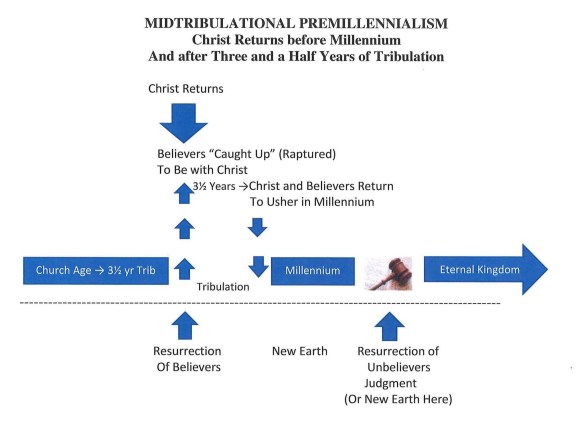
Let’s look at this diagram, from left to right and top to bottom.
C. How to interpret the diagram
Here is an expanded interpretation of the diagram, from left to right, top to bottom, step by step.
Millennium means a “thousand years,” and “pre” means “before.”
Therefore “premillennial” or “premillennium” means Christ returns before the millennium.
The teaching on the tribulation, or more specifically, the great tribulation, is based on Jesus’ words: “For then there will be great tribulation, such as has not been from the beginning of the world until now, no, and never will be” (Matt. 24:21, ESV).
The length of the tribulation comes from Daniel 9:27, which talks about the seventieth week, and in context a “week” is symbolically expanded to mean seven years (one day = one year).
Believers and others going through half of the seven years also comes from Daniel 9:27, 9:25, and 12:7, 11, and Revelation 12:14. Daniel 9:27, for example, speaks of the end of sacrifice and offering in the middle of the week. Half of seven is three and a half.
The first half is the wrath of man, which the church will face, while the second half is the wrath of God, which the church will not face.
The rapture or catching up of the church comes from these two verses: “For the Lord himself will descend from heaven with a cry of command, with the voice of an archangel, and with the sound of the trumpet of God. And the dead in Christ will rise first. Then we who are alive, who are left, will be caught up together with them in the clouds to meet the Lord in the air, and so we will always be with the Lord” (1 Thess. 4:16-17, ESV, emphasis added).
So, Christ appears halfway down between the sky and earth, catches up his followers, and then goes back up into heaven with them.
The dotted lines represent what happens on earth.
The believers who have been raptured remain in heaven while the last half of the great tribulation is going on.
Presumably, at this time they will be judged to determine the degree of their rewards (2 Cor. 5:10), not whether they are saved. That has been established.
Back down on earth and during the great tribulation, many of the visible signs are fulfilled, like the bringing in of Jews who will convert to the Messiah, and terrible signs in the heavens.
Christ and the saints and angels return at the end of the last half of the great tribulation. This is called the Second Coming (Matt. 24:30-31). (His first coming was his being born of a virgin and ministering on earth and so on.)
His coming will be bodily, glorious, visible to all around the globe, geographically located (Jerusalem), and accompanied with his holy angels and believers. His Second Coming will not be secret or hidden.
The rapture is not the same as the Second Coming, but the rapture is sudden, and unexpected. It happens before the Second Coming.
Revelation 20:1-10 speaks of a thousand years when Christ will reign. Premillennialists take the thousand years literally.
At the beginning of the thousand years, Satan is bound in a bottomless pit, and Jesus, the Lord and Messiah, rules with his believers and many other humans.
At the end of the millennium, Satan will be loosed, form alliances with those who outwardly, but not inwardly or really, submitted to Christ, wage war, but be defeated (Rev. 20:7-10).
Around this time the dead unbelievers will be resurrected, judged, and receive condemnation. This judgment is called the great white throne judgment (Rev. 20:11-15). (This is represented by the gavel and Scripture.) Christians do not go through this judgment. In fact, they help in it.
Satan is thrown into the lake of burning sulfur, and death and hades are thrown into the lake of fire.
Now we will enjoy the eternal kingdom or state without end or trials or opposition or injustice because Christ is in charge in full manifestation.
V. Posttribulational Premillennialism
A. Brief intro
This theory interprets the millennium literally to be a thousand years, but before then a great tribulation takes place. Christ’s Second Coming happens after that tribulation. There is no pre- or mid-tribulation rapture. The rapture and the Second Coming are the same event.
B. The diagram
Let’s again look at this diagram, from left to right and top to bottom.

C. How to Interpret the Diagram
Here is an expanded interpretation of the diagram, from left to right, top to bottom, step by step.
Post means “after,” and in this context it means Christ returns after the great tribulation.
The teaching on the tribulation, or more specifically, the great tribulation, is based on Jesus’ words: “For then there will be great tribulation, such as has not been from the beginning of the world until now, no, and never will be” (Matt. 24:21, ESV).
Some interpreters believe it will last seven years. The length of the tribulation comes from Dan. 9:27, which talks about the seventieth week, and in context a “week” is symbolically expanded to mean seven years (one day = one year).
The dotted lines represent what happens on earth.
Christ and the saints and angels return at the end of the great tribulation.
Here is a sample verse about his Second Coming: “For the Lord himself will descend from heaven with a cry of command, with the voice of an archangel, and with the sound of the trumpet of God. And the dead in Christ will rise first. Then we who are alive, who are left, will be caught up together with them in the clouds to meet the Lord in the air, and so we will always be with the Lord” (1 Thess. 4:16-17, ESV, emphasis added).
This is called the Second Coming (Matt. 24:30-31). (His first coming was his being born of a virgin and ministering on earth and so on.)
We will be changed in the twinkling of an eye (instantly), and we will reunite with our resurrected bodies (1 Cor. 15:52).
His coming will be bodily, glorious, visible to all around the globe, geographically located (Jerusalem), and accompanied with his holy angels and believers. His Second Coming will not be secret or hidden.
We who are alive and caught up at his Second Coming will descend immediately with him to earth to usher in his millennial reign.
This descent agrees with the parousia (Second Coming or arrival or visitation), which says in historical context that a Roman dignitary arrives at a Roman colony, and the people of the colony go out to greet him and usher him into the city. They do not board his ship and sail off.
Revelation 20:1-10 speaks of a thousand years when Christ will reign. Premillennialists take the thousand years literally.
At the beginning of the thousand years, Satan is bound in a bottomless pit, and Jesus, the Lord and Messiah, rules with his believers and many other humans.
At the end of the millennium, Satan will be loosed, form alliances with those who outwardly, but not inwardly or really, submitted to Christ, wage war, but be defeated (Rev. 20:7-10).
Around this time the dead unbelievers will be resurrected, be judged, and receive condemnation. This judgment is called the great white throne judgment (Rev. 20:11-15). (This is represented by the gavel and Scripture.) Christians do not go through this judgment. In fact, they help in it.
Satan is thrown into the lake of burning sulfur, and death and hades are thrown into the lake of fire.
Presumably, at this time they will be judged to determine the degree of their rewards (2 Cor. 5:10), not whether they are saved. That has been established. But this judgment could happen at anytime during the millennium or during the eternal kingdom or state.
Most premillennial Bible interpreters say the new earth and heaven appear at the end of the literal millennium.
Now we will enjoy the eternal kingdom or state without end or trials or opposition or injustice because Christ is in charge in full manifestation.
VI. Amillennialism
A. Brief intro
The reign of Christ is not literally for a thousand years. The number is a figure of speech for a long, unknown duration when God’s purposes are accomplished. He is reigning right now.
B. The diagram
Read it from left to right, and top to bottom:

C. How to Read the Diagram
Revelation 20:1-10 speaks of a thousand years when Christ will reign; however, the idea of the millennium has been replaced by the Church Age, which has been going since the church’s birth in Acts 2.
Amillennialists believe that there is no literal thousand years. Christ’s reign in the millennium is not bodily here on earth, but in heaven with the believers who have died. Further, Christ reigns in part over worldly systems but not yet fully. He reigns invisibly.
5 The Kingdom of God: Already Here, But Not Yet Fully
In the Church Age, Satan’s influence has been greatly reduced, relative to Satan’s power before Christ came (think of all the awful paganism, like cannibalism and human sacrifices around the globe) and the gospel goes forth with such power that it reaches the entire world.
At an unknown time, Christ returns to gather the living believers together and the living unbelievers together. The resurrection puts bodies on the spirits of those who have died, both believers and unbelievers. (The dotted lines represent the earth.)
And he judges them separately (see the gavel and Bible, above).
God judges the believers to determine their degrees of rewards in heaven, not to decide whether they go into heaven (2 Cor. 5:10). Their places there are already secure.
God judges the unbelievers, and they receive condemnation.
4 Introduction to the Doctrine of Final Judgment
5 Final Judgment on the Basis of Good and Bad Works and Words
God will renovate a new heaven and a new earth and will establish his new, eternal kingdom.
Some verses that support reading “thousand” nonliterally: Psalms 50:10; 84:10; 90:4, 7; Isaiah 60:22; 2 Peter 3:8. Of special importance is Psalm 90:4, quoted by 2 Peter 3:8, which says that a day is as a thousand years before the Lord. The other verses can be interpreted as figures of speech merely indicating numerous people or things (see below for the quoted verses).
Therefore, “a thousand years” is just a figure of speech for a long, unknown duration for the purposes of God to be accomplished.
As for the signs of the time, some amillennialists believe Christ could return at any time, while others believe certain signs have to be fulfilled before he returns.
Sometimes postmillennialism resembles amillennialism when both deny the literal thousand years, but amillennialism says no millennium, while postmillennialism says it exists through the kingdom of God on earth through the church.
In any case, this theory has the beauty of simplicity.
VII. Postmillennialism
A. Brief intro
This theory says that the reign of Christ is not a literal thousand years, but is expressed in the expanding kingdom of God, using the church to span the globe in the hearts of believers. Christ is reigning invisibly from heaven.
B. The diagram
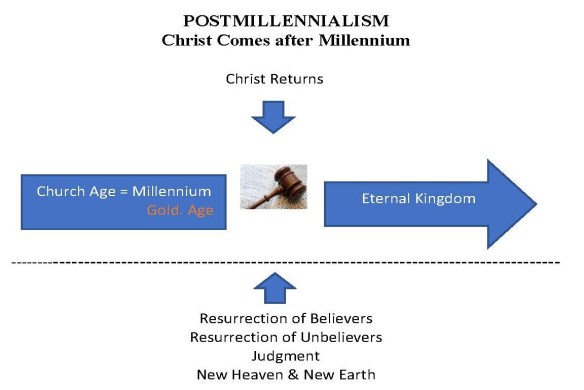
Read this diagram from left to right and from top to bottom.
C. How to Read the Diagram
Millennium means a “thousand years,” and “post” means “after.” “Postmillennialism” therefore means “after the millennium.”
Revelation 20:1-10 speaks of a thousand years when Christ will reign; however, the idea of the millennium is actually just the Church Age, which has been going on since the church’s birth in Acts 2. Postmillennialists believe that there is no literal thousand years.
Postmillennial believers teach that the gospel will grow so powerful and widespread that the kingdom of God will dominate the worldly systems. There will be a Golden Age toward the end of the Church Age. This is their version of the (nonliteral) millennium. It is a very optimistic belief system.
Then at an unknown time, Christ shall return to gather the living believers together and the living unbelievers together. The dead in Christ shall rise first; then those who are alive will meet Christ in the air and forever be with him. The resurrection puts bodies on the spirits of those who have died, both believers and unbelievers. (The dotted lines represent the earth.)
And he judges them separately (see the Gavel and Bible, above).
God judges the believers to determine their degrees of rewards in heaven, not to decide whether they go into heaven (2 Cor. 5:10). Their places there are already secure.
God judges the unbelievers, and they receive condemnation.
4 Introduction to the Doctrine of Final Judgment
5 Final Judgment on the Basis of Good and Bad Works and Words
God will renovate a new heaven and a new earth and will establish his new, eternal kingdom. However, some postmillennialists teach that Christ will have no earthly throne, but the kingdom millennium is in the heart of the believers.
Some verses that support reading “thousand” nonliterally: Psalms 50:10; 84:10; 90:4, 7; Isaiah 60:22; 2 Peter 3:8. Of special importance is Psalm 90:4, quoted by 2 Peter 3:8, which says that a day is as a thousand years before the Lord. The other verses can be interpreted as figures of speech merely indicating numerous people or things (see below for the quoted verses)..
Therefore, “a thousand years” is just a figure of speech for a long, unknown duration for the purposes of God to be accomplished and the kingdom to expand and to span the globe.
As noted, it is a very optimistic system about God using the church to express his kingdom.
One virtue in this scheme or diagram is streamlined simplicity.
VIII. Summary Table
A. Essentials of each system
|
Views on Eschatology |
||||
| Categories | Amillennialism | Postmillennialism | Historic Premillennialism | Dispensational Premillennialism |
| Second Coming | Single event; rapture and Second coming happen at same time, on last day; second coming launches eternal kingdom / state, where Christ reigns in new heaven and new earth | Single event, no distinction between rapture and Second Coming (see amill.) | Rapture and Second Coming simultaneous; Christ returns to reign on earth | Second Coming in two phases
(1) Rapture of church; (2) Second Coming to earth 7 years later |
| Resurrection | General, of believers and unbelievers together at Second Coming | General, of believers and unbelievers at Second Coming (see amill.) | Resurrection of believers at beginning of millennium; resurrection of unbelievers at end of millennium | Distinction:
1.. Church at rapture 2.. OT / tribulation saints at Second Coming 3.. Unbelievers at end of the millennium |
| Judgments | One judgment of all people at same time after Second Coming | General judgment of all people (see amill.) | Judgment at Second Coming; and judgment at end of future tribulation at end of millennium | Distinctions:
1.. Believers’ judged works at rapture 2.. Jews / Gentiles at end of tribulation 3.. Unbelievers at end of millennium |
| Tribulation | Experienced in this age, maybe it intensifies right before Second Coming | Experienced in this age (see amill.) | Posttrib view: church goes through the future tribulation | Pretrib. view: church is raptured before trib. |
| Millennium | No literal millennium; “thousand years” means a long time; Christ reigning invisibly from heaven now | Present age blends into millennium because of progress of the gospel; (amills. do not believe in positive progress, so this is a difference). Christ reigns invisibly from heaven. | Millennium is both present and future; Christ is reigning in heaven; millennium not necessarily 1,000 years | At Second Coming Christ inaugurates literal thousand-year millennium on earth |
| Israel and Church | Church is the new Israel; no distinction between Israel and church (but I believe ethnic Jews and geo-political Israel still play an important role and will be saved if they do not continue in unbelief (Rom. 11:23, 26) | Church is new Israel, no distinction between Israel and church | Some distinction between Israel and church; future for Israel but church is spiritual Israel | Complete distinction between Israel and church’ distinct program for each |
| Moody, Handbook, p. 411, I adapted their basic idea. | ||||
B. Simplicity
Amillennialism and postmillennialism are the simplest. So which one do I prefer, since I like streamlined biblical doctrine?
IX. My Preference
A. Brief intro.
My preference is built on my exegesis and interpretation of many passages and the clarity (perspicuity) of Scripture. It is amillennialism.
B. Basics of amillennialism
An amillennialist believes that the millennium begins with the inaugurated kingdom, but apparently it is quiet and behind the scenes (note, for example, the Parable of the Mustard Seed and its slow growth in Matt. 13:31-32); The literal thousand-year reign of Christ was not inserted in the flow charts with sequential arrows, because Jesus and the apostles did not teach it.
C. Silence of the Gospels, Acts, and epistles
If Jesus had believed in a literal thousand-year reign, which is so important, he would have taught it. But he did not teach it. Therefore he did not believe in it nor see it as important. If the apostolic community had believed in it and considered it as important, they too would have taught it in Acts and the epistles. But they did not teach it. Therefore they did not believe in it, nor considered it to be important.
This silence is decisive for me.
Objection: Youth ministry is not mentioned in the NT. Reply: but verses do not teach against it either. In contrast, verses in the NT do teach against the standard view of a literal millennium, as taught by current believers in it. One example, after the Second Coming, there will be no more death, yet the millennial literalists teach that people will die.
For more information, see the post: 1 Eschatology: Basic Eschatology in the New Testament
D. Clarity of Scripture
The clarity of Scripture at the beginning of these posts in Theology 101 says we should allow the clear, straightforward, nonsymbolic teachings in the Gospels, Acts and epistles to guide our interpretations of the most symbolic book in the Bible, in which even the numbers are symbolic. I have flipped the script on how popular end-time Bible prophecy teachers interpret things, for these teachers seem to guide their interpretation of Jesus’s and the apostolic community’s teachings through the lens of the Revelation. But just the opposite is the best way.
In any case, to see how everything fits together, all we have to do is turn the kaleidoscope one notch and adopt amillennialism.
I am willing to do that. And I have now done that.
E. Revelation: the most symbolic book in the Bible
In contrast, based on his interpretation of a few verses in Revelation 20, in the most symbolic book of the Bible, a premillennialist believes that a literal thousand years of Christ is ushered in at the Second Coming, where there will be peace and harmony for a literal thousand years.
And Satan is literally bound in chains and placed in prison until the end of the thousand years. He will not deceive the nations before he is loosed again at the end of the millennium. During the literal millennium, people will still die, so the last enemy (death) is not defeated after all, at the Second Coming, even though Paul clearly stated in his epistle that death would be defeated (1 Cor. 15:23-26, 51-56). However, the theory of a literal thousand years says that death and Satan are defeated at the end of the millennium, when another resurrection and another judgment will take place. (So needlessly complicated!)
In interpreting the Revelation in an ad-hoc manner, sometimes literally, other times nonliterally, things soon become convoluted and complicated, in comparison with the clear and streamlined eschatology of Gospels, Acts, and epistles. Therefore I keep the Revelation in perspective: Numerous symbols with startling imagery (John the revelator sure seemed often startled!).
F. Thousand years always literal?
Many verses, even in the OT, say that a thousand years or things are not always literal but mean a long time or a large, undetermined number.
Exodus 20:6:
[…] but showing love to a thousand generations of those who love me and keep my commandments. (Ex. 20:6)
How many generations go back from King Charles III of Great Britain to Charlemagne (1,200 years)? About 40-42 generations. A thousand generations is therefore huge.
Deuteronomy 7:9:
Know therefore that the Lord your God is God; he is the faithful God, keeping his covenant of love to a thousand generations of those who love him and keep his commandments. (Deut. 7:9; 1 Chron. 16:15; Ps. 105:8)
As noted a thousand generations is a long time.
Psalm 50:10:
10 for every animal of the forest is mine,
and the cattle on a thousand hills. (Ps. 50:10)
The number is indeterminate and just means a countless number of hills–many hills.
Psalm 84:10:
Better is one day in your courts than a thousand elsewhere; I would rather be a doorkeeper in the house of my God than dwell in the tents of the wicked. (Ps. 84:10)
A long time, not to be taken literally, as if David counted up a thousand days. No, he means a long time.
Psalm 90:4:
A thousand years in your sight are like a day that has just gone by, or like a watch in the night. (Ps. 90:4)
Again, this is a long time, because God does not always measure time as we do, from our subjective point of view.
Ecclesiastes 6:6:
[…] even if he lives a thousand years twice over but fails to enjoy his prosperity.
Today we might say “even if he lives a million years twice over.”
Second Peter 3:8:
But do not forget this one thing, dear friends: With the Lord a day is like a thousand years, and a thousand years are like a day. (2 Peter 3:8)
Recall Psalm 90:4. It is a large number, and the Lord measures time not as we do, so be patient about the return of the Lord. The verse in 2 Peter, quoted just above, is in the context of the Lord’s return, indicating that we should not interpret a thousand years literally. In God’s sight a thousand years is fluid or non literal.
Therefore, since the Revelation is the most symbolic book in the Bible, an amillennialist (and a postmillennialist) can interpret a thousand years in Revelation 20 as nonliteral or symbolic of a long time.
G. Amillennialism and the binding of Satan
The amillennialist believes that Satan is not literally bound with chains (as if a spirit being could be). (The Revelation often uses explosive, startling, rhetorically charged imagery. John the revelator was frequently startled.) Using picture language, Jesus did teach that he bound the strongman (Matt. 12:29; Mark 3:27; Luke 11:21-22). The same Greek verb deō (pronounced deh-oh), “bind,” is used in Revelation 20:2 for binding Satan and in Matthew 12:29 and Mark 3:27 for binding the strongman.
So what this binding and imprisonment in the Revelation means is that Satan can no longer fully stop the advance of the kingdom (as Satan did to the ancient Israelites, except a remnant). Before Jesus came, every nation was bound by satanic deception. Satan can no longer deceive the nations as he did before Jesus came. Satan had kept all nations under paganism, sometimes of the worst kind, like bloodthirsty human sacrifices and Satan worship. However, after Jesus inaugurated the kingdom, the gospel has a way of infiltrating societies, even if underground, even under evil Islamic and communist regimes, for example. The gospel of the kingdom penetrates everywhere today and improves society–gradually–wherever it enters the hearts of people individually.
Also, Paul writes: “And having disarmed the powers and authorities, he made a public spectacle of them, triumphing over them by the cross” (Col. 2:1). In Luke’s passage (11:22) about binding the strongman, he uses the verb “conquer” or “defeat” (nikaō, pronounced nee-KAH-oh). This disarming cannot be absolute because we observe that Satan and his hordes are alive and active. Nor can Luke’s version of conquering the strongman be absolute and final.
Instead, the disarming concept teaches us that we do not have to be bound by the satanic strong man, but we can expel demons from people. The gospel will push demons back and improve human lives through salvation under Jesus’s lordship. The ultimate victory is assured, but now we have to fight and work towards the final and absolute victory. And so it is in Revelation 20. Satan’s binding in chains and imprisonment is yet another startling image of his curtailment relative to the unstoppable power of the gospel which transforms people from the inside out.
Kingdom citizens, surrendered to the kingship of the King and the lordship of the Lord and sonship of the Son, are plundering Satan’s domain of this age and rescuing people out of it and transferring them to the inaugurated kingdom of God. The final victory over Satan will be fully manifested at Jesus’s Second Coming, the parousia, the glorious appearing.
This strong activity of Satan towards the end of Christ’s invisible reign from heaven explains why I am not a postmillennialist.
H. Great tribulation
An amillennialist can believe in a great tribulation. After all, Satan is loosed from his chains towards the end of the millennium (or the end of the church age). So Satan can really persecute believers severely and pour out degraded things in the larger society to slow (but not stop) the gospel going around the globe.
Will the church experience God’s wrath? No, for God will protect them from wrath and judgment, just as he protected the children of Israel from the plagues on Egypt (Exod. 7-11).
I. First resurrection
Revelation 20:5-6 speak of a “first resurrection.”
Amillennialism teaches that this is the new birth and salvation, when we had been dead in our trespasses and sins, but have been made alive in Christ (Eph. 2:1-5; Col. 2:13)
John the Gospel writer also wrote the Revelation, and in his Gospel he writes of going from death to life by simply believing in the Father who sent the Son of Man:
“Very truly I tell you, whoever hears my word and believes him who sent me has eternal life and will not be judged but has crossed over from death to life (John 5:24)
In Revelation 20, this is the first resurrection.
J. One final judgment
Further, in John 5:28-29 and Matthew 13:41-43 and 25:31-46 (and elsewhere), Jesus teaches that the wicked and righteous are judged together at the end of this age. Interpreting literally a deliberately and intentionally symbolic book (Revelation) runs aground quickly, even on this one point of judgment (and others points).
I covered the one final judgment in the post titled
Sec. 11, 1 Eschatology, Doctrine of Last Things: New Testament Basics
K. Summary
This explains, in brief, why I have adopted amillennialism. The Gospels, Acts, and epistles teach a streamlined simplicity and against a literal thousand years reign, where there will be death of some people, even though at the Second Coming or appearing, death, the last enemy, will be conquered.
I believe NT eschatology is simplified and streamlined. Amillennialism matches this. Postmillennialism is not the best for me because of its optimism. I believe the times will get worse, because Satan will intensify his influence on society and persecution of Christians, just before the Second Coming.
L. Just to be clear
I turned the kaleidoscope one notch towards amillennialism for these three reasons:
1.. A literal thousand year reign is not taught in the Gospels, Acts or epistles.
If this doctrine were so important or even a thing, then Jesus and the apostolic community would have taught it, but they did not. Therefore it was not important to them or even a thing.
2. This reason is related to the first. The doctrine of a literal thousand years is taught only in a few verses in Revelation 20, the most symbolic book in the Bible.
Charles C. Ryrie in his book on dispensationalism, in his chapter on hermeneutics, says the dispensationalist interprets the Bible literally. The symbols must refer to something actual (p. 99). So presumably when he reads of a thousand years, he interprets it as a thousand years. Read the genre of a prophetic apocalypse or an apocalyptic prophecy, like a literal newspaper report. Simple and streamlined, right?
Not so fast. Numbers in the Revelation, the most symbolic book in the Bible, can refer to ideas or concepts. Example: the 144,000. What happens if there were 144,001 in reality? Does God eliminate the extra man to make the number literal? Or 143,999? Does God search around for an extra man? How literally do we take 144,000? So what does a 1000 years refer to in the Revelation? It signifies a long time, as I have shown above. We do not read Revelation 20–or the entire book after Revelation 3–like a newspaper. In Revelation 1:1-3 John says we should not, but the images he saw signify signs (he uses the verb form, signify, of the noun sign).
If symbolism is really just literalism, a fake symbolism, then the meaning of symbolism disappears. If in the Revelation a thousand years = a literal thousand years, then what’s the point of symbols and the apocalyptic genre?
3. I followed the eschatology of the Gospels, Acts and epistles, reading them literally (in most passages). I also read the Revelation symbolically, especially the 1000 years.
Once I turned the kaleidoscope one notch, all of NT eschatology fell into place and became streamlined and clear and straightforward. (I was amazed.) Consistency of doctrine for me is dispositive or decisive, especially in eschatology, when so many teachers over the past 200 years have complicated it, needlessly.
To sum up, you can call me a streamlined amillennialist, as follows.
Jesus came the first time in Bethlehem, and he will come only a second time, called the Second Coming or the parousia or the glorious appearing.
There will be no two-stage return, one secret (Rapture) and one glorious and public (the Second Coming). If I could find the first partial return in Scripture, without cobbling together many Scriptures to finagle this doctrine into existence, I would believe it.
Whether there will even be a literal seven-year tribulation is not firmly supported or clearly taught in Scripture. An interpreter has to cobble together verses from various places to find it. The natural disasters in the Revelation may refer merely to judgment on the world–apocalyptic imagery. Therefore I do not obsess over a literal seven-year tribulation. I just need to be a disciple of Jesus, no matter what comes.
Cosmic Disasters = Apocalyptic Imagery for Judgment and Major Change (in that post I cite many passages in the OT that describe the earth splitting in two, the sun not shining, and stars falling from the sky–those gigantic stars, many of which are literally and actually galaxies. No, those natural disasters did not happen literally, but are cosmic disaster images signifying judgment.)
Next, there will be one judgement of the living and the dead who will be raised up (a rapture of sorts), of the righteous and unrighteous together. One final judgment.
When that is done, we the redeemed with our new glorified, resurrected, and transformed physical bodies will see with our own eyes new creation. No human was alive when Genesis 1:1 happened, but redeemed humans will be around when God creates the new heavens and the new earth. Then the Revelation will reverse Genesis.
This is the eternal or Messianic kingdom or the new age, that age, in contrast to this age.
10 Final and Total Victory of God over Evil and Then Comes His New Creation
This streamlined teaching is consistent and harmonious throughout the Gospels, Acts and epistles, and even the Revelation, if the book is interpreted as John said we should in the opening three verses–if it is interpreted properly–symbolically–the images he saw symbolizing something deeper.
I don’t go in for complicated systems and timelines and charts. The ones I produced for amillennialism and postmillennialism are streamlined. I prefer them. And of those two I prefer amillennialism because I am not confident that the whole world will turn Christian on any level. Satan will make a final assault of some kind, according to Revelation 20. (By the way, how do I know that Satan is real and not symbolic in the Revelation? Because he appears throughout Scripture, particularly in the Gospels, Acts and epistles.)
So, once again, call me a streamlined amillennialist.
M. My metanarrative
It is not dispensationalism. Here’s a better metanarrative because it is rooted in Scripture.
Jesus told Cleopas and his unnamed traveling companion that the Messiah–he himself–is the center of God’s overarching story from Genesis through all the prophets:
26 Did not the Messiah have to suffer these things and then enter his glory?” 27 And beginning with Moses and all the Prophets, he explained to them what was said in all the Scriptures concerning himself. (Luke 24:26-27)
And Jesus said to his eleven disciples the same metanarrative: the Scriptures speak of him:
44 He said to them, “This is what I told you while I was still with you: Everything must be fulfilled that is written about me in the Law of Moses, the Prophets and the Psalms.”
45 Then he opened their minds so they could understand the Scriptures. 46 He told them, “This is what is written: The Messiah will suffer and rise from the dead on the third day, 47 and repentance for the forgiveness of sins will be preached in his name to all nations, beginning at Jerusalem. 48 You are witnesses of these things. (Luke 24:44-46)
Jesus said to the religious leaders:
You study the Scriptures diligently because you think that in them you have eternal life. These are the very Scriptures that testify about me, (John 5:39)
So what is my metanarrative? I would like for the ascended Lord to open my mind to see him in all of the books of the OT. Christocentrism or being Christ-centered is my metanarrative of the Bible. Now I just need to study it more thoroughly. I am a lifelong learner.
I put together this table, for starters:
X. Application
A. Everything will be made right
This post furthers our relationship with God because we now know that he will put all to rights. The world is broken, and he intends to restore and heal it through his mighty, unstoppable, power—even his re-creation of the universe.
B. Purify yourselves
In the meantime, we have to be ready morally. “But we know that when Christ appears, we shall be like him, for we shall see him as he is. All who have this hope in him purifies themselves, just as he is pure” (1 John 3:2-3). Going through some of the tribulation will urge us and cause our purification.
C. The Great Commission over end times obsessions
As we get to know him more intimately, he calls us to tell our story of salvation—how God reached out to us and saved us. He can do the same for those we talk to.
“All authority in heaven and on earth has been given to me. Therefore go and make disciples of all nations, baptizing them in the name of the Father and of the Son and of the Holy Spirit, and teaching them to obey everything I have commanded you. And surely I am with you, to the very end of the age” (Matt. 28:18-20).
That passage is called the Great Commission. We are to go to all nations in his authority, not our own. The phrase “to the very end of the age” tells us that it will all end, and other verses teach us that this age will end at his Second Coming. Until then we are called to reach as many people as we can with the gospel—his good news. It is wise to reach, first, people closest to us—our family, friends, and neighbors. And then God will call us to enlarge the circle to other people we barely know.
D. We do not know the times or the seasons
6 Those who were gathered asked him, saying, “Lord, is this the time you are restoring the kingdom to Israel?” 7 But he said to them, “It is not for you to know the times and seasons that the Father set by his own authority. 6 Those who were gathered asked him, saying, “Lord, is this the time you are restoring the kingdom to Israel?” 7 But he said to them, “It is not for you to know the times and seasons that the Father set by his own authority. 8 Instead, you shall receive power when the Holy Spirit comes upon you, and you shall be my witnesses in Jerusalem, and in all Judea and Samaria, and to the ends of the earth.” (Acts 1:6-8)
Jesus wants to draw a clear line between the mission to the world and the localized concern about their homeland, Israel. Our task is to fulfill God’s mission to the world.
We not only do not know the day or the hour of his return, but we don’t even know the times or the seasons. Therefore, any teaching that says we are called to understand the times and seasons, as I heard a radio teacher say recently, is wrongheaded. He desperately wants the kingdom restored to geopolitical Israel, so he disobeyed and overturned Jesus’ exhortation not to focus on those things.
E. Counsel
For whatever my opinion is worth, in these eschatological discussions, let’s remember this wise slogan:
“In essentials, unity; in nonessentials, liberty; in all things, charity (love).”
We should not break fellowship with those with whom we differ in eschatological matters. It is not a tier-one issue like Christ’s lordship or salvation in him are, for example.
God has called us to love one another.
F. Time for salvation
Whatever happens, we now know the heart of God better because he is love. He loves people so much that he wants to take them out of themselves and their sinful lives—sin hurts them—before his return. He gives them multiple chances of salvation before they undergo the final judgment, when people have to give an account of what they have done and for rejecting Christ.
BIBLIOGRAPHY
I got the idea for my diagrams from Wayne Grudem (pp. 1369-73), but I went my own way in some of the images. There are now many such diagrams online.
 Dr. Jim's Essential Bible Teaching