The church is consecrated to God. Therefore, it is sacred to him because he imputes sacredness to it. His Son saved and redeemed it. It is the new sacred temple. It replaces and fulfills the Old Testament tabernacle and temple.
Let’s begin our study.
I.. Scriptures
A.. Brief intro.
These Scriptures teach that the church = the new temple, and the new temple fulfills and replaces the Old Testament temple. Therefore, the church fulfills and replaces the old temple.
B.. Jesus’s own words
Jesus says something (not someone) is here: “I tell you that something greater than the temple is here (Matt 12:6). In context, he is talking about the whole gospel message, his new movement, and the kingdom of God that he is ushering in. It is God’s new way. It fulfills and replaces the temple elements in the old law.
At his trial when Jesus stood before the high priest, Caiaphas, two false witnesses came forward and said: “This man said, ‘I am able to destroy the temple of God within three days build it’” (Matt. 26:61).
John’s Gospel confirms that Jesus said it (2:19-21). In v. 21, he equates his body with the temple, indirectly confirming the new imagery that will be revealed to the church, in the next verses, namely, that the Body of Christ is the church, and the church is the new temple. The new temple fulfills and replaces the old one.
In discussion with the woman at the well, he says it won’t matter which place people worship. The woman is speaking:
20 Our ancestors worshiped on this mountain, but you Jews claim that the place where we must worship is in Jerusalem.” 21 “Woman,” Jesus replied, “believe me, a time is coming when you will worship the Father neither on this mountain nor in Jerusalem. 22 You Samaritans worship what you do not know; we worship what we do know, for salvation is from the Jews. 23 Yet a time is coming and has now come when the true worshipers will worship the Father in the Spirit and in truth, for they are the kind of worshipers the Father seeks. 24 God is spirit, and his worshipers must worship in the Spirit and in truth.” (John 4:20-24)
The Gospel of John was probably written in the 90’s, two decades after the destruction of the temple and Jerusalem, in A. D. 70. True worshippers won’t need or be required to sacrifice animals, but they will worship in Spirit and truth. The Father now seeks those kinds of worshippers. No need for the temple–ever.
C.. Acts
In Stephen’s speech before the Sanhedrin, he describes the mobile tabernacle made by Moses, brought into the promised land until the time of David. Then Solomon built the temple (Acts 7:44-47). Now Stephen has the eternal and heavenly perspective:
48 “However, the Most High does not live in houses made by human hands. As the prophet says:
49 “‘Heaven is my throne,
and the earth is my footstool.
What kind of house will you build for me?
says the Lord.
Or where will my resting place be?
50 Has not my hand made all these things? (Acts 7:48-50)
Paul is speaking to the pagans of Athens, but the truth is general:
24 “The God who made the world and everything in it is the Lord of heaven and earth and does not live in temples built by human hands.” (Acts 17:24)
D.. Epistles
Now let’s turn to the epistles.
Remember that the Jerusalem temple was going strong, while the next verses quoted in this section were written. God’s presence has moved from the temple to the church; note how many OT verses Paul refers, to in this one verse (2 Cor. 6:16).
“For we are the temple of God, as God has said, ‘I will live with them and walk among them, and I will be their God, and they will be my people’” (2 Cor. 6:16; Lev. 26:12; Jer. 32:38; Ezek. 37:27). Another translation says that God will make his dwelling among them, which is how God ordered his tabernacle to be built.
Next, 1 Corinthians 3:16-17 talks about God protecting his church / temple from deficient teachers:
16 Don’t you know that you yourselves are God’s temple and that God’s Spirit dwells in your midst? 17 If anyone destroys God’s temple, God will destroy that person; for God’s temple is sacred, and you together are that temple. (1 Cor. 3:16-17)
In the above two verses, in their context, God’s presence lives in the new temple, the church. Take care, teachers, how you build on Paul’s apostolic foundation! God watches out for his new temple / church!
Next, Paul writes in his letter to the Ephesians:
[…] Christ Jesus himself as the chief cornerstone. 21 In him the whole building is joined together and rises to become a holy temple in the Lord. 22 And in him you too are being built together to become a dwelling in which God lives by his Spirit. (Eph. 2:20-22)
So, we the church, built together, are the dwelling place of God by the Spirit.
Peter writes that the individual members of the church are “like living stones”:
4 As you come to him, the living Stone—rejected by humans but chosen by God and precious to him— 5 you also, like living stones, are being built into a spiritual house to be a holy priesthood, offering spiritual sacrifices acceptable to God through Jesus Christ. (1 Pet. 2:4-5)
Peter says in those two verses how the church fulfills the old temple. We believers are a spiritual priesthood and we offer spiritual sacrifices to God through Jesus–not by Moses. And we certainly do not offer animal sacrifices. Then Peter goes on to quote the verses from the OT which talk about Jesus being the chief cornerstone, even though it had been rejected (vv. 6-8). Nonetheless, God put Jesus in the top spot in his new temple, the church, which is like living stones. Peter adds that we are a royal priesthood. Bottom line: the church fulfills and replaces the OT priesthood, which had performed their duties in the old temple (v. 9).
Of course Hebrews 9 and 10 talk about the heavenly tabernacle, which replaces the old one. Christ entered it by the authority and power of his own sacrifice:
11 But when Christ came as high priest of the good things that are now already here, he went through the greater and more perfect tabernacle that is not made with human hands, that is to say, is not a part of this creation. 12 He did not enter by means of the blood of goats and calves; but he entered the Most Holy Place once for all by his own blood, thus obtaining eternal redemption. (Heb. 9:11-12)
And the author of the epistle goes to great lengths to prove that Jesus is the high priest over it, even while the old one was still existing and animal sacrifices were still going on. Hebrews 13:15 says we, his followers, offer a sacrifice of praise, implying, instead of animal sacrifices.
Hebrews 3:6 says Jesus is over God’s house. Who is his house? “But Christ is faithful as the Son over God’s house. And we are his house, if indeed we hold firmly to our confidence and the hope in which we glory” (Heb. 3:6). We are God’s house.
E.. The Revelation
Revelation, which most scholars believe was written after the destruction of Jerusalem’s temple, must be treated with caution, because it is the most symbolic book in the Bible and ushers in a brand-new age (Rev. 21-22). But I believe these verses are talking about the church = the new temple:
5 After this I looked, and I saw in heaven the temple—that is, the tabernacle of the covenant law—and it was opened. […] 8 And the temple was filled with smoke from the glory of God and from his power […] (Rev. 15:5, 8).
And these verses are also clear, at the end of the Revelation:
2 I saw the Holy City, the new Jerusalem, coming down out of heaven from God, prepared as a bride beautifully dressed for her husband. 3 And I heard a loud voice from the throne saying, “Look! God’s dwelling place is now among the people, and he will dwell with them. They will be his people, and God himself will be with them and be their God. (Rev. 21:2-3)
Note how the temple is wearing a wedding garment (v. 2). How can a literal temple or city of huge dimensions wear one? This is an indicator that we are now looking symbolically at the bride of Christ. “For the wedding of the Lamb has come, and his bride has made herself ready” (Rev. 19:7). ““Come, I will show you the bride, the wife of the Lamb.”” (Rev. 21:9) “The Spirit and the bride say, “Come!” (Rev. 22:17).
22 I did not see a temple in the city, because the Lord God Almighty and the Lamb are its temple. 23 The city does not need the sun or the moon to shine on it, for the glory of God gives it light, and the Lamb is its lamp. (Rev. 21:22-23)
These next verses to the church at Philadelphia reinforce a symbolic reading of the above passages:
12 The one who is victorious I will make a pillar in the temple of my God. Never again will they leave it. I will write on them the name of my God and the name of the city of my God, the new Jerusalem, which is coming down out of heaven from my God; and I will also write on them my new name. 13 Whoever has ears, let them hear what the Spirit says to the churches. (Rev. 3:12-13)
A human is not literally a pillar in a literal temple. Jesus is talking about the church and being a part of it, and a “pillar-Christian” is an example to us all. Let’s look at one last passage in this section that clarifies the verses in the Revelation. Here is Paul’s teaching that the bride or wife is the church:
25 Husbands, love your wives, just as Christ loved the church and gave himself up for her 26 to make her holy, cleansing her by the washing with water through the word, 27 and to present her to himself as a radiant church, without stain or wrinkle or any other blemish, but holy and blameless. […] This is a profound mystery—but I am talking about Christ and the church. (Eph. 5:25-27, 32)
Christ is the husband and the church is his bride, symbolically.
So. all in all, the Body = the Church, the Bride = the Church, and the Church = the temple. Therefore, the temple in Rev. 21 is the church. So the temple is the Lord God and the Lamb, and the church is in Christ. That is, let’s follow the standard and wise method of letting the clear Scriptures guide our interpretation of the symbolic or unclear Scriptures.
To conclude this section, since Revelation is the most symbolic book in the Bible and Rev. 21 is about the final days and the beginning of the New Messianic Age, I won’t press my interpretation of the verses too far. Jesus’s and the apostles’ clear teaching in the Gospels of Matthew and John and Acts and the epistles are sufficient. It is easy to interpret their words.
The church = the new temple.
The old temple is obsolete. There is no need to build a third temple in Jerusalem.
II.. Early Christians and the Jerusalem temple
A.. God called them to remain there for a time.
All converts to the Jesus Movement were Jews at first, so it is natural that they would cling to the temple. Maybe it is more accurate to say that they clung to their outreach to the people depending on the temple. Their fellow Jews needed the gospel, too. In any case, here are sample verses on how the earliest Christians proclaimed the gospel in the temple.
This verse speaks of the new believers right after the ascension. “They were continually in the temple, blessing God” (Luke 24:53). And the next verse shows the Christians remaining in Jerusalem, even though Jesus told them to spread the good news elsewhere (Acts 1:8). “And every day they did not stop teaching and spreading the good news in the temple and households that the Messiah is Jesus” (Acts 5:42).
And finally these summary verses say the same as the previous one, but in more descriptive terms: “in the temple precincts” (Acts 2:46-47).
46 Each day they were persistently devoted together in singleness of heart and mind in the temple precincts, breaking bread by household, taking their meals with gladness and generous hearts, 47 praising God and enjoying the favor of all the people. And each day the Lord was adding to the community those who were being saved. (Acts 2:46-47)
The last phrase of v. 27 says that the Lord was adding to the early Messianic community’s numbers. How many, approximately? Thousands. Myriads (Acts 2:41; 4:4; 6:7; 21:20).
The reason God called the apostles to remain in Jerusalem is to establish that even Gentiles could be saved. Acts 10 describes the Roman centurion Cornelius and his household getting saved and filled with the Spirit, in Caesarea. Then Peter returned to Jerusalem, and the apostles and other leaders challenged him. Why did he eat with Gentiles? The apostle explained to then what happened. They approved (Acts 11:1-18). It is so revealing that the temple was situated in Jerusalem, and yet God expanded his outreach to non-Jews. This foreshadows the global outreach and the destruction of Jerusalem and the temple. God is moving on from Judaism and the temple religion, begun all the way back to Moses.
B.. The destruction of the Jerusalem temple
Jesus had already spoken of judgment coming on the temple (Matt. 11:16; 12:39, 41-42, 45; 16:14; 17:17). This generation (Jesus’s generation) will experience judgment of the most real kind (Matt. 24:34 // Mark 13:30 // Luke 21:32). They are about to experience the destruction of the temple that will forever change Judaism. And the main section spelling out its demolition is in Matt. 24:4-35 // Mark 13:5-31 // Luke 21:5-33).
Matt 24, Mark 13, and Luke 21 (and 17) in Parallel Columns Are Finally Clear
The clear sign that the end of the temple is about to happen is the devastating pollution standing in the holy place. This is a reference to Daniel 8:13; 9:27, 11:31, 12:11, which further referred to events in 167 B.C., when Antiochus Epiphanes conquered Jerusalem and stopped Jewish sacrificial worship and set up an altar for pagan sacrifices (a pig included). However, Jesus also applied this imagery to the Roman military. Here is Luke’s Gospel linking the abomination of desolation with the Roman armies:
20 “When you see Jerusalem being surrounded by armies, you will know that its desolation is near. 21 Then let those who are in Judea flee to the mountains, let those in the city get out, and let those in the country not enter the city. 22 For this is the time of punishment in fulfillment of all that has been written. 23 How dreadful it will be in those days for pregnant women and nursing mothers! There will be great distress in the land and wrath against this people. 24 They will fall by the sword and will be taken as prisoners to all the nations. Jerusalem will be trampled on by the Gentiles until the times of the Gentiles are fulfilled. (Luke 21:20-24)
Luke clearly connects the abomination of desolation prophesied in Daniel 9:21, 11:31, 12:11 with the Roman armies surrounding Jerusalem. They stomped all over it.
Jesus warns the Judeans to flee. As for fleeing on the Sabbath, it would be difficult for scrupulous Messianic Jews or unconverted Jews. It may refer to the buying of food as one left Jerusalem, en route. Business owners shut their doors on Sabbath day.
This urgent call to flee can only refer to the destruction of the temple, not the Second Coming and final judgment, from which no one can successfully flee and escape. Church historian Eusebius says that the Judean Christians did flee to Pella, beyond the Jordan River (Church History, 3.5.3).
Matthew 24:4-35 Predicts Destruction of Jerusalem and Temple
From the time Moses set up the tabernacle in the desert to the destruction of the temple in AD 70, Judaism would be drastically changed. Epic and epochal. No wonder Jesus said in the context of this prediction of its overthrow that the times would produce the “great tribulation” like the world has never seen and never will see (Matt. 24:21). At that time the Messianic Jews and unconverted Jews had to move on. And they did.
C.. Photos depicting the aftermath of the destruction of the temple
This section about the photos confirms that the destruction happened during Jesus’s generation, though he died young.
I took these photos in June 2001, while in Rome.
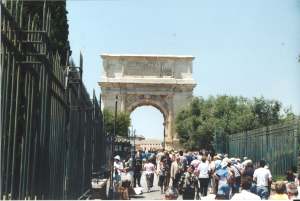
Tourists show the size of the Arch of Titus.

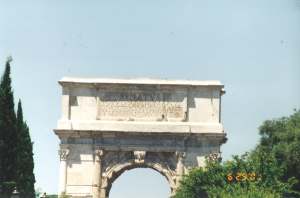
It is difficult to read but it says: “The Senate and the Roman People, to Divine Titus, son of Divine Vespasian, Vespasian Augustus.” “Divine” indicates it was built after his death.
The Menorah and other temple implements.
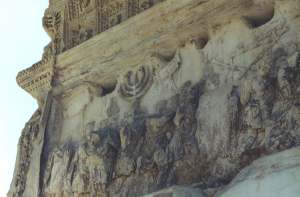
The judgment on Jerusalem happened in A.D. 70 when the Romans sacked the city and destroyed the temple. They stomped all over it; therefore, the abomination of desolation prophesied in the synoptic Gospels actually happened within the generation living at the time of Jesus’s prophecy (Matt. 24:34 // Mark 13:30 // Luke 21:32).
Matthew 24:15-16:
15 “So when you see standing in the holy place ‘the abomination that causes desolation,’ spoken of through the prophet Daniel—let the reader understand— 16 then let those who are in Judea flee to the mountains. [….] (Matt. 24:15-16 // Mark 13:14)
Another look at the Jewish Menorah and other utensils, from the temple.

The Roman army really did stand in the Holy Place in the temple, where the Menorah and other tools were kept. The abomination of desolation already happened within Jesus’s generation, just as he had predicted. God was not going to look back, and neither should we, Christians. God has always been looking forward, and so should we.
III.. Answers to Objections and Questions
A.. Here are the questions and answers
1.. So what about the man of lawlessness appearing in the temple (2 Thess. 2:3-4)?
My thesis, to be consistent, has to conclude that the temple in those two verses refers to the church. This ecclesiastic context–a man who works signs and wonders inside the church and in the name of the church–would give him more (apparent) “credibility.” In this context, the great falling away or rebellion or apostasy would be more widespread and robust (2 Thess. 2:3). Due to all the Scriptures, particularly in Paul’s epistles, in this post, this thesis makes much more sense than the belief that the literal temple has to be rebuilt in Jerusalem, just for one man of lawlessness to work his evil signs and wonders.
2.. But is this not replacement theology?
Yes, the church absolutely replaces the temple. That’s clear from the key NT verses, quoted above. But God still has a plan for Israel, so the church does not replace this geopolitical nation or ethnic Jews wherever they are found. God has regathered this nation in 1948, so they can hear the gospel in one location and in modern Hebrew (Rom. 11:25-32). God still has his eye on this nation because his gifts and calling on it are irrevocable (can’t be re-called) (Rom. 11:29). All Israel will be saved (Rom. 11:26), provided they don’t remain in their unbelief and hardness of heart (Rom. 11:23). Conditions do apply.
Does the Land of Israel Belong to Jews Today by Covenant?
Only by God’s grace is the answer.
I finally studied the issue here:
Replacement Theology: True or False?
In contrast to Israel, God’s heart is now focused on accomplishing the global mission towards all people. So it is more accurate to say that God has ordained that his Son’s church move past Israel, not so much replace Israel. And as noted, God wants to reach Israel too with the gospel, so he regathered Jews in their ancient homeland for this purpose.
3.. But I heard that God will re-ordain sacrificing animals in the Messianic Age to commemorate the death of the Messiah.
Dispensationalists get this notion from verses in the OT that say sacrifices will go on forever in the temple. Some verses say that people from around the world will gather to the temple and offer sacrifices and hold the feasts (see Is. 40 and 52 and Zech. 9 and 14, for example). For those verses to be fulfilled, the temple must be rebuilt (Ezek. 40-48).
However, in comparison, God’s covenant with David is said to live on forever (2 Sam. 7:16; 1 Chron. 17:14; Ps. 89:3-4, 28-37), and the priesthood of Aaron will also be active forever (Exod. 29:9; 40:15; Num. 25:13). Now Jesus is the one who fulfills the Davidic covenant and the priesthood. They live on forever through him now. Jesus is called the Son of David many times, but he is David’s Lord (Matt. 21:41-46). And Hebrews 6-10, all of those chapters, talk mainly about Jesus replacing the priesthood of Aaron. Now Jesus ordains that the church fulfill the earthly temple.
The church = the new temple.
It replaces the old one.
More importantly, here is how Jesus commands us to remember his death:
26 While they were eating, Jesus took bread, and when he had given thanks, he broke it and gave it to his disciples, saying, “Take and eat; this is my body.” 27 Then he took a cup, and when he had given thanks, he gave it to them, saying, “Drink from it, all of you. 28 This is my blood of the covenant, which is poured out for many for the forgiveness of sins. 29 I tell you, I will not drink from this fruit of the vine from now on until that day when I drink it new with you in my Father’s kingdom.” (Matt. 26:26-29)
I say those verses are clear and should sweep aside any complicated interpretive template imposed on the OT and transferred to the NT. Jesus and the apostles never taught that the church should reinstitute animal sacrifices to commemorate Jesus’s sacrificial death. In fact, they might even have considered it blasphemous. Jesus is the once-and-for-all sacrifice (Heb. 7:27, 9:12, 26, etc.).
To drive home the third point, as I read Galatians, Paul would be so offended by this teaching of animal sacrifices that he might have put a curse on anyone who taught it, and his issue was mere physical circumcision (Gal. 1:8-9). In short, the apostolic community would have seen this teaching as bizarre and distracting from how Christ told us to commemorate his death: the cup and bread (1 Cor. 11:23-26). They would have seen Ezekiel’s rebuilt temple even in the Messianic Age as irrelevant to how God was building a new temple–his global church, where his presence would live forever.
4.. Will the third temple ever be rebuilt, and should it?
Read the third point, for a more detailed reply. I focus on the question again, here in this point, from a different angle.
Some Christians are eager to rebuild it because they believe that prophecies about it in the OT must be fulfilled literally (see the third objection). However, the New Testament authors are silent about the old temple being rebuilt or even the need for it. Just the opposite. The church is now the new temple, they taught us. Those OT temple prophecies are fulfilled in Christ. Therefore if it is rebuilt, God is not backing the project. These Christians, instead, should contribute their money to global outreach done by the church. God’s Son and his Son’s church now takes center place in God’s heart, not the old temple system and certainly not some complicated interpretations of Scripture that insist on its being rebuilt.
More specifically, bringing Ezekiel’s actual and literal temple (or a version of it) forward to our world today (or the Millennium) is a wrong idea because Ezekiel himself said it was conditional (Ezek. 43:9-11). The apostolic community never wrote about bringing Ezekiel’s temple forward to their day (or any day in a new millennium), where animal sacrifices would be reinstituted, to supposedly commemorate the sacrifice of Christ.
B. Summary
Keep the plain things the main things, by allowing the NT to filter out OT verses and particularly convoluted interpretive systems.
IV.. Application
A.. Clearer understanding
We need to understand God’s global plan, and the church is the most important part of it. Without the church proclaiming the kingdom of God and the gospel, the world is doomed. So let’s study the church’s fuller identity, in God’s eyes. Let’s get stronger and stronger and acquire a clearer and clearer vision of who we are in Christ, and who Christ is in us. Let’s ignore distracting doctrines that lead us away from his plan. Then God can accomplish his plan with us and through us.
B.. No more complicated interpretations
The teaching that the old temple must be rebuilt to fulfill certain OT prophecies, based on overly complicated interpretations and convoluted hermeneutical systems, must be left behind. Though they dominate Christian TV, they miss the mark and confuse average church goers. Now pastors won’t go near eschatology, and that’s a pity because it is remarkably straightforward and streamlined if we follow what Jesus and the apostolic community, some of whom were inspired to write Scripture, actually taught.
C.. Christ’s return and Jerusalem
I do believe that when Christ returns, it will be to Jerusalem (Acts 1:11; Luke 21:24), but once this and other kingdom business are done, God will recreate the heavens and the earth by eliminating the surface of this earth and heaven or by some powerful, fiery cataclysm (2 Peter 3:10). All churches–even the Medieval cathedrals and St. Paul’s cathedral in London, St. Peter’s basilica in Rome and the national cathedral in Washington–the temple in Jerusalem, synagogues, mosques, Hindu temples, Shinto shrines, LDS temples, Buddhist shrines and small, store-front churches in the inner city will be destroyed in the fiery cataclysm. God has no use for any of them anymore, for he will dwell among his people, and they will be his new kind of living temple (Rev. 21-22).
D.. Moses and the old temple religion
Remember: if Moses lived, say, in 1400 B.C, then the Israelites followed his temple religion from then until the temple was destroyed by the Romans in A.D. 70 (with a gap during the Babylonian exile). And thus, A.D. 70 to right now adds up to about 2,000 years, without any temple religion. There is no theological or biblical reason to reinstitute the temple and its religion. We have lived for 2000 years without it. Everything is fulfilled in Christ.
Hebrew 8:13: “By calling this covenant ‘new,’ he has made the first one obsolete; and what is obsolete and outdated will soon disappear.”
And so Hebrews 8-11 teach the teachable that there will absolutely be no future sacrifice in a third temple because there will be no temple, whether in this age or in some sort of literal millennium. Most importantly, Jesus already told us how to honor his sacrificial death: through the Eucharist or communion. We will not have to be purified by Mosaic sacrifices done for this purpose because the Spirit of God living in us will continuously purify us.
E.. New Testament theology simplified
Here is NT theology on this topic, boiled down:
The church = the new temple
And the new temple fulfills and replaces the Old Testament temple; therefore the church fulfills and replaces the Old Testament temple.
We must return to following Jesus and the apostolic community and their inspired statements and writings, now embodied in the NT; we must let their streamlined and simple theology guide the church; we must reject and filter out, on the authority of the NT, any and all convoluted, ad-hoc interpretive systems about an old, obsolete temple. The clarity of Scripture guides us.
F.. The center of God’s heart
We have come to know God better because we have learned who is and what are at the center of God’s heart: His Son and his church. And now you can fit within God’s plan to reach the whole world by belonging to the church in your own area–the local church. Please be sure that the local church is outreach-minded. Be sure your local church teaches the Bible and is full of the Spirit. Then your walk with God will go from faith to faith and from glory to glory, and his plan can advance through you, in your own family and neighborhood. You are one among “like living stones,” and are part of his new temple, the living and glorious church.
G. God’s presence in the tabernacle and the temple
Moses had just finished placing the instruments in the mobile tabernacle, and the glory of God came do such that Moses could not enter it.
34 Then the cloud covered the tent of meeting, and the glory of the Lord filled the tabernacle. 35 Moses could not enter the tent of meeting because the cloud had settled on it, and the glory of the Lord filled the tabernacle. (Exod. 40:34-35(
Similarly, when Solomon dedicated the temple, God presence filled it. The priests just finished putting the implements in the Holy Place, what some call the Holy of Holies. Then the presence of the Lord filled the temple so powerfully that the priests could not do their work.
10 When the priests withdrew from the Holy Place, the cloud filled the temple of the Lord. 11 And the priests could not perform their service because of the cloud, for the glory of the Lord filled his temple (1 Kings 8:10-11)
While we don’t want to chase after glory clouds, we should not despise them, either, when it happens. All we can do is pray that the presence and glory of God will settle on open and receptive churches and meetings, to bless his people with salvations and healings, and fill their spirits and souls with peace and love.
However, this post says no wild displays in the assembly, so be careful about soul power instead of the Spirit’s power:
What 1 Corinthians 14 Really Teaches
BIBLIOGRAPHY
 Dr. Jim's Essential Bible Teaching