The previous posts on humanity’s needs and God’s offer of salvation, redemption, reconciliation and the cross are included in the gospel call. This post also discusses election and predestination.
Let’s begin.
I. Introduction
A. Call of the gospel
Preaching about sin, repentance, faith in Christ, forgiveness, and salvation is the call of the gospel.
B. People’s response
Professional theologians then break down the human response and how it relates to God’s foreknowledge, choice (election), predestination, and human freewill. So we have to cover those complications.
C. Calm
If we have calm, we can reach sensible conclusions. The main point is that we respond to the call of the gospel and experience salvation in all its fullness.
D. Word of encouragement
Don’t feel frustrated if you have to read this post several times before it clicks. I have to do this for many subjects!
II.. Calling
A.. What does calling or call mean?
In the context of salvation, it means God calls or woos us to salvation in Christ. It means the salvation calling of God. The gospel was proclaimed in some form, and it went into your heart and energized or produced faith in you that saves you. You responded to the call of the gospel and accepted the invitation.
B.. Is there a general call to salvation?
Yes, and it means God’s salvation is for everyone.
A good passage is Matt. 22:1-14, the parable of the wedding banquet. The king prepared the wedding banquet for his son, and he sent his servants to invite certain ones. They refused to come and brought up excuse after excuse. Then he sent his servants to call more people, and they did come.
Both calls illustrate the general call. The first group, representing Israel, said no. The second call, representing Gentiles, said yes. And many Jews converted to the Messiah (Acts 21:20), but not the national leaders who represented the nation.
Either way, God calls everyone, but not everyone responds with yes, but walks away. So the gospel does not always generate a positive response, but that responsibility is on the hearer and refuser.
C. Effectual call versus general call
Effectual call means that it is so powerful that no one can resist it. It is synonymous with irresistible grace.
However, in my own study of numerous Scriptures, God’s call can be resisted. This is why I now changed to general call, and not effectual call. The call of the gospel goes out to all and some hearers resist without God causing their resistance or by God not working on them to accept it.
D. So is there a specific calling?
If it means that God effectually calls only those whom he foreknew would choose him, then I say no. God so loved the world that he sent his Son (John 3:16). His call to salvation is general or for everyone. So I believe in a general call. And people welcome the gospel or reject it.
E.. But what does called and chosen mean at the end of the parable?
“Many are called, but few are chosen” (Matt. 22:1-14)?
We should not over-analyze the words “many,” as if that does not mean “everyone.” The context of the parable includes all Jews and Gentiles at large and now around the globe where the gospel is gradually going forth. The gospel is for everyone.
F.. So that verse is not a specific call to salvation, just for a few?
Right. As noted, God so loved the world that he gave his unique and special Son. Commentator Blomberg is on target. We should not over-read “many” and “few.” He writes:
Many people hear the summons of the gospel, but only a certain percentage responds properly. In light of the imagery of the parable itself and in view of common Semitic usage, “many” here may well mean all. “Few” may thus imply nothing about how many are saved except that the number is noticeably less than all. This is interesting use of election terminology. Klētoi (literally, called) is not to be taken here as irresistible calling […] but in the sense of “invited.” Those responding properly may be said to have been chosen. The elect are the true community of the people God chooses to save, even as Israel had once been so chosen, but those people must freely respond to the Spirit’s work in their lives. The imagery here is in fact more that of corporate than of individual election, but the former cannot exist without the latter. [,,,]. Election does not violate free will nor occur irrespective of the man’s conduct. (Matthew, vol. 22, The New American Commentary, p. 329)
So “few” just means that the ones who enter the kingdom are less numerous than all who are invited. Key line in Blomberg: “Those responding properly may be said to have been chosen.”
So it works out like this:
Invitation → The corporate community responds and enters → They are now chosen, elected (they are part of a large team).
This does not mean, however, that God himself acted to exclude the ones who were unwilling to respond to the general invitation. In the parable, the man who was “disinvited” into the kingdom did not have the right garments on. He sneaked in. The whole context of the parable reveals a corporate calling (Israel or Gentiles), not an individual.
G. God’s call through the gospel
His general call simply adds up to the truth that God foreknows everything. It also teaches us that we cannot simply strut into his kingdom and his salvation on our own. We don’t stumble into his kingdom either. He must call us first, and the call goes out to everyone.
God’s grace is resistible. He woos; he does not “rape.”
H.. Scriptures
Several verses mention a remarkable truth: God’s plan was established from long ago, before the foundation of the world.
Second Timothy 1:9 says that God saved us and then called us to a holy calling. That is, we (the saved) are called to live a holy calling or walk out our sanctification, which comes subsequent to salvation. We are called not by our works, but by his purpose and grace which he gave us in Christ Jesus ages ago. This verse is not predestination to salvation, but sanctification.
Ephesians 3:10-11 says that the church (the saved) is to make known his eternal purpose that he accomplished in Christ Jesus. This is calling for mission or service.
Ephesians 1:9-10 teaches us that the ultimate purpose of God is to head up or sum up all things in Christ.
The import of these verses is that since God is omniscient and eternal; his plans do not pop into his mind at random or like a light bulb lighting up, while before it was dark. Rather, he purposed the whole plan of salvation from eternity past.
III. Election
A.. Brief intro.
In this section, election (noun or elect (verb) and choice (noun) or choose (verb) are synonyms. Select or selection are also synonyms of choose and choice.
I also go from the OT to the NT at Letter F.
It will soon become evident that election is God choosing individuals or nations for service or a mission. It is not about election to salvation or damnation.
B. God chose Abram / Abraham
He was chosen to start a family, who will turn into a nation, who will eventually bring forth the Messiah (see the genealogies in Matthew’s and Luke’s Gospels). Here is te Scripture:
The Lord had said to Abram, “Go from your country, your people and your father’s household to the land I will show you.
2 “I will make you into a great nation,
and I will bless you;
I will make your name great,
and you will be a blessing.
3 I will bless those who bless you,
and whoever curses you I will curse;
and all peoples on earth
will be blessed through you.” (Gen. 12:1-3)
God first called Abram, who responded with obedience. Then Abram believed that God could accomplish this mission. And Abram’s faith was credited to him as righteousness before the law was given (Gen. 15:6).
C. God chose Moses.
In these two verses “choose” is not mentioned, but the concept certainly is: God chose Moses for service.
9 And now the cry of the Israelites has reached me, and I have seen the way the Egyptians are oppressing them. 10 So now, go. I am sending you to Pharaoh to bring my people the Israelites out of Egypt.” (Exod. 3:9-19)
Moses came up with all kinds of excuses not to go, but God countered all of them.
Psalm 106:23 says Moses is God’s “chosen one.”
D. God chose David.
Samuel anointed David for service:
12 So he sent for him and had him brought in. He [David] was glowing with health and had a fine appearance and handsome features.
Then the Lord said, “Rise and anoint him; this is the one.”
13 So Samuel took the horn of oil and anointed him in the presence of his brothers, and from that day on the Spirit of the Lord came powerfully upon David. (1 Sam. 16:12-13)
David recognized God’s election when he told Michal, Saul’s daughter and David’s wife: “It was before the Lord, who chose me rather than your father or anyone from his house when he appointed me ruler over the Lord’s people Israel” (2 Sam. 6:21). God is speaking here when the ark was brought to the temple: “I have chosen David to rule my people Israel” (1 Kings 8:16c).
David had a heart for God (1 Sam. 13:14) even before he was chosen, so he humbly accepted God’s election. He did not make excuses as Moses did.
God chose David before his birth: (Ps. 139:16). He chose Jeremiah before he was born and appointed him for his mission (Jer. 1:15).
E. God chose Israel.
This carries on Abraham’s original calling. Moses is speaking to the Israelites.
6 For you are a people holy to the Lord your God. The Lord your God has chosen you out of all the peoples on the face of the earth to be his people, his treasured possession.
7 The Lord did not set his affection on you and choose you because you were more numerous than other peoples, for you were the fewest of all peoples. 8 But it was because the Lord loved you and kept the oath he swore to your ancestors that he brought you out with a mighty hand and redeemed you from the land of slavery, from the power of Pharaoh king of Egypt. (Deut. 7:6-8)
God was keeping his oath he swore to Abraham and the other ancestors. God’s gifts are irrevocable (Rom. 11:29).
Then God chose Israel for service and mission. Abraham is called God’s friend. Isaiah is writing:
8 “But you, Israel, my servant,
Jacob, whom I have chosen,
you descendants of Abraham my friend,
9 I took you from the ends of the earth,
from its farthest corners I called you.
I said, ‘You are my servant’;
I have chosen you and have not rejected you. (Is. 41:8-9)
God original mission to raise up a family is moving forward. In the next chapter of Isaiah, Israel’s mission is to be a light to the nations and open the eyes of the blind and set captives free from a spiritual and moral prison and dungeon:
6 “I, the Lord, have called you in righteousness;
I will take hold of your hand.
I will keep you and will make you
to be a covenant for the people
and a light for the Gentiles,
7 to open eyes that are blind,
to free captives from prison
and to release from the dungeon those who sit in darkness. (Is. 42:6-7)
This promise was fulfilled in the Messiah (see Matt. 4:12-17; and Luke 4:17-21)
God’s election is corporate, but it focuses on individuals, to bring about the sustain the corporate election.
Now let’s move to the NT.
F. God chose the Son.
Matthew quotes from Isaiah 42:1-4:
17 This was to fulfill what was spoken through the prophet Isaiah:
18 “Here is my servant whom I have chosen,
the one I love, in whom I delight;
I will put my Spirit on him,
and he will proclaim justice to the nations. (Matt. 12:18)
At the Mount of Transfiguration, God spoke: “A voice came from the cloud, saying, ‘This is my Son, whom I have chosen; listen to him.’” (Luke 9:35).
God chose his Son who will become the head of his Body, his church. God elected him for a corporate purpose, much like God chose Abraham for a corporate purpose. Now we individuals, on our salvation, are the elect in the Son. Our election is corporate, just like God’s election of the ancient Israelites are corporate. Jews in Paul’s day (and ours) are in Abraham, and we the redeemed are in Christ. Salvation is found only in the Messiah. not Abraham.
G. God chose Saul / Paul.
Saul (later Paul) was chosen for service. Jesus is speaking to Ananias, who was reluctant to visit Saul because he had been persecuting the church.
But the Lord said to Ananias, “Go! This man is my chosen instrument to proclaim my name to the Gentiles and their kings and to the people of Israel. (Acts 9:15)
Paul, an individual, is about to be in Christ because of his encounter with him and baptism (v. 18). An individual has been brought into the corporate Body, and now God selects or chooses Saul for service. No word and God electing him for salvation. This is not hair-splitting if this patterns is repeated over and over again.
Like Jeremiah, Paul states that he too was set apart from his mother’s womb.
15 But when God, who set me apart from my mother’s womb and called me by his grace, was pleased 16 to reveal his Son in me so that I might preach him among the Gentiles (Gal. 1:15-16)
When God set him apart and consecrated him, it was for a mission to preach the Son among the Gentiles. Election for service is the key.
G. Summary
I like what theologian Adam Harwood writes in his chapter summary. After respectfully telling us what Augustinians believe, he writes:
They [non-Augustinians] affirm that God selects the plans, means, and scope of salvation. An individual’s salvation, however, depends on that person’s response to the message of the gospel. According to this view, predestination and election do not refer in the Bible to God determining all things, including the selection of some individuals for salvation. None of the six occurrences of predestination in the Bible [see the next section] requires one to affirm such a view. Rather, predestination concerns God’s promises for believers. In the Old Testament, election concerns God’s selection of individuals for service, his choice of a nation to reach other nations, and his choice of his Son as the Messiah. None of these instances entails God selecting individuals for salvation, which has always been by grace through faith. Election concerns God’s choice of individuals for service, a people for himself, his Son as the Messiah, and his plan to save sinners. (pp. 604-05).
In both the OT and NT, election is for service, not for salvation or damnation. Our election is also corporate. You, an individual, get saved because by God grace you put your faith in Christ Jesus. At that moment you are a member of the Body of Christ. That means you are elect because you are in Christ. You are part of his team.
God will call you to perform a service or carry out a mission. You have to seek God to find out what his service and mission is. Ask mature believers if you believe your mission or service is outlandish. But start small, and just reach out to a family member or a neighbor or join a prayer team at church.
IV. Predestination
A. Brief intro.
There are six occurrences of this verb predestine or destine or the noun predestination, in the NT. They are not about predestination to salvation of individuals.
B.. The cross of Christ was predestined.
Acts 4:27-28 says “decided beforehand”:
27 Indeed Herod and Pontius Pilate met together with the Gentiles and the people of Israel in this city to conspire against your holy servant Jesus, whom you anointed. 28 They did what your power and will had decided beforehand should happen. (Acts 4:27-28)
The key verse is 28. God decided beforehand that Herod and Pilate (a Gentile and his Gentile court) and the people of Israel conspired to put Christ on the cross. God had predestined the cross of salvation. This verb has nothing to do with choosing an individual to be saved (or not).
C. Christians are predestined to be conformed to the Son’s image
Verses 29 and 30 count as two of the six occurrences of the verb or noun.
Romans 8:29-30:
28 And we know that in all things God works for the good of those who love him, who have been called according to his purpose. 29 For those God foreknew he also predestined to be conformed to the image of his Son, that he might be the firstborn among many brothers and sisters. 30 And those he predestined, he also called; those he called, he also justified; those he justified, he also glorified. (Rom. 8:28-30)
We are called according to his purpose, and his purpose means that he will send us on to glory (v. 29). But first he predestined us who already believed to be conformed to the image of his Son. Then the Son will be the firstborn or preeminent among us who believe. Christ went through suffering and obeyed. Now we too will go through the difficulties of this earthly life and be conformed to his image, by his sustaining call. The last verse says we who were predestined are further called to reach the goal or purpose of glory. He justified us–declared us righteous–to obtain that goal, which will be glorification first in heaven and then in new creation, as Paul taught earlier in Romans 8.
In any case, those verses are not about predestination to be saved in the first place. They are about those already saved to be conformed to the image of his Son and his glory.
D. God destined the plan to save Gentiles
First Corinthians 2:7 reads:
7 No, we declare God’s wisdom, a mystery that has been hidden and that God destined for our glory before time began. (1 Cor. 2:7)
This verse speaks of God’s plan to allow Gentiles to experience salvation. Ephesians 2 and Colossians 1:26-27 explain this, as well. The verse therefore is not about an individual’s predestination to be saved. It’s about a global plan to provide and enlarge the scope and breadth of salvation for millions (now billions) of non-Jews. His plan for an inclusive salvation for Gentiles and glory existed before time began.
E. Corporate predestination or election
These two passages make up the fifth and sixth occurrences of the verb or noun.
Ephesians 1:5 and 11-12 read:
5 he predestined us for adoption to sonship through Jesus Christ, in accordance with his pleasure and will […] 11 In him we were also chosen, having been predestined according to the plan of him who works out everything in conformity with the purpose of his will, 12 in order that we, who were the first to put our hope in Christ, might be for the praise of his glory. (Eph. 1:5, 11-12)
Verse 11 says we were chosen in Christ, so his election is corporate in him. Verse 12 reveals the entire plan. “in order that” is a purpose or direction phrase. We the church are predestined to be for the praise of his glory. We who are already saved, the Body, will be the capstone or pinnacle of God’s glory, when he sustains us all the way to the eternal kingdom. We the saved are his shining example of how he accomplishes his plan.
The previous two verse (5 and 11) now easily fall into place. His adoption plan for the entire church will be finalized through Jesus Christ and in glory. We were chosen, elected, or predestined according to this plan to get us to become the praise of his glory. It is the entire church who will shine. “We are predestined to receive an inheritance” (Harwood, p. 589).
Harwood writes that predestination in Ephesians 1 “refers to what occurs to believers and what they receive as a result of trusting in Jesus” (p. 589). I agree. So the chapter in Ephesians is not about unbelievers being predestined to salvation or damnation.
F. Table
This table is a summary of the previous verses.
|
Predestined and Predestination |
||
| 1 | Acts 4:28 | God predestined the cross of Christ |
| 2 | Rom. 8:29 | Believers are predestined to be conformed to the image of God’s Son |
| 3 | Rom. 8:30 | Believers who are predestined are called, justified, and glorified. |
| 4 | 1 Cor. 2:7 | God predestined the plan that Gentiles can be saved too. |
| 5 | Eph. 1:5 | Believers are predestined to complete and final adoption in the future |
| 6 | Eph. 1:11-12 | Believers are predestined to obtain the praise of his glory. |
| Adapted from Harwood, p. 589. | ||
V.. God Initiates; You Respond
A.. Brief intro
You have to respond to God’s call, as we saw in 2 Thessalonians 2:14. You believe, but only through his call. He initiates. You respond. And the Spirit-empowered and grace-filled gospel is sufficient to elicit saving faith in you, and you respond to his call with your Spirit and gospel-empowered saving faith.
B. Further explanations and answers
1.. Puzzle
How can God choose us before the foundation of the world, and yet we have to respond in faith and choose him?
Yes, it can be confusing (for me too at times!). I think what Paul and others are saying is that God is omniscient, so he foreknew those who would choose him, after he sent out his call to salvation through a variety of means, like a gospel tract or a street preacher or a TV program or even in a dream, which is happening in the Muslim world, more and more often. He was not caught by surprise, but your faith has to respond to the general call. For me, the Spirit-inspired gospel is sufficient in itself to prompt saving faith in you and to turn your free will towards him. God initiates and you respond by his grace.
I affirm both God’s sovereignty and human free will. More importantly, as we saw at the table, God predestines believers to move forward in God’s plan of salvation; he does not predestines some people to believe and others to not believe.
I don’t think we should over-analyze predestination or election. I surely don’t.
2. How does God’s foreknowledge fit into God’s plan and our free will?
First let’s say what foreknowledge is not. He did not compel us against our wills to accept his invitation.
Foreknowledge ≠ Force
Foreknowledge ≠ compulsion
Foreknowledge ≠ Causation
Imagine that God revealed to you in a dream that your best friend was going to be promoted at her job tomorrow. You know this. You have foreknowledge. You get a phone call later. She really got promoted! Did your foreknowledge cause the promotion? No.
An objector replies: But you’re not God. God can cause things simply by his knowledge that they will happen. He can promote your friend.
Reply: I am not God, true, but the illustration shows we should not conflate the categories of knowledge and causation. God foreknew that some people, out of their own free will, would reject the gospel. But he did not cause their rejection. God foreknew that some people would accept the gospel by his grace, after they heard the word, which is efficacious enough to instill saving faith in them. Then, out of their grace-inspired free will and now grace-inspired saving faith, they responded to the call of salvation and are now saved. God saved them through his grace and by the means or channel of their faith, which was made alive through grace. Yet human free will, a gift of God and inspired by grace built into the gospel, plays a part.
God’s grace is resistible. God woos; he does not “rape.”
3.. Are you saying that God chose only those who can believe?
No. God chose those who do believe. Humans have their part to play in their salvation response. Once they are saved, they are the elect in Christ. The entire body of Christ is the elect of God. Election is corporate and each individual must respond positively to the call and then he is elect in Christ. He is part of the large team of God.
4.. If God is sovereign, and some do not believe, does this mean he predestined some to damnation?
No. This is what a certain strand of Calvinism teaches. Nor does he pass them by or ignore them, as some moderate Calvinists say.
Clearly, then, humans have enough free will to resist the call of God for salvation. So God’s sovereignty is limited to the wonderful gift he gave us—our freewill. This limit is expressed people, but his sovereignty not limited in his essence.
This illustration represents some strands of Calvinism. Foreordination just means predestination.
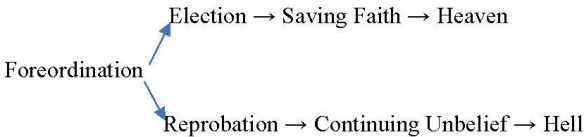
In this simple diagram, the two arrows coming from “foreordination” or predestination means that God predestines humanity in two directions: some for saving faith that leads to heaven, and others for unbelief that leads to hell. The horizontal arrows mean “leads to” (adapted from J. Rodman Williams, vol. 2, p. 22). Williams (and I) do not approve of double predestination.
Better still, as we just saw in the previous major section, predestination in the Bible is for the believer and we are predestined to be conformed into the image of Christ.
Election does not rule out human responsibility. “Light has come into the world, and men loved darkness rather than light” (John 3:19). This “love” that men have and express and by which they choose darkness speaks of free will.
So humans set themselves on the path of damnation, like so:
Human freewill → Refuses the gospel → Hell
5.. So is election closely related to faith?
Yes, absolutely. God does not choose us based on his foreseeing our faith (Arminianism), nor does he choose us who are able to believe (Calvinism). He calls everyone, and some or a few respond (provisionism or traditionalism). Once again, just because God foreknows something does not mean he forces it into our hearts.
Once again: Foreknowledge ≠ Compulsion (or Force)
He allows us to respond or not respond (and even refuse) to the call of salvation throughout our entire lives. Election just means that this is God’s plan and you did not just stumble across it or invent it on your own. Because you responded with gospel-inspired saving faith, you are now within the elect. You are in a large circle (= in Christ) with everyone else who responded just like you did. Together, you are the elect. You have been elected to serve him and to like him.
6.. But doesn’t this gift of freewill limit God’s absolute sovereignty?
Temporarily, yes, but he limits it from a human point of view as he interacts with people. But is not limited in his essence. The fact is that he graciously and voluntarily gave us a certain measure of free will–it is his gift to humankind. But it is only temporary because when God returns through his Son, every knee will bow and every tongue confess that Jesus is Lord (Phil. 2:10-11). Then his gift of freewill to us will be limited.
And no, the attribute of sovereignty is not permanently lost or damaged when he gives us free will. He chooses not to exercise sovereignty with absolute power until Philippians 2:10-11 is carried out.
7.. But what about those outside election and faith?
God yearns for their salvation, and Jesus died for them as well (1 Tim. 2:3-4). But God did not foreordain them to damnation, as the Calvinist diagram wrongly teaches.
8.. So there is no limited atonement then?
Right. As Williams says, “It is reprehensible to speak of limited atonement, that is to say, Christ died only for those whom God elected to salvation. Christ did not come into the world to save some and condemn others, but to save all” (vol. 2, p. 20, emphasis original). He adds: “Thus general calling is the calling of God’s outreaching love that would take every person to Himself. He has no hidden agenda, by which He has already decided to save some and reprobate or bypass others. There is no predestination to death” (volume 2, p. 20, emphasis original).
9.. But what does Romans 9:22 mean when it says that some are fitted for destruction?
The larger context says they were not prepared beforehand by God for wrath and destruction, but they are ready or ripe for it because of their own condition and refusal to obey the call to salvation (Williams, volume 2, p. 21 and note 31). God did not foreordain or predestine them for hell.
Williams adds: “Accordingly, a view of ‘double predestination’—a predestination referring to death and damnation as well as to eternal life—has utterly no basis in Scripture. This does not mean there is no death or damnation, but such does not belong to God’s predestining action, which […] refers only to the general arena of salvation” (Williams, p. 17).
Further, Romans 9 is referring to Jacob and Esau, who represent two nations. While pregnant with the twins, their mother asked why they seemed to be struggling within the womb. She got her answer. “The LORD said to her, ‘Two nations are in your womb, and two peoples from within you will be separated; one people will be stronger than the other, and the older will serve the younger” (Gen. 25:23). But God also loved and blessed the Edomites, the descendants of Esau (Gen. 26 and Deut. 27:3). So the bottom line is that we should not apply Paul’s theology about nations to our lives individually, when the gospel calls everyone. Anyone who responds and accepts the invitation can be saved.
10.. So what is the method of the general call that leads to salvation?
Here are two ways.
First, the proclamation of the word or the gospel must go forth.
Christ’s followers are sent, they proclaim, people hear, they believe, and then they are saved (Rom. 10:14-15). But the gospel must be clearly presented, not with a lot of confusing ideas. In other words, this post is not designed for unbelievers. It is too complicated. Evangelists don’t need to bring up these ideas.
Second, the Holy Spirit must apply the word.
C. Summary
For Renewalists like myself, the cooperation and direction and empowerment are the main thing. The Spirit must energize the gospel. A preacher cannot use soul power, a lot of shrieking and freaking and dancing and prancing, but the power from on high (Acts 1:8). I have heard very calm presentations of the gospel, and people respond. Yes, it is okay to be animated; we are not androids, after all. But the Spirit has to super-charge the word; then both the Spirit and the word spark faith in your heart and mind, and this Spirit-inspired faith leads to saving faith.
VII.. Application
A.. Don’t lose sight of the bigger picture.
Personally, I don’t make a too big thing of God’s foreknowledge or election. God’s knowledge is just one of his many attributes. To me, it just means that he is omniscient and had a plan of salvation from eternity past. This plan did not just pop into his head (so to speak) billions of years before Gen. 1:1. Your salvation did not catch him by surprise. He was involved from the very beginning.
B. To be clear ….
One last time: human free will is not strong enough for people to be saved on their own. They cannot strut into God’s kingdom and truly belong to his church on their own willpower. They need God’s power working on them, and the Spirit-energized gospel is just powerful enough to elicit saving faith. However, human free will can empower them to walk away from this same gospel, heard at the same time as those who accept it. The gospel offers its refusers their liberty. Once again, God woos. He does not rape.
C. Confirm your calling and election.
You have to work–not for your initial salvation–but to remain within your calling and election, by doing these things, writes Peter. The virtues must be sustained and increased. Verses 10-11 are the payoff.
5 For this very reason, make every effort to add to your faith goodness; and to goodness, knowledge; 6 and to knowledge, self-control; and to self-control, perseverance; and to perseverance, godliness; 7 and to godliness, mutual affection; and to mutual affection, love. 8 For if you possess these qualities in increasing measure, they will keep you from being ineffective and unproductive in your knowledge of our Lord Jesus Christ. 9 But whoever does not have them is nearsighted and blind, forgetting that they have been cleansed from their past sins.
10 Therefore, my brothers and sisters, make every effort to confirm your calling and election. For if you do these things, you will never stumble, 11 and you will receive a rich welcome into the eternal kingdom of our Lord and Savior Jesus Christ. (2 Peter 1:5-11)
We have to make every effort to stay within our calling and election (v. 10). If we do, we will receive a “rich welcome into the eternal kingdom of our Lord and Savior Jesus Christ” (v. 11). The implication is that if we do not, then we will not enter the eternal kingdom.
D.. The New Testament authors were wise.
As for God’s foreknowledge and the gospel call, how else were the NT authors supposed to write about God’s omniscience and his eternal plan of salvation and his love for humanity? That all of this was just his whim? That he was not involved until the last minute? That he just stumbled across an interesting and clever idea? That you can just strut into his eternal plan on your own? On your whim? On your own power? Or that can just stumble into it? That you initiated the whole thing?
No to all those questions.
E.. Gospel call illustrated
God’s plan of salvation is not like Dorothy getting caught up in an unexpected tornado that lands her in Oz against her will, in the movie the Wizard of Oz. Rather, God’s gospel call to salvation was carefully planned from the beginning and then we have to respond in faith.
F. Election illustrated
Imagine a football team. Those on the team were chosen by the coach. They are the elect. Those who did not try out for the team were not condemned by the coach. They are not the elect, because of their own refusal, out of their own free will to disobey the coach’s announcement to join the team.
But do not take the illustration too far, because in theology, the Spirit and the gospel can work behind the scenes on all those who are about to believe; the coach cannot.
G. Encouragement to pray
Pray for your loved ones who refuse the gospel at this point in their lives. God can work on their hearts without their knowing it. He is wooing them. Do not give up on them.
H. Encouragement to evangelists
Most evangelists and revivalists I have ever seen just focus on proclaiming the word, the Spirit energizing it and them, and people responding to it. These evangelists and revivalists are right. So before we preach the gospel, let’s pray that the Spirit will anoint us, the word, and the hearers. Always depend on God in our ministries.
BIBLIOGRAPHY
This post in certain sections borrows from Harwood, chapter 23, and Williams, Renewal Theology, vol. 2, chapter 1. I have to be careful of Williams, though I admire him, because he was a Presbyterian minister. And sometimes Reformed theology slipped through. But he is still worth quoting on certain points when he does not agree with complicated Reformed position.
 Dr. Jim's Essential Bible Teaching