Theologians divide God’s attributes into two basic categories: incommunicable and communicable. Incommunicable means God does not communicate or share specific attributes with us in an absolute sense. In this post: Self-existence, unchangeable, infinite (yet personal), omnipresent (everywhere), simplicity, and eternity.
In contrast, communicable means God communicates or shares an attribute with us; we have it in common with him because he grants it to us. Therefore, we can share in them to a greater degree because they are attributes of his character, like love and holiness.
So some incommunicable attributes are not always neat and tidy, since they vary by degrees. Example: eternity.
In any case these are attributes that we humans do not have, in the main. We could call them attributes of God-in-himself. They describe God without any reference to his creation or our world or to us. He is who he is in himself without us or his creation.
I. Aseity: Self-existence or independence
A. Brief intro.
It means he does not need us, but we need him—desperately, even when we don’t realize it.
Often in theology the big word for self-existence is aseity (pronounced uh-SEE-uh-tee or ah-SAY-i-tee).
B. Quick illustration
For one thing, we depend on oxygen and food and water. And when we were born, we depended on our parents. However, our parents got a little taste of independence or self-existence when they realized their baby needed them for existence, but they did not need their baby for existence. So self-existence retains a feeble and faint trace in us, but nowhere near God’s absolute self-existence.
So maybe this attribute belongs in the communicable category. Things are not always neat and tidy.
C. What do theologians say?
Don’t feel frustrated if you have to read this section several times before it “clicks.”
Dictionary of Latin and Greek Theological Terms defines the big term aseity as follows:
Aseitas: Having being from oneself … Aseitas is, literally, a-se-itas, from-self-ness, indicating self-existence (p. 42).
Reformed theologian Louis Berkhof:
As the self-existent God, He is not only independent in Himself, but also causes everything to depend on Him. This self-existence finds expression in the name Jehovah [I Am]. It is only as the self-existent and independent One that God can give the assurance that He will remain eternally the same in relation to His people. (p. 58)
Borrowing from Berkhof, Wayne Grudem calls it God’s independence and defines it thus:
God does not need us or the rest of creation for anything, yet we and the rest of creation can glorify him and bring him joy. This attribute of God is sometimes called his self-existence or his aseity … (p. 190, emphasis original)
Norman Geisler is more philosophical:
Aseity … denotes that He exists in and of Himself, independent of anything else. He is self-existent.
He continues:
Being self-existent, however, is not the same as being self-caused (causa sui). It is impossible to cause one’s own existence, since, again, a cause is ontologically prior to its effect … Thus a self-existent Being (a Being with aseity) is not a self-caused being; rather, a self-existent Being is an uncaused Being. It simply has no cause, since only beings who can possibly not be need a cause. Hence, a Being who not possibly not be must be an uncaused (necessary) Being. (p. 435, emphasis original)
Translation of Geisler: A being that does not have to exist needs a cause. It is contingent. But since it is impossible for God not to exist, he is the uncaused, necessary Being. “Necessity has to do with the impossibility of His nonexistence” (ibid.). Necessary ≠ contingent. We and all creation are contingent; he is Necessary, and the only necessary Being that exists. We contingent beings depend on him for our existence.
Finally, Reformed theologian Donald Frame comes up with these synonyms for aseity: independence, self-existence, self-sufficiency, self-containment and absolute; he exists “without receiving existence from something else” (Systematic, p. 406).
D. Quick definition:
This attribute or perfection of God means that he is independent of his creation, self-sufficient in himself, cannot not exist, uncaused, without beginning or end and remains eternally the same for his people.
E. What do the Scriptures teach?
Here is a mere sample of verses.
He existed before creation and outside of it:
In the beginning God created the heavens and the earth. (Gen. 1:1)
“You are worthy, our Lord and God, to receive glory and honor and power, for you created all things, and by your will they were created and have their being.” (Rev. 4:11)
His very name means existence:
God said to Moses, “I am who I am. This is what you are to say to the Israelites: ‘I am has sent me to you.’” (Ex. 3:14)
He possesses everything, but it does not possess him. God needs nothing in his creation:
The earth is the Lord’s, and everything in it, the world, and all who live in it (Ps. 24:1)
I have no need of a bull from your stall or of goats from your pens, 10 for every animal of the forest is mine, and the cattle on a thousand hills. 11 I know every bird in the mountains, and the insects in the fields are mine. 12 If I were hungry I would not tell you, for the world is mine, and all that is in it. 13 Do I eat the flesh of bulls or drink the blood of goats?
He is unlike anything in creation:
Who then is like me? Let him proclaim it. (Is. 44:7)
God is self-existent or independent from everything, but it is not self-existent or independent of him:
He is self-existent or independent in his thoughts:
33 Oh, the depth of the riches of the wisdom and knowledge of God!
How unsearchable his judgments,
and his paths beyond tracing out!
34 “Who has known the mind of the Lord?
Or who has been his counselor?” (Rom. 11:33-34)
He is self-existent or independent in his will and counsel:
But the plans of the Lord stand firm forever, the purposes of his heart through all generations. (Ps. 33:11)
He is self-existent or independent in his power:
Our God is in heaven; he does whatever pleases him. (Ps. 115:3)
F. Other verses to study:
Psalm 50:9-12; Daniel 4:35; John 5:26; Ephesians 1:5; Acts 17:24-29
G. Knowing God better through his self-existence
The fact that he created us demonstrates that he loves us. His entire creation demonstrates his love too. Its existence and our existence prove he is love, much like parents who are blessed with a baby.
He did all of this out of his free and generous will and bountiful grace, uncoerced and unforced. He wanted to make us and the universe.
Therefore, God does not need us, and he is independent of us, but he wants us. He wants to shower his love and knowledge of him on us. He wants us to be with him forever in his eternal kingdom, in eternal fellowship with him.
II. Immutability: Unchangeable and Consistent
A. Brief intro
God is stable and consistent. He does not act on a whim. We can trust him to act not according to a mood, like the Greek gods, but according to his wisdom and knowledge.
Unchangeableness is also called immutable or immutability.
B. What do theologians say?
The great theologian of the nineteenth century Charles Hodge says:
So God is absolutely immutable in his essence and attributes. He can neither increase or decrease. He is subject to no process of development or of self-evolution. His knowledge and power can never be greater or less. He can never be wise or holier or more righteous or more merciful than He has ever been or ever must be. (vol. 1, p. 390)
Berkhof writes:
God’s immutability “is that perfection [attribute] of God by which He is devoid of all change, not only in His Being, but also in His perfections, and in His purposes and promises. In virtue of this attribute He is exalted above all becoming and is free from all accession or diminution and from all growth and decay in His Being or perfections. His knowledge and plans, His moral principles and volitions remain forever the same. Even reason teaches us that no change is possible in God, since a change is either for better or for worse. (p. 58)
Grudem writes:
God is unchanging in his being, perfections, purposes, and promises, yet God does act and feel emotions, and he acts and feels differently in response to different situations. (p. 192-93, quoting Berkhof).
God’s acting and feeling differently will be explained shortly, but for right now it means that when God deals with humans, there are always implicit or explicit conditions in how he guides the outcome (see below at the section objection and reply).
Williams writes:
God is One who does not change. The universe is constantly undergoing transition from one state to another, and human existence is marked by continuing alteration. With God there is no such mutability. “For I the LORD do not change” (Mal. 3:6).
Millard Erickson calls it divine constancy and replies to deficient views of God:
Some interpretations of the doctrine of divine constancy, expressed as immutability, have actually drawn heavily on the Greek idea of immobility and sterility. This makes God inactive. But the biblical view is not that God is static but that he is stable. He is active and dynamic, but in a way that is stable and consistent. (p. 250).
Quick definition:
This attribute of God means that he is unchanging, unchangeable, consistent, forever the same, undevelopable, without self-evolution, and constant, yet active with his creation, particularly with humankind.
C. Reply to an objection
But Scriptures seem to say that God “repenteth” that he acted in this or that way (see Gen. 6:6-7). He seems to change his mind.
Reply: The best way to translate “repenteth” is “has sorrow” or “regrets.” God has emotions. Now as for God changing his mind, we need two perspectives: his and ours. When people sin habitually, he guarantees their judgment and warns them of it. This is God’s attribute of justice. Built into this warning is the assumption that if the people repent, God will relent and not judge them. They repented. God did not judge them. From our point of view God seemed to have changed his mind. But from his eternal and omniscient point of view God already knew that his people would repent. So he did not change his mind, but he did show another attribute: mercy. Please study Jeremiah 18:1-10.
Please click on this post for a longer reply.
Do I Really Know God? He Is Unchanging and Consistent
D. What do the Scriptures teach?
God does not change or lie or go back on his Word:
18 God did this so that, by two unchangeable things in which it is impossible for God to lie, we who have fled to take hold of the hope set before us may be greatly encouraged. (Heb. 6:18)
In the hope of eternal life, which God, who does not lie, promised before the beginning of time (Titus 1:2)
Every good and perfect gift is from above, coming down from the Father of the heavenly lights, who does not change like shifting shadows. (James 1:17)
In the beginning you laid the foundations of the earth, and the heavens are the work of your hands. 26 They will perish, but you remain; they will all wear out like a garment. Like clothing you will change them and they will be discarded. 27 But you remain the same, and your years will never end. (Ps. 102:25-27; cf. Heb. 1:11-12, which is applied to Jesus)
God the Son shares this attribute with God the Father:
“Jesus Christ is the same yesterday and today and forever.” (Heb. 13:8)
God’s purpose and counsel remains the same:
But the plans of the Lord stand firm forever, the purposes of his heart through all generations. (Ps. 33:11)
I am God, and there is none like me, declaring the end from the beginning and from ancient times things not yet done, saying, “My counsel shall stand, and I will accomplish all my purpose” … I have spoken, and I will bring it to pass; I have purposed, and I will do it. (Is. 46:9-11)
God is unchanging in his promises:
“God is not a man that he should lie, or a son of man that he should repent. He has said, and will he not do it? Or has he spoken, and will he not fulfill it? Num. 23:19; cf. 1 Sam. 15:29)
See also these verses about his unchanging purposes and counsels: Matthew 13:35; 25:34; Ephesians 1:4, 11; 3:9, 11; 2 Timothy 2:19; 1 Peter 1:20; Revelation 13:8.
E. Knowing God better through his immutability
God remains ever the same. He does not have a shadowy side to him. He is full of light. He will never abuse his children. Yes, sometimes he has to discipline and correct them, but not abuse. God will always love his children and people generally—even when he has to judge them for their misdeeds. So, it is unfair to project our upbringing on to God. He is willing to relent if people repent. God loves to show mercy on the wayward, whether Christian or not. He calls them all to draw closer to him. Are they listening?
When we pray, we can change the condition in a seemingly unbending process. For example, if someone in your family is unsaved, he is headed on a trajectory of destruction, whether in this life or the next. The trajectory seems so fixed and unbending because your family member appears to be so stubborn and enjoys going astray. But you can step in and change things when you pray. It moves God to act. You are the change God and your family member has been waiting for. You are one who inserted the new condition, and God’s unchanging character to save is activated and moved (from a human vantage point), while his unchanging character to judge has been deactivated (so to speak), and your family member will be saved; God has bent your family member’s “firm” trajectory towards him.
So, whether in salvation or in judgment, God’s essential character or who he is does not change when we pray. Rather, down here on earth he applies different aspects of his unchanging essence when dealing with changing humans. In his eternal and unchanging attributes, he is and will always be Judge and Savior, regardless of what happens in the fluctuating world of humans.
Once we understand this aspect of his character, we can depend and build our entire lives on his constancy, consistency, unchangeableness, stability and immutability.
III. Infinite (and Personal)
A. Brief intro
God is greater than the universe. He is limitless and boundless. But he chooses to relate to us anyway. He is personal.
B. What do theologians say?
Berkhof has a deep definition of God’s infinity:
The infinity of God is that perfection [attribute] by which He is free from all limitations. In ascribing it to God we deny that there are or can be any limitations to the divine Being or attributes. It implies that He is in no way limited by the universe, by this space-time world, or confined to the universe. It does not involve His identity with the sum-total of existing things, nor does it exclude the co-existence of derived and finite things, to which he bears relation. The infinity of God must be conceived as intensive rather than extensive and should not be confused with boundless extension, as if God were spread out through the entire universe, one part being here and another there, for God has no body and therefore no extension. (p. 59)
Translation: God’s infinity is without limits; it is limitless. It is not limited by the universe, but he relates to his creation. God is not a body, so he does not exist here or there. God is not the universe (pantheism) or live in the universe, like the mind inhabits the body (panentheism). No, God is infinite, while the universe is finite (or growing towards something like infinity).
Geisler defines God’s infinity like this:
The term infinite (“not-finite”) is negative in form [the word not], but it denotes a positive attribute of God. God is literally limitless in His Being. He is without boundaries, a Being beyond the limits of the created universe. It is only because of the finite nature of our concepts that the positive attribute must be expressed in negative terms [not finite]. (p. 470)
Then Prof. Geisler goes on to say that God is not an abstract infinite as in math—an infinite number of points between A and B. Instead, God is infinite in a metaphysical way. “He is an actual infinite Being, not an abstract one.” He further says that God is not an endless series of moments, one after another. Rather, “He is an actually Infinite Being (not a series) and cannot be added to in any way.”
Translation: God is not growing towards infinity; he is actually infinite. His infinity is not abstract, but complete. It is not serial or sequential. He simply is limitless and unbounded.
Grudem insightfully joins the infinite and the personal:
In the teaching of the Bible, God is both infinite and personal: he is infinite in that he is not subject to any limitations of humanity or of creation in general. He is far greater than everything he has made, far greater than anything else that exists. But he is also personal: he interacts with us as a person, and we can relate to him as persons. We can pray to him, worship him, obey him, and love him, and he can speak to us, rejoice in us, and love us. (p. 197, emphasis original)
Erickson:
God is infinite. This means not only that God is unlimited, but that he is illimitable. In this respect, God is unlike anything we experience. (p. 243).
He goes on to describe things we used to think were “infinite” or limitless, like sources of energy, the ocean, food, but they are not. But God really is illimitable.
Prof. Erickson continues by saying that God is not limited by space; he is immense and all-present:
All finite objects have a location. They are somewhere. This necessarily prevents their being somewhere else. The magnitude of finite objects is measured by how much space they occupy. With God, however, the question of whereness or location is not applicable. God is the one who brought space (and time) into being. He was before there was space. He cannot localized at a particular point. There can be no plotting of his location on a set of coordinates. This is because he has no physical body to be located at a particular place. (p. 243)
C. Quick definition:
It is difficult to improve on Berkhof’s definition, but basically God is limitless, for his universe does not contain him or restrain him, yet he is personal and relates to his creation, particularly humankind.
D. What do the Scriptures teach?
The concept of God’s infinity is built on Scriptures that affirm he is beyond the physical universe—he created and sustains it. We should not demand of the practical and poetic Scriptures philosophical arguments, but the core message of God’s infinity is clear enough.
In the beginning, God created the heavens and the earth. (Gen. 1:1)
Will God dwell on earth? The heavens, even the highest heaven, cannot contain you. (1 Kings 8:27)
Great is our Lord and might y in power; his understanding has no limit (Ps. 147:5)
“For my thoughts are not your thoughts, neither are your ways my ways,” declares the Lord. 9 “As the heavens are higher than the earth, so are my ways higher than your ways and my thoughts than your thoughts. (Is. 55:8-9)
This is what the Lord says: “Heaven is my throne, and the earth is my footstool. Where is the house you will build for me? Where will my resting place be? 2 Has not my hand made all these things, and so they came into being?” declares the Lord. (Is. 66:1-2)
He is before all things, and in him all things hold together (Col. 1:17)
What about Scriptures revealing his personal relations to us? The entire Bible is about that. The greatest example is the Incarnation:
Here is Jesus as the preincarnate Word:
In the beginning was the Word, and the Word was with God, and the Word was God. He was with God in the beginning. Through him all things were made; without him nothing was made that was made. (John 1:1-3)
Then the eternal Word relates to us in the next verses:
In him was life, and that life was the light of all mankind. […] The Word became flesh and made his dwelling among us. We have seen his glory, the glory of the one and only Son, who came from the Father, full of grace and truth. (John 1:4, 14)
Please study these verses: Job 11:7-9; Isaiah 40:12-14; Isaiah 57:15; Romans 11:33
E. Knowing God better through his infinite and personal nature
As the personal, infinite God relates to us, he reveals to us through Scripture quotes above that he is bigger than our problems—bigger than your search for a job, bigger than anxiety over your family member who is not committed to Christ, bigger than your grief over the passing of your beloved relative. God will see you through your problems and needs. God is boundless and limitless, yet personal.
God is inexhaustible. His love can never be exhausted. True, sometimes he has to judge, but for those who repent his mercy is inexhaustible. Financially and materially, there are no shortages with God. Therefore his supply is inexhaustible.
Let the notion of God’s infinity sink into you mind, and the anxiety over your problems will disappear. God is infinitely greater than your tiny, finite problem.
IV. Omnipresence: Everywhere
A. Brief intro
Omni- means “all” and is one of the perfections of God. There is no place in the universe where he is not there—he is in every corner. He is everywhere.
B. What do theologians say?
Williams explains the term omnipresence (all-present):
Omnipresence signifies that God is totally present everywhere in creation. Hence we are not to understand God as spatially spread throughout the universe so that a part of him is here, another part there. God’s filling heaven and earth means rather that He is totally and equally present everywhere. He is as much present to a single atom as to the most distant star, to a single seed as to all the plants and trees of the world. There is no place where God is not. He is everywhere. (vol. 1, p. 77).
Geisler reminds us what omnipresence does not mean:
It does not mean that God is creation; this is pantheism. In theism God made the world; in pantheism God is the world; Nor does omnipresence mean that God is in creation, which is panentheism” (p. 493, emphasis original).
Then Geisler gives us three illustrations: God is in the universe or present to the whole universe the way the mind is in its brain, or beauty is present in art, or thought in a sentence. Note how the mind, beauty, and thought are not physical, but are present and penetrate the whole physical things without one part being in another part of the thing. God is indivisible (“simple” or not in parts), and infinite and immense.
So an imperfect illustration is water filling a swimming pool because water can be divided into separate molecules, where each one is in different parts of the water. God is not physical, so his whole being is everywhere at the same time, not a part here and a part there. So go back to the mind, beauty, and thought illustrations.
Erickson says that objects have to be in one place and not another. They are limited. However, God is different. He is not confined to space at all, for he is the one who brought space and the entire universe into being—he created it. He cannot be local in one place. Then Erickson teaches us about the tension between immanence (he is everywhere or right here) and transcendence (he is not anywhere in creation or out there) (p. 243). It is difficult for us to conceive of those two realities, but only God can do it.
Let’s conclude this section in this way. God’s immanence (he is “down here”) is opposite to his transcendence (he is “up there”). God is not limited by time or space, but he himself is present everywhere without being in parts. God himself is omnipresent. He is not creation itself, but is distinct from it. He is not in creation as if he is confined by it, yet he is everywhere because he is a non-physical being, while all of creation is physical. Therefore there is no contradiction because those are two different terms—physical and nonphysical.
C. Quick definition:
This attribute or perfection means that God is everywhere because he is Spirit and does not exist in parts, here or there, and he is not confined by the universe nor is he the universe.
D. What do the Scriptures teach?
God cannot be contained by the universe, but he can be found by humans:
27 “But will God really dwell on earth? The heavens, even the highest heaven, cannot contain you. How much less this temple I have built! (1 Kings 8:27)
See 1 Kings 8:28, below, for how God connects with us in his immanence (God is here).
Now the psalmist personalizes God’s immanence / omnipresence to us humans, and then says even the darkness of space cannot hide him:
Where can I go from your Spirit?
Where can I flee from your presence?
8 If I go up to the heavens, you are there;
if I make my bed in the depths, you are there.
9 If I rise on the wings of the dawn,
if I settle on the far side of the sea,
10 even there your hand will guide me,
your right hand will hold me fast.
11 If I say, “Surely the darkness will hide me
and the light become night around me,”
12 even the darkness will not be dark to you;
the night will shine like the day,
for darkness is as light to you. (Ps. 139:7-12)
God fills the universe. There is no use in hiding.
23 “Am I only a God nearby,”
declares the Lord,
“and not a God far away?
24 Who can hide in secret places
so that I cannot see them?”
declares the Lord.
“Do not I fill heaven and earth?”
declares the Lord. (Jer. 23:23-24)
Finally, Paul preaches to intellectual Athenians that God is not limited by temples or statues, but he is so involved with us that he sustains us; we don’t sustain him by offerings:
24 “The God who made the world and everything in it is the Lord of heaven and earth and does not live in temples built by human hands.25 And he is not served by human hands, as if he needed anything. Rather, he himself gives everyone life and breath and everything else. […] 28 ‘For in him we live and move and have our being.’ (Acts 17:24-25, 28)
In light of all these passages, God causes the universe to come into being, and in that sense he can be everywhere.
Please study these verses: Psalm 95:3-5; Jeremiah. 23:23-24; Matthew 6:6; 28:20; Hebrews 1:3;
E. Knowing God better through his omnipresence.
God is omnipresent, but God is here for you. So God acts in space to reveal himself to humans who have faith in him or who at least seeks him. God the Omnipresent One comes down to our level. This truth should not necessarily scare you, for he is love. Isaiah proclaims that when the eternal God dwells in the highest place, God is there to help you; he will enable you to repent and have a contrite heart:
For this is what the high and exalted One says—
he who lives forever, whose name is holy:
“I live in a high and holy place,
but also with the one who is contrite and lowly in spirit,
to revive the spirit of the lowly
and to revive the heart of the contrite. (Is. 57:15)
Finally, God does not dwell in temples in the sense that he is confined there, but when you pray in God’s house he will meet you there:
1 Kings 8:27-28 says:
27 “But will God really dwell on earth? The heavens, even the highest heaven, cannot contain you. How much less this temple I have built! 28 Yet give attention to your servant’s prayer and his plea for mercy, Lord my God. Hear the cry and the prayer that your servant is praying in your presence this day.
God’s presence is with you, no matter where you go. Travel across country? God is there! Going into battle? God is there! Going through a transition in life, like marriage or having a child? God is there! Going through a sad moment, like a divorce or the death of a loved one? God is there.
But warning: God fills the heavens and earth, true, but he is not just a God for “Me and God by ourselves.” He loves his creation and particularly his highest creation: all of humankind.
V. Simplicity
A. Brief intro.
God is not made up of moving parts, as we humans are. Grudem says this attribute can be called unity (p, 211). Pieper separates unity and simplicity (vol. 1, pp. 437-40). To keep this post shorter than it could be, I will combine them.
B.. What do theologians say?
Charles Hodge speaks of the differences between the attributes in God and in us humans:
God is a simple Being, not only as not composed of different elements, but also as not admitting [allowing in] of the distinction between substance [essence] or accidents. Nothing can either be added to or taken from God. In this view simplicity, as well as the other attributes of God, are of a higher order than the corresponding attributes of our spiritual nature. The soul of man is a simple substance, but it is subject to change. I can gain or lose knowledge, holiness, and power. These are in this view accidents in our substance. But in God they are attributes, essential and immutable [unchangeable] (vol. 1, p. 379).
Reformed theologian Herman Bavinck boils down what God’s being and essence is.
… God is “simple,” that is, free from composition. God is identical with each of his attributes; he is what he possesses. In God “to be” is the same as to be wise, to be good, or to be powerful. All God’s attributes are identical with his essence. In all his attributes he is pure being, absolute reality. (Reformed, p. 175).
Wayne Grudem teaches us that God’s simplicity means his unity. Further, he is indivisible, but he does relate to us with different attributes that we humans may need at any moment in our lives. He defines it simply:
God is not divided into parts, yet we see different attributes of God emphasized at different times. … When Scripture speaks about God’s attributes, it never singles out one attribute of God as more important than all the rest. There is an assumption that every attribute is completely true of God and is true of all of God’s character. (pp. 177-78).
Then he gives an example in 1 John. One verse says, “God is light” (1:5) and another one says, “God is love” (4:8). God is not part light and part love. “It is God himself who is light, and God himself who is also love” (ibid., emphasis original).
C. Quick definition:
This attribute or perfection means that God is a unity, undivided in parts and non-composite.
D. What do the Scriptures say?
Recall that “simple” and “one” are synonyms in this context.
Hear, O Israel, the LORD our God, the LORD is one (Deut. 6:4).
Kingdoms may believe they are the greatest, but only God is.
16 “Lord Almighty, the God of Israel, enthroned between the cherubim, you alone are God over all the kingdoms of the earth. You have made heaven and earth. … so that all the kingdoms of the earth may know that you, Lord, are the only God. (Is. 37:16, 20)
Jesus references Deut. 6:4:
“The most important one,” answered Jesus, “is this: ‘Hear, O Israel: The Lord our God, the Lord is one. (Mark 12:29)
Paul repeats it:
Since there is only one God …. (Rom. 3:30)
Other gods are really just nonexistent or some are demonic spirits. God is one:
“There is no God but one.” 5 For even if there are so-called gods, whether in heaven or on earth (as indeed there are many “gods” and many “lords”), 6 yet for us there is but one God, the Father, from whom all things came and for whom we live; and there is but one Lord, Jesus Christ, through whom all things came and through whom we live. (1 Cor. 8:4-6)
Paul in the next two verses proclaim God’s unity or oneness:
[O]ne God and Father of all, who is over all and through all and in all. (Eph, 4:6)
For there is one God and one mediator between God and mankind, the man Christ Jesus (1 Tim. 2:5)
James, the brother of Jesus, affirms God’s unity:
You believe that there is one God. Good! (James 2:19)
Is there an illustration of how God is unity but has various attributes?
Yes, please click on The Spirit’s Deity and Divine Attributes.
E. How do I know God better through this post?
It is true that God is completely and absolutely and simultaneously all his attributes, but if he were to show us all of them down here at the same time and in their total fullness while we live in our untransformed and unresurrected bodies, we would die. It is merciful of God to show them only little by little through Scripture and through the Spirit living in our hearts. That is, God acts within his creation and in the world of humans, and he shows forth his attribute or attributes when this or that human needs one or more of them.
For example, creation shows forth the glory of God (Ps. 19:1), and God gets the glory when he performs a miracle in our lives. Even in the Old Testament God is love, but often he had to show his justice or judgment. But God’s essence never changed or changes from then to now.
Let’s contrast God with us—easy to do! Humans have only one essential attribute that never goes away: the soul that lives on forever (conditioned on God), but even that attribute can change as one mentally or emotionally grows or develops. (Some misinformed teachers say that the human spirit, distinct from the soul, is perfect and never develops, but the Bible never says a part of humankind is absolutely perfect or perfected here—the presence of sin degrades us even a little.) But God is so unlike us in his perfections or attributes that we can worship him as the wholly other Being.
So how do God and you relate? God shares some of his attributes with us in small part, because he made us in his image. He is completely and absolutely merciful, and we are part-time and incompletely merciful. When his Spirit lives in us, we have a better time showing mercy, as he nudges and reminds us to do so.
VI. Eternity
A. Brief intro.
This may be an attribute that God shares with us in part. He gives us eternal life. The difference is that he has no beginning, but we do.
B. What do theologians say?
These definitions are deep, so you may have to read them over several times if they don’t “click” the first time or even third time.
Princeton theologian Charles Hodge says God’s infinity as it is related to space is his immensity or omnipresence (everywhere). But relative to time God’s infinitude is his eternity. Then Hodge gets to the formal definition:
As he is free from all limitations of space, so He is exalted above all the limitations of time. As He is not more in one place than in another, but is everywhere present, so He does not exist during one period of duration more than another. With Him there is no distinction between present, past, and future; but all things are equally and always present to Him. With Him duration is an eternal now. (vol. 1, p. 385)
Wayne Grudem writes:
God’s eternity may be defined as follows: God has no beginning, end or succession of moments in his own being, and he sees all time equally vividly, yet God sees events in time and acts in time. (p. 168).
In other words, God is eternal “in his own being” means without his relating to us humans—he is who he is, with or without us. He is eternal. But his interaction with us means he sees all human and earth-bound events equally and vividly, and he even acts in time. Think of all the biblical events and especially the incarnation.
Millard Erickson puts God’s eternity within the attribute of infinity, but here is his more specific definition of eternity:
God is also infinite in relation to time. He was before time began and will have no end. The question “how old is God?” simply is inappropriate. He is no older now than a year ago, for infinity plus one is no more than infinity. He simply is not bound by the usual restrictions of time. … God is timeless in the sense that he does not grow or develop. There are no variations in his nature at different points within his existence. The interests, knowledge, activities, and even personalities of humans change from childhood to youth to adulthood to old age. With God there is no such change, however. He has always been what he is. (pp. 244-45)
He continues by saying God relates to our existing in time:
The fact that God is not bound by time does not mean that he is not conscious of the succession of points of time. He knows what is now occurring in human experience. He is aware that events occur in a particular order, and in biblical accounts, he knows what has already transpired, what is now the case, and what is yet in the future. (pp. 245)
Reformed theologian John M. Frame reminds of the Hebrew (Old Testament) and Greek words (New Testament):
The terms eternity and eternal in Scripture represent several Hebrew (‘ad, ‘olam, qedem) and Greek (aidos, aion, aionios) terms.” He goes on to say that the terms refer can sometimes refer to a finite time or long or endless duration through time. The terms refer mainly to the quality of our life or the punishments that awaits us. (p. 360)
Finally, Norman Geisler, after quoting many biblical verses, concludes:
God not only created the ages, but He was also before the ages. To be before time and to have made time is not to be in time. Therefore, the Bible teaches that is was not a creation in time, but a creation of time that God accomplished at the beginning. The Creator of time can be no more temporal than the Creator of the contingent can be contingent or the Creator of an effect can be an effect Himself (p. 455, emphasis original)
C. Quick definition:
This attribute of perfection means that God is outside created time and is everlasting, without beginning or end, without a succession of moments, one after another, and all things are eternally present before him.
D. What do the Scriptures say?
The biblical authors wrote for the people; they did not go deep into philosophical theology, but God’s eternity is still clear in these passages. Only a small sample follows:
There he [Abraham] called on the name of the Lord, the Eternal God. (Gen. 21:33)
The eternal God is your refuge, and underneath are the everlasting arms. He will drive out your enemies before you, saying, ‘Destroy them!’ (Deut. 33:27)
Before the mountains were born or you brought forth the whole world, from everlasting to everlasting you are God. (Ps. 90:2)
Your throne was established long ago; you are from all eternity. (Ps. 93:2)
Trust in the Lord forever, for the Lord, the Lord himself, is the Rock eternal. (Is 26:4)
Remember the former things, those of long ago; I am God, and there is no other; I am God, and there is none like me. 10 I make known the end from the beginning, from ancient times, what is still to come. (Is. 46:9-10)
But the Lord is the true God; he is the living God, the eternal King. (Jer. 10:10)
For since the creation of the world God’s invisible qualities—his eternal power and divine nature—have been clearly seen (Rom. 1:20)
Now to the King eternal, immortal, invisible, the only God, be honor and glory for ever and ever. Amen. (1 Tim 1:17)
… [T]he eternal Spirit … (Heb. 9:14)
In the last verse, the Spirit is also eternal, sharing this attribute with God the Father and God the Son.
More Scriptures:
- God is the eternal Rock (Is. 26:4).
- He lives forever (Is. 57:15).
- His name endures forever (Ps. 135:13).
- He is not bound by time (Ps. 90:4; 2 Pet. 3:8; Rev. 1:8).
- He does not change (Ps. 102:27; Mal. 3:6; Heb. 13:8), which means he is not victimized or brought under the control of time, as if he grows old or deteriorates, as we do.
- His love endures forever (2 Chron. 7:3-6; Ps. 136:1-26).
- His righteousness endures forever (Ps. 100:5; Ps. 117:2).
- His purpose for humanity endures forever or is eternal (Eph. 3:11).
- His power is eternal (Rom. 1:20).
- His kingdom is eternal (Ps. 145:13; Dan. 4:3; Dan. 4:34).
- Christ reigns forever and ever (Rev. 11:15).
- God Word is eternal (Ps. 119:89; Is. 40:8; 1 Pet. 1:24-25)
If those attributes and things that belong to God last eternally, then he must be eternal—he undergirds and sustains them eternally.
E. Question and Answer
1.. How does God relate to time?
Wayne Grudem created an interesting illustration (p. 204), which I have adapted for this post.
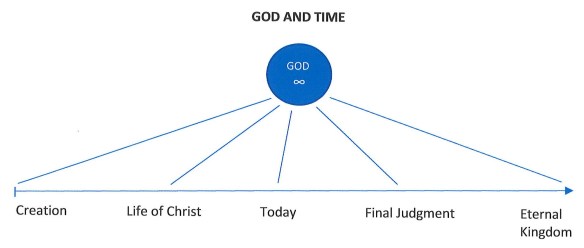
Here God is above time and exists in eternity (∞), but he sees all events and moments in time equally and vividly. He even sees everything that is happening in our eternal state (the arrow pointing on the left). As Hodge said, above, “With Him [our] duration [in time] is an eternal now.” But God interacts with humans in time and reveals himself to us in time. God is eternal and personal, so we can relate to him.
2.. God made the universe and time, but who made God?
God has no beginning; therefore he has no creator. This teaching of Scripture is clear. Since they asked, let the skeptics come up with evidence and arguments for a “god” existing before the biblical God.
3.. How old is God?
He is infinite and eternal. God never gets older. No one can add a minute, day or year to him. Such is the nature of infinity or eternality.
4.. Will redeemed humans exist in time, even in the eternal kingdom?
Yes, we are finite creatures and will experience moments in sequence.
Revelation speaks of time passing in heaven. Nations “walk,” (21:24), and this means one step after another. The twenty-four elders will throw their crowns at Jesus’s feet (4:10), and this means one moment after another, as the crowns go through space. The tree of life will yield fruit each month (22:2). Clearest of all, heaven experienced a half hour of silence (8:1). And we will reign forever and ever (22:5).
F. How can I know the eternal God more deeply?
Let’s first quote a deep Scripture: “For our light and momentary troubles are achieving for us an eternal glory that far outweighs them all” (2 Cor. 4:17). God invites us to have an eternal perspective, as much as he gives us grace to have it.
To answer that question, we have to talk about human pain down here in our earth-bound existence, where accidents and disease and death happen.
In the same chapter, Paul writes that he experienced all sorts of troubles: “We are hard pressed on every side, but not crushed; perplexed, but not in despair; persecuted, but not abandoned, struck down, but not destroyed” (2 Cor. 4:8-9). He too went through tough times.
What happens when we go through awful times? Let’s take the worst example of all—when parents have to bury their young child. They simply have to come to grips with the biblical truth that their child slipped off his earthen “pajamas” (his body) and now has a spiritual body. He lives in the everlasting kingdom. He is happy and joyous and is leaping and playing, and best of all Jesus has welcomed him. Their child is very eager to see his parents in his eternal existence and enjoy their company forever. It would be an eternal disaster if the parents became so bitter against God that they would snub him and never see their child in heaven.
Their child is currently experiencing the “eternal glory that far outweighs” all his former troubles and his parents’ present troubles. Their child is more alive and happier than he could ever be on earth.
Here is sound advice. Paul writes: “So we fix our eyes not on what is seen, but on what is unseen, since what is seen is temporary, but what is unseen is eternal” (2 Cor. 4:18).
One more verse immediately after v. 18: “For we know that if the earthly tent [our body] we live in is destroyed, we have a building from God, an eternal house in heaven, not built by human hands” (2 Cor. 5:1).
Our human bodies can be destroyed with disease and accidents and death, but never our heavenly bodies.
Therefore, stay close to God and keep an eternal perspective, and then we will not get bitter against the eternal God who loves us. This earthly existence is not final.
RELATED
What Do Words ‘Eternity,’ ‘Eternal’ Fully Mean in the Bible?
BIBLIOGRAPHY
 Dr. Jim's Essential Bible Teaching