Recall from the Introduction to Theology 101 that Theology Proper means studying God as he is in his essence and attributes and the Trinity. So we could title this post and the next eleven, Theology Proper. But let’s avoid complications and call this long section Doctrine of God. This post has a table of his attributes.
We need to know God. He is the Creator and we depend on him for our existence. The blessing is that he wants us to know him, so he revealed himself in Scripture and nature. So who is he, as we scan the Scriptures for hundred or thousands of verses throughout Theology 101?
I write to learn, so let’s learn together.
Word of encouragement: Don’t feel frustrated if you have to read this post several times before it “clicks.”
I. Quick Definitions
A. Attribute
In general terms, an attribute, divine or otherwise, is a property, characteristic, proper quality.
“Proper” here means belonging particularly to someone or something, e.g. eternality belongs only to God; it is strictly limited or proper to God. In God, attributes are of a much greater magnitude than we humans have, and some we cannot share.
B. Essence
It describes what a thing or being is in its true identity. It is indispensable and intrinsic to the thing or being. If you take away this necessary quality that defines it, it would cease to be that thing or being.
We will learn that all the attributes of God are his essence. If you took one away, God would diminish and not be the true God. For example, don’t take away his attribute of eternality, because God would cease to be God as we understand him from Scripture.
Let’s expand on this huge idea.
II. Essence
A. What it is
It is a property, characteristic, or proper quality that is essential to God. It defines who he is.
Some theologians do not use the term attribute, but prefer perfection. They have a point.
B. What it is not
The divine attributes or perfections are not accidents or incidental things that inhere in and are separable from and can be withdrawn from God. Rather, the divine attributes or perfections are the essence of God himself.
C. Attributes are identical with God’s divine nature
God is not a composite being, as if he had a body, soul, and spirit, but he is pure spirit. Therefore the attributes are not parts of God. But since they are identical with the divine nature, they are also equal to each other. They are unified by God. So one attribute is not better or worse or more important than the other. All God’s attributes are his essence. Without even one, he would cease to be God and become a demi-god or a pagan god.
D. God’s attributes and existence
God is eternal, so his attributes are eternal. Nothing is prior to God, and his essence and existence are inseparable, so his attributes are identical with his existence.
His attributes or perfections are not distinct from the divine essence. But they are predicated of God. His self-existence is his attribute that separates us from him.
III. Attribute
A. What it is in humas
It is an incidental property of a thing. It is attached to a thing and can be withdrawn from it without substantial change or alteration. It is contingent.
B. Example
What is the essential nature of a human? It cannot be this or that hair or eye color. If they vary, then his essence does not cease. They are “accidents.” He can exist without them.
C. Contrast with God
In contrast, in God, his attributes are not incidental, but essential. As I keep stressing, if an attribute like love or justice were withdrawn, then he would not be God (he would be a demi-god or something like it). His existence and attributes are identical to his existence.
IV. What Theologians Say
A. Herman Bavinck:
Every attribute is identical with God’s being. God is what he has. When we speak about creatures, we distinguish variously between what they are and what they have; e.g. a human being remains a human being even though he has lost the image of God and has become a sinner. But when we speak about God, we must maintain that each of his attributes is identical with his being. God is all light, all mind, all wisdom, all logos, all spirit, etc. … Whatever God is, he is completely and simultaneously. God has no properties but is merely his essence, God’s properties are really the same as his essence: they neither differ from his essence, nor do they differ materially [relationally] from one another (Doctrine, p. 121, emphasis original)
B. John Frame
“Nor is he [God] made up of substance and accidents, because there are no accidents in him. Since God has no accidents, everything in him is essential to his being, in a sense, his essence.” (Systematic, p. 429).
C. Millard Erickson
He is clear about God’s and man’s attributes:
The attributes are permanent and intrinsic qualities, which cannot be gained or lost. Thus, holiness is not in this sense an attribute (permanent, inseparable characteristic) of Adam, but it is of God. God’s attributes are essential and inherent dimensions of his very nature. (p. 236)
All of his attributes = his essence = his existence.
Erickson again:
It is better to conceive of God’s attributes as his nature, not a collection of separate parts or an addition to his essence. Thus, God is love, holiness, and power. These are simply different ways of viewing the unified being, God. God is richly complex, and these conceptions are merely attempts to grasp different objective aspects or facets of his being” (ibid.).
V. God’s Incommunicable Attributes
A. Brief intro.
Lutherans call them “negative attributes” because they are his attributes that no (negation) relation to the world or his creation or to humans, for example, eternity, simplicity, and infinity. They are God’s alone. He does not (negation) “communicate” or “share” them with us.
Positive attributes are those that yes (positive), God shares them in a lesser sense with humans e.g. (holiness, righteousness, truth, power), though God has these in greater magnitude. (Franz Pieper, Christian Dogmatics, vol. 1, pp. 428-37).
I will follow the classification that Wayne Grudem laid out, which apparently reflects Reform theology, since Lous Berkhof classifies attributes in the same way.
Communicable and incommunicable (note the –in before communicable, which is a negation)..
Lutheran and the Reformed classifications are not far off.
B. Scriptural language and accommodation
The reason God’s essence and attributes are identical because he is infinite and above space (1 Kings 8:27) and time (Ps.90:2, 4). There are no parts in God because we should not ascribe finitude to the infinitude God and erase the differences between God and people.
However, God does accommodate his attributes to our small minds, so we can grasp who God is. The Scriptures do seem to indicate the essence and attributes are separable. Example: the Bible says, “God is love” (1 John 4:8, 16). This gives the impression that love is the core of God’s essence, a deeper kind of essence within a larger essence.
However, God does not have two or more essences. We have to use theological logic to analyze who God is–infinite–and draw conclusions from this.
Result: God’s essence and attributes are identical in him. One attribute is not more important or deeper in God than the other ones (Pieper, Christian Dogmatics, vol. 1, pp. 428-30).
Once again, if God lost one of his attributes, he would cease to be the God of the Bible. Don’t take away, for example, his attributes of holiness, righteousness or infinitude. Or if one attribute were more important than the others, then he would be in parts and not simple–two or more essences, which makes no sense because you are violating the meaning of essence. He would be like the Greek gods, who have different attributes or some that are more important or missing in the gods and goddesses.
Our knowledge of God would devolve and get unclear and messy.
C. Examples
Here are some attributes that humans cannot have, but only God does:
Self-existence (God does not depend on or need anyone or anything)
Immutability (unchanging)
Simplicity (pure spirit, without parts)
Eternity (humans have a beginning; God does not. He transcends time; humans do not)
Omnipresence (he transcends space, and he is everywhere, but not confined to or held down in nature).
D. Why they are incommunicable
As noted, those attributes or perfections are called incommunicable because we do not share in them. However, sometimes the incommunicable ones are shareable, in part. For example, he grants us everlasting life or eternity. But he has always existed; we have not. He does not have a beginning, but we do. So his sharing of it is only partial and incomplete.
We can still share one or two these attributes in a small, faint sense, so the “incommunicable” attributes do not have a high wall built around them. That’s why some theologians don’t use the categories communicable or incommunicable. But we do here, just for convenience and to inform the reader that the idea of incommunicable attributes is taught by some theologians.
Maybe I should just say that these attributes that are incommunicable describe God in himself, and leave it at that.
VI. God’s Communicable Attributes
A. He can communicate or share them
And then there are attributes that are communicable with us, since we are created in his image.
B. Here are samples:
Knowledge, wisdom and power;
Goodness, love, and mercy;
Holiness, righteousness, and justice.
VII. Different in God and Us
A. God’s attributes exist with absolute perfection.
If they did not, but he needed to improve, then he would not be God. He would be imperfect. (He would be a Greek god, for example.)
But his mercy shown to us when needed is perfect, unchanging, and complete.
B. Contrasts with humans attributes
We humans, on the other hand, can improve or get worse. Sometimes we are merciful, other times we are not, even though it may be needed.
C. The Trinity
As to the Trinity, the Father, Son, and Spirit have all these attributes, essentially, in their nature, not haphazardly or inconsistently or part-time (accidentally).
Frame:
So God’s attributes are not parts or divisions within the Godhead … but each attribute is necessarily to God’s being. But each attribute is necessary is necessary to God’s being. Each is essential to him, and therefore his essence includes all of them. God cannot be God without his goodness, his wisdom, his eternity. In other words, he is necessarily good, wise, and eternal. None of his attributes can be removed from him, and no new attribute can be added to him. (429).
D. Summary
In God, these attributes or perfections or characteristics are essential to his existence, and they are perfect, without diminishment or inconsistency.
In us humans they are parts; some attributes in some people are lacking, others strong, others weak—they are not essentially human.
VIII. Illustrations of God’s Attributes
A. Brief intro.
The images are adapted from Grudem (pp. 212-13)
B.. Small circles represent attributes
Each small circle is an attribute like justice, eternity, love, holiness, omniscience (all knowing), wisdom, and so on. Here, God’s attributes are depicted as a mere collection:
Not this:

That illustration does not work because they have no unity within one Being, God. They are not ingredients in a recipe.
C. A big circle and added-on attributes
In the next illustration, God is the big circle, and they are added and attached to God’s being:
Not this:

This illustration falls short because God is all his attributes; they are not add-ons.
D. Better illustration
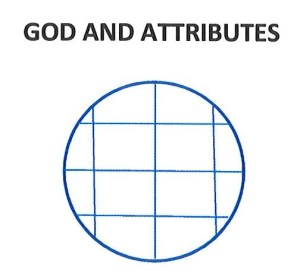
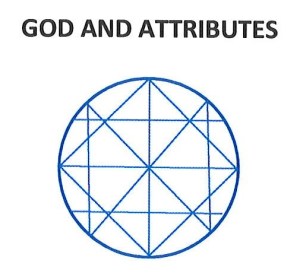
Let’s say the three horizontal lines represent God’s love. Why three? Father, Son and Holy Spirit.
These are right:

Next, let’s say the vertical lines represent God’s justice:
Let’s keep going. The diagonal lines represent wisdom:

Finally, the other set of diagonal lines represents his holiness:
We could go on with the other attributes, but the point has been made.
Each one qualifies the other. God is completely and absolutely and simultaneously loving; he is completely and absolutely and simultaneously just; he is completely and absolutely and simultaneously wise; and he is completely and absolutely and simultaneously holy. He never sheds one or gains another. He is completely and absolutely and simultaneously all his attributes. And they are contained within the One or Unitary God.
The three lines remind us that the Son and the Spirit share the same divine attributes in their essence—but don’t take it too far, because two lines are shorter than the other! (A square would have worked better if that was the purpose of this post.)
E. Important Question
If God is one and indivisible, how can there be three?
Answer: God is one and indivisible in his being and essence, but he is three persons—”being and essence” and “persons” are different terms and realities. So there is no contradiction.
IX. Application
A. God is wholly Other
You can know him better because you can distinguish between him and you. You are filled with accidental properties—the colors of your hair, skin, and eyes; your height and girth (which changes!). You have many of his attributes, but in weak and imperfect forms or expressions.
B. He is who he is.
But God has no accidental properties in him. He is who he is. He does not change in his essence or being; you do. He is the Creator; you are the creature. You worship him; he does not worship you.
C. He shares some of his attributes.
You know God better because you need more of God to let his character grow and develop in you.
D. Incarnation
We will discover later in Theology 101 that the heavenly and eternal Son of God was incarnated (made flesh). Was he God in the flesh? Yes, he was the God-man. He added a human nature to his divine nature.
Was he born with all of the attributes of the Father? If we say he was God in the flesh, then he was born with them. So, yes.
Did he exercise them when he was a child? No. Then what happened to all the divine attributes? The Father managed them. He wanted his Son to grow up fully experiencing his human nature.
Then what about all the divine attributes when he was empowered by the Spirit and was doing the work of the ministry? The Father and the Son managed them together.
One theologian offers this human illustration. Imagine a safety deposit box that can be opened only by the bank manager and the customer who owns the box, at the same time. So it was with the Father (the bank manager) and the Son (the customer). The Father and the Son cooperated to let his divine nature shine at the right time. One example: Jesus at the Mount of Transfiguration.
But the dominant image of the four Gospels is that Jesus worked his miracles by the Spirit and his anointing, as the Anointed One. But the Father was also with him (Acts 10:38).
[…] how God anointed Jesus of Nazareth with the Holy Spirit and power, and how he went around doing good and healing all who were under the power of the devil, because God was with him. (Acts 10:38)
Please note that this verse is Trinitarian: God (the Father), the Son, and the Holy Spirit. They cooperated together for the Son to complete his earthly mission. The three persons of the Trinity were involved in the rescue plan of redemption and salvation.
Now let’s look into God’s attributes.
Addendum: Table of Attributes
They are the attributes included in this section of Theology 101: The Basics
|
Table of the Attributes of God |
||
| Doctrine of God: Essence and Attributes of God | ||
| Attribute | Brief Definition | |
| 1 | Aseity: Self-existence or independence | He is independent of his creation, self-sufficient in himself, cannot not exist, uncaused, without beginning or end and remains eternally the same for his people. |
| 2 | Immutability: Unchangeable and Consistent | He is unchanging, unchangeable, consistent, forever the same, undevelopable, without self-evolution, and constant, yet active with his creation, particularly with humankind. |
| 3, 4 | Infinite and Personal | God is limitless, for his universe does not contain him or restrain him, yet he is personal and relates to his creation, particularly humankind. (Louis Berkhoff) |
| 5 | Simplicity or One | God is a unity, undivided in parts and non-composite. |
| 6 | Eternity | God is outside created time and is everlasting, without beginning or end, without a succession of moments, one after another, and all things are eternally present before him. |
| 7 | Omnipresence: Everywhere | God is everywhere because he is Spirit and does not exist in parts, here or there, and he is not confined by the universe nor is he the universe. |
| 8 | Omnipotence | God is able to do everything out of his sovereign free will and according to his nature. |
| 9 | Omniscience | God knows everything about every thing, past, present and future, actual or possible, and nothing is unknown and hidden from him. |
| 10 | Omnisapience | God is all wise. His knowledge of everything enables him to apply it to bring about his goals. |
| 11, 12 | Sovereign and Free | God’s sovereign free will means that he exists in himself, delighting in his existence, and is the foundation of our existence. |
| 13 | Perfection | God is absolutely and totally complete and entire and whole—not broken or incomplete or deficient in his nature or being. |
| 14 | Blessed | God takes calm delight in all his being and excellencies and attributes. He blesses his creation. |
| 15 | Glory | God is radiant and awesome in splendor and light, honor and dignity, and fame and renown. He shines it on his creation and people. |
| 16 | Majesty | God’s majesty consists of unsurpassed greatness, highest eminence, unparalleled exaltation, and unmatched glory. (Norman Geisler) |
| 17 | Beauty | God’s attribute of beauty is the perfection and summation of his goodness and all desirable qualities in him, and it shines through his glory and light, producing awe and delight and inner beauty in the beholder. God’s beauty transforms everything it touches or claims, for the better. It makes a human morally good. |
| 18 | Spirit | God is spirit, unextended, unlimited by space, and nonphysical. |
| 19 | Invisibility | God is Spirit, not physical, and cannot be seen with human eyes. |
| 20 | Love | God is totally committed to his people. He deals kindly and mercifully and generously with humankind. |
| 21 | Goodness | God is morally upright, and kind and generous and bountiful with his people. |
| 22 | Graciousness | God gladly shows his unmerited goodness or love to those who have forfeited it and are by nature under a sentence of condemnation. |
| 23 | Compassion or Mercy | God takes pity on, shows love for, and is moved to help his people, when they suffer or are in trouble or need and do not deserve them. |
| 24 | Wrath | Out of his love and justice combined, God judges and punishes consistent and regular law-breaking and destructive sin. Wrath is judicial. |
| 25 | Jealousy | God is shows loving zeal and a righteous sense of urgency to protect his people and his covenant. |
| 26 | Peacefulness | God is calm, in control, and orderly, separate from all confusion and disorder. All his innumerable actions reflect his order, calm, and full control. |
| 27 | Patience | God is willing to wait for us to catch up to his moral law and show mercy and not judgment, despite our provoking him and breaking his law. |
| 28 | Holiness | God is completely distinct and separate from the ordinary and profane and common, and he reaches out to people to separate and save them from evil. |
| 29 | Righteousness or Justice | God is the ultimate standard of just and right actions, and he is the ultimate judge of unrighteousness and injustice. |
| 30 | Truthfulness or Faithfulness | God is stable, dependable, faithful, integrous, honest, accurate and completely veracious. |
| Table of God’s Names, Titles, and Activities | ||
| For the references to the theologians and the Scriptures, please click on the links. | ||
RELATED
Sec. 3, 1 Doctrine of God: Essence and Attributes of God.
8 Love, Goodness, Graciousness, and Compassion
14 God’s Names, Titles, and Activities
BIBLIOGRAPHY
 Dr. Jim's Essential Bible Teaching