The Trinity is completely biblical, for the Bible teaches us about the Father, the Son, and the Holy Spirit. We have a relationship with each person. Let’s see how.
Don’t feel frustrated if you have to read this post several times. Tough ideas are difficult in the first, second or third rounds of study—or more rounds! But gradually you will get it.
I. Introduction
A. Basic teaching
This post is about God in himself. The doctrine of the Trinity teaches that one God exists in three persons who fully and equally have the same essence or being.
Three statements
1.. There is one God.
2.. Three persons (Father, Son, and Holy Spirit)
3.. Each person is God. (Williams, vol. 1, pp. 83-90)
Explanation:
1.. The Scriptures clearly teach that God is one. Even Jesus says this (Mark 12:29).
2.. Many Scriptures affirm the existence of the Father, the Son, and the Holy Spirit.
3.. The Scriptures teach that the three persons are equally and fully deity or God
See Addenda One and Two, at the very end of this post, for their attributes and roles to support the third statement. We will show the Son’s deity and humanity more fully in the section on Christology (doctrine of Christ), and the Holy Spirit’s deity in the section Pneumatology (doctrine of the Spirit).
Fuller explanation:
Thus the Father is totally God, the Son if totally God, and the Holy Spirit is totally God: there is no depth, width, or breadth of the divine reality [God-ness] that is not fully Father, Son, and Holy Spirit. […] Hence. Father, Son, and Holy Spirit are the same essence. To use the language of the Nicene Creed (A.D. 325) they are homoousios. [homo = same; ousios = essence]. Thus the Father, Son, and the Holy Spirit, while differing in their personality, do not differ essentially. The whole undivided essence belongs to each of the three persons (Williams, vol. 1, pp. 90-91)
Translation: The Father, Son and Holy Spirit fully and equally have the same essence (being) as the one God.
Expanded explanation: This means that God exists in the distinct persons of the Father, the Son, and the Holy Spirit, but they equally have the same fully divine, undivided essence or being, such as uncreatedness, eternality, simplicity (pure spirit, non-composite or indivisible), immutability (unchangeableness), omniscience (all-knowing), omnipotence (all-powerful), goodness, mercy, holiness, will and freedom, and so on.
B. Attributes that relate to God
In God, the attributes of his essence are fully possessed by three persons, making each person fully God.
For God, essence and existence are identical; his attributes are essential to his existence (Evangelical Dictionary of Theology, p. 344).
In contrast, we humans exist and express certain attributes, but to be ignorant of something does make us less human. We are not omniscient. But in God, his attributes are perfect, never lacking, never accidental, never uneven, and never inconsistent. God would not be God if he were ignorant even to the slightest degree.
Reformed theologian Louis Berkoff:
The divine essence is not divided among the three persons, but is wholly with all its perfection in each one of the persons, so that they have numerical unity of essence (p. 88).
The three persons wholly possess the same essence, the same “Godness.” That is, the Father and Son and Holy Spirit share the same attributes. The Father, the Son, and the Holy Spirit are equally wise and merciful and holy; one is not more wise or merciful or holy than the other. In that quotation, “numerical” means only one.
Simplest definition of all: Three persons are contained in One God—Triunity. We will look at an illustration, below (one triangle within one circle).
Once again, see the two addenda at the very bottom, for the attributes and roles of the triune God.
C. The three persons are distinct.
They are separated in this way: The Father is neither the Son nor the Holy Spirit; the Son is neither the Father nor the Holy Spirit; and the Holy Spirit is neither the Father nor the Son. The difference is in their personhood or subsistence (Father, Son, and Holy Spirit). Only the Father begets and is not begotten. God does this by necessity. It is not optional. It is in his nature. And his begetting is eternal, since it is in his essence to beget or generate. So the the property that belongs to the Father is generation.
Only the Son is begotten and does not beget. He receives his personhood (Sonship) eternally. This property is called filiation. To simplify “begottenness,” just think of a divine, eternal Father-Son relationship. This relationship existed for eternity, never beginning and never ending.
Only the Spirit proceeds or spirates from the Father and the Son. The Spirit does not do the works that the Father and Son do (begets or is begotten). And this spiration is eternal, since it comes from the essence of of the Father and the Son. And his procession is always occurring and will never end because it is in the essential nature of God to spirate. Therefore the property belonging to the Spirit is spiration or spirated.
Thus it is important to keep the three persons distinct. If they never were distinct, then there would be no difference in how the three persons interrelate. In other words, without these distinctions their personhoods would blur and fuse together (“con-fusion”). But each person is fully God and has all the attributes of God.
And we will see their distinctiveness in their roles in creation and redemption.
D. Summary: God’s oneness in essence, in three distinct persons.
The three persons (Father, Son, and Holy Spirit) are equally of the exact same essence of one God. But this one God revealed himself throughout Scripture as three distinct persons—Father, Son. and Holy Spirit—who are never fused together.
In understanding the basics, it is crucial keep persons and essence clear. There are three persons who are fully of the one essence of one God.
Once again, the best single word to describe God is Tri-unity or three persons in one essence or Godness.
II. Key Terms
A. Source of the word Trinity
It comes from the Latin word trinitas, meaning “threeness.” Another word is Tri-unity, which means “three in one.”
Fuller meaning of Triunity: Three persons fully and equally share one essence and so car contained within one God.
B. The word Trinity and the Bible.
The word itself is not found in the Bible. The New Testament authors were engaged in other issues, like church life and salvation for Jews and gentiles. However, they assumed the reality of the Trinity, which is greater than a label.
C. The words essence and substance and being are interchangeable.
For our purposes they are interchangeable, but some theologians, like Berkoff (p. 87), explain the fine nuances between the three terms. But let’s not get into them since this post is basic.
In this post I almost invariably use essence.
The meaning of essence is as follows:
God’s constitutional nature or his fundamental nature (Berkoff p. 87).
Evangelical Dictionary of Theology: “An essence consists in a thing’s most basic properties, what it is most fundamental” (p. 279).
Norman Geisler:
By essence or nature is meant what something is, and essence is a set of characteristics—properties necessary to the thing … For example, it is necessary to the essence of a triangle that it has the following characteristics:
(1) It must have three sides
(2) It must have three corners or angles
(3) The sum of the three angles must be 180 degrees (p. 550, emphasis original)
Without those three properties, a triangle would not be a triangle, but something else. So now we can distinguish it from a square or a circle, for example.
Webster’s dictionary: “ultimate nature of a thing.”
D. Meaning of the word subsistence
It means God existing as Father, Son and Holy Spirit and how they operate between themselves and in relationship with humankind. It is a rough synonym for existence.
Berkoff again:
To denote these distinctions [between God’s three persons] Greek writers generally employed the term hypostasis, while Latin authors used the term persona and sometimes substantia. Because the former was apt to be misleading and the latter ambiguous, the Schoolmen [Medieval scholars] coined the word subsistentia (p. 87).
Bottom line: subsistence can be often swapped out for person, and vice-versa, for our purposes here. For this post it is synonymous with their personhoods or personalities.
E. The meaning of person
A living being who thinks, feels, and wills.
Geisler:
Personhood is traditionally understood as one who has intellect, feelings, and will. All three characteristics are attributed to all three members of the Trinity in Scripture. Essentially, personhood refers to an ‘I,’ a ‘who,’ or a subject. Each ‘I’ in the Trinity possesses (by virtue of its one common nature) the power to think, feel, and choose. Personhood itself is the I-ness or who-ness. (p. 541)
Translation: person means ‘I’ or ‘who,’ a living being, as distinct from a thing that can’t feel, think, or choose. It means one who has mind, feelings, and will. All three persons of the Trinity have them.
F. Summary of the uses of the terms
The person of Jesus is fully God and unlike us, and he is fully human and like us (except without sin). Those two natures come together to form one person or being. Theologians usually stick with person: Christ is two natures in one person. Or this is equivalent and acceptable: Christ is two natures in one being.
I like how theologian Adam Harwood simplifies things:
|
Essence and Persons |
|
| Western Church (Latin) | Eastern Church (Greek) |
| Substantia (substance) | Ousia (essence) |
| Personae (persons) | Hypostaseis (persons) |
| Harwood, p. 150, adapted. | |
For more information and a more detailed table, please go here:
And scroll down to II.F.
G. Meaning of the Godhead
It is an old term for divine being or nature. It is often employed to show the divine nature with the three persons.
H. Meaning of the term ontological Trinity
Ontos means existence, and in this case it is used for the Trinity as he exists necessarily and eternally, apart from creation and humanity. It is what God essentially is, in his nature and in relation to the three persons—Father, Son, and Holy Spirit.
I. Meaning of the term economic Trinity
The term economic is used in its old sense, “ordering of activities.” It was used in the household, as well, ordering the full activities there. Word origins always help me. It comes from the Greek term oikoumenē (pronounced oi-KOO-meh-nay), which means “inhabited world.” So picture God reaching out to the world by creating and redeeming its inhabitants.
It is the Trinity in relation to his creation and humanity, including the roles each person plays in redemption and providence.
So it describes the roles that the three persons have, while ontos (see Letter H) describe God’s essence. The three persons have different roles but share the same essence in perfect unity.
III. Illustrations
A. Relational illustration of the Trinity
Nothing is more relatable to us humans than love.
Augustine (354-430 AD) comes up with this deep analogy: the lover, the beloved, and love. At the baptism of Jesus, the Father says that he loves the Son, and at that very moment, the Spirit descends and rests on Jesus (Matt. 3:16-17). Augustine seems to say that the Father loves the Son, who receives his love and returns it, for example, in his willingness to obey the Father and die on the cross, while the Spirit communicates the love between them.
This image of a triad of love expresses how the Father, the Son, and the Holy Spirit existed before the creation of time and the universe, and how the three persons will forever exist. It is into this love that the Trinity welcomes all believers and all who have received the love of God, through Christ and by the power of the Holy Spirit. (The Trinity Books VIII.14; IX.2, and XV.10)
The verses “God is love” (1 John 4:8 and 16) now take on a much, much deeper meaning.
In contrast, the strict unity of God seen in Islam or Judaism, for example, does not make sense in terms of the love of God, because divine love amounts to self-love. This is deficient.
Back to Augustine. His analogy is profound, because we have all experienced love from a lover, and we have returned the same love. All illustrations are inadequate, and this one still does not explain how, in detail, the one God shares this divine attribute of love and the other three persons. Our human love is but a poor reflection of divine love.
B. Images to illustrate the Triunity
1.. Grudem produces this one (p. 321):
ONE GOD IN THREE PERSONS

Note how the three persons Father (F), Son (S), and Holy Spirit (HS) are located in one circle—God. The dotted lines merely indicate their personal relationship, not a division in God. They interpenetrate each other yet maintain their distinctive persons.
2.. Here is an ancient representation of the Trinity (Moody p. 207).
This image has existed for centuries. You may need to study it for a while.

Note that God and the three persons are within the triangle, which symbolizes their unity. God is in the center, which symbolizes their one essence. It says the Father is not the Son, and the Son is not the Spirit, and the Spirit is not the Father, and so on. But all three persons are one God in the center.
3.. Geisler suggests a simple triangle (p. 551).
It possesses a simultaneous threeness in its oneness. I expand on this idea, next.
4.. The next illustration also works.
The circle represents one God or unity or monotheism. The triangle symbolizes three persons: Father Son, and Holy Spirit: plurality or threeness.
Circle = One God = Unity = Monotheism
Three Sides of Triangle = Three Persons (Father, Son, Holy Spirit)
= Plurality or Threeness
Here is the triangle within the circle, representing:
ONE GOD IN THREE PERSONS

Note how the three persons of the Father, the Son, and the Spirit are all contained within one God and share the same space (or nature) within the circle. All three persons have the same “Godness” or deity within the circle (one God).
Placing a triangle within a circle is not a contradiction or even odd. It does not damage either geometric shape.
So this is Trinitarian (plurality) monotheism (unity).
C. Sunlight
Athanasius (c. 296-373 A.D.) uses the radiance of the sun to express the Son being co-equal with the Father. The sun cannot help but radiate light–radiating light is in the sun’s nature. So the sun and light have the same essence or nature. Light proceeds from the sun. Likewise, the Father and Son have the same essence or nature, and the Son proceeds from the Father. So Athanasius described Jesus as Light (the Son) from Light (the Father)
Now what about the Spirit and the metaphor of Light? Athanasius did not deal with this topic (in his surviving writings that I’m aware of). But let’s try. It is also in the nature of the sun and its radiance to be hot. Heat proceeds from the sun and light. Heat has a different role, but it cannot exist apart from the sun and its light. Heat proceeds from the sun and the radiating light.
Here the analogy breaks down a little–as all analogies do–but the main point is clear. The sun and light and heat–three things–go together as one, though they have different roles. All three elements co-exist as co-equals; one cannot properly exist without the other two, by the nature of the one thing.
You can try this illustration with your children and newcomers. But as usual, let’s not push illustrations or metaphors too far.
IV. Three Persons in the New Testament
A. Brief intro
The Trinity is found in the Old Testament. Please see this article at my website drjimsebt.com:
The Trinity: What Does the Old Testament Say?
In this section let’s cite passages that formulate the Father, Son, and Holy Spirit. Verses that discuss Christ’s and the Spirit’s full deity will be covered in posts about Christ and the Spirit
B. Table of the Trinitarian verses
This table has verses where God (the Father), the Son (Jesus Christ) and the Spirit appear in the same verses. This proves that the Trinity is a true doctrine. We can never give it up. It is a sure thing that I left many verses back in the Bible.
|
Trinitarian Verses The Father (God), the Son (Jesus Christ), and the Holy Spirit Are Mentioned |
|
| 1 | As soon as Jesus came up out of the water, “he saw the Spirit [Spirit] of God [Father] descending like a dove and lighting on him. And a voice from heaven said, ‘This is my Son, whom I love and with him I am well pleased’” (Matt. 3:16-17). |
| 2 | But if it is by the Spirit of God that I [Jesus] drive out demons, then the kingdom of God [Father] has come upon you. (Matt. 12:28) |
| 3 | All authority in heaven and on earth has been given to me. Therefore, go and make disciples of all nations, baptizing them in the name of the Father, the Son, and the Holy Spirit […] (Matt 28:18-19) |
| 4 | At that time Jesus, full of joy through the Holy Spirit, said, “I praise you, Father, Lord of heaven and earth, because you have hidden these things from the wise and learned, and revealed them to little children. Yes, Father, for this is what you were pleased to do. (Luke 10:21) |
| 5 | Jesus answered, “Very truly I tell you, no one can enter the kingdom of God [Father] unless they are born of water and the Spirit. (John 3:5) |
| 6 | For the one [Jesus] whom God [Father] has sent speaks the words of God [Father], for God [Father] gives the Spirit without limit. (John 3:24) |
| 7 | But the Advocate, the Holy Spirit, whom the Father will send in my [Jesus’s] name, will teach you all things and will remind you of everything I have said to you. (John 14:26) |
| 8 | “When the Advocate comes, whom I [Jesus] will send to you from the Father—the Spirit of truth who goes out from the Father—he will testify about me [Jesus]. (John 15:26) |
| 9 | All that belongs to the Father is mine [Jesus] That is why I said the Spirit will receive from me what he will make known to you.” (John 16:15) |
| 10 | Again Jesus said, “Peace be with you! As the Father has sent me, I am sending you.” 22 And with that he breathed on them and said, “Receive the Holy Spirit. (John 20:21-22) |
| 11 | On one occasion, while he [Jesus] was eating with them, he gave them this command: “Do not leave Jerusalem, but wait for the gift my Father promised, which you have heard me speak about. 5 For John baptized with water, but in a few days you will be baptized with the Holy Spirit.” (Acts 1:4-5) |
| 12 | He [Jesus] said to them: “It is not for you to know the times or dates the Father has set by his own authority. 8 But you will receive power when the Holy Spirit comes on you; and you will be my [Jesus’s] witnesses in Jerusalem, and in all Judea and Samaria, and to the ends of the earth.” (Acts 1:7-9) |
| 13 | God [Father] has raised this Jesus to life, and we are all witnesses of it. 33 Exalted to the right hand of God, he has received from the Father the promised Holy Spirit and has poured out what you now see and hear. (Acts 3:32-33) |
| 14 | Peter replied, “Repent and be baptized, every one of you, in the name of Jesus Christ for the forgiveness of your sins. And you will receive the gift of the Holy Spirit. 39 The promise is for you and your children and for all who are far off—for all whom the Lord our God [Father] will call.” (Acts 2:38-39) |
| 15 | God [Father] exalted him to his own right hand as Prince and Savior that he might bring Israel to repentance and forgive their sins. 32 We are witnesses of these things, and so is the Holy Spirit, whom God has given to those who obey him.” |
| 16 | […] how God [Father] anointed Jesus of Nazareth with the Holy Spirit and power, and how he went around doing good and healing all who were under the power of the devil, because God was with him. (Acts 10:38) |
| 17 | […] the gospel he [Father] promised beforehand through his prophets in the Holy Scriptures 3 regarding his Son, who as to his earthly life was a descendant of David, 4 and who through the Spirit of holiness was appointed the Son of God in power by his resurrection from the dead: Jesus Christ our Lord. (Rom. 1:2-4) |
| 18 | For what the law was powerless to do because it was weakened by the flesh, God [Father] did by sending his own Son in the likeness of sinful flesh to be a sin offering. And so he condemned sin in the flesh, 4 in order that the righteous requirement of the law might be fully met in us, who do not live according to the flesh but according to the Spirit. (Rom. 8:3-4) |
| 19 | 12 And again, Isaiah says,
“The Root of Jesse [Jesus] will spring up, 13 May the God [Father] of hope fill you with all joy and peace as you trust in him [Jesus], so that you may overflow with hope by the power of the Holy Spirit. (Rom. 15:12-13) |
| 20 | And that is what some of you were. But you were washed, you were sanctified, you were justified in the name of the Lord Jesus Christ and by the Spirit of our God [Father]. (1 Cor. 6:11) |
| 21 | Therefore I want you to know that no one who is speaking by the Spirit of God [Father] says, “Jesus be cursed,” and no one can say, “Jesus is Lord,” except by the Holy Spirit. (1 Cor. 12:3) |
| 22 | 4 There are different kinds of gifts, but the same Spirit distributes them.5 There are different kinds of service, but the same Lord [Jesus]. 6 There are different kinds of working, but in all of them and in everyone it is the same God [Father] at work. (1 Cor. 12:4-6) |
| 23 | […] to be a minister of Christ Jesus to the Gentiles. He gave me the priestly duty of proclaiming the gospel of God [Father], so that the Gentiles might become an offering acceptable to God, sanctified by the Holy Spirit. (Rom. 15:15-17) |
| 24 | […] by the power of signs and wonders, through the power of the Spirit of God [Father]. So from Jerusalem all the way around to Illyricum, I have fully proclaimed the gospel of Christ. (Rom. 15:19) |
| 25 | “May the grace of the Lord Jesus, and the love of God [Father], and the fellowship of the Holy Spirit be with you all” (2 Cor. 13:14). |
| 26 | But when the set time had fully come, God [Father] sent his Son, born of a woman, born under the law, 5 to redeem those under the law, that we might receive adoption to sonship. 6 Because you are his sons, God sent the Spirit of his Son into our hearts, the Spirit who calls out, “Abba, Father.” (Gal. 4:4-6) |
| 27 | For through him [Jesus] we both have access to the Father by one Spirit. (Eph. 2:18) |
| 28 | But when the kindness and love of God [Father] our Savior appeared, 5 he saved us, not because of righteous things we had done, but because of his mercy. He saved us through the washing of rebirth and renewal by the Holy Spirit, 6 whom he poured out on us generously through Jesus Christ our Savior, (Titus 3:4-6) |
| 29 | It is impossible for those who have once been enlightened, who have tasted the heavenly gift, who have shared in the Holy Spirit, 5 who have tasted the goodness of the word of God [Father] and the powers of the coming age 6 and who have fallen away, to be brought back to repentance. To their loss they are crucifying the Son of God all over again and subjecting him to public disgrace. (Heb. 6:4-6) |
| 30 | […] have been chosen according to the foreknowledge of God the Father, through the sanctifying work of the Spirit, for obedience to Jesus Christ and sprinkling by his blood (1 Peter 1:2) |
| 31 | But you, dear friends, by building yourselves up in your most holy faith and praying in the Holy Spirit, 21 keep yourselves in God’s [Father’s] love as you wait for the mercy of our Lord Jesus Christ to bring you to eternal life. (Jude 20-21) |
| 32 | And this is his command: to believe in the name of his Son, Jesus Christ, and to love one another as he commanded us. 24 The one who keeps God’s [Father’s] commands lives in him, and he in them. And this is how we know that he lives in us: We know it by the Spirit he gave us. (1 John 3:23-24) |
| 33 | 21 To the one who is victorious, I [Jesus] will give the right to sit with me on my throne, just as I was victorious and sat down with my Father on his throne. 22 Whoever has ears, let them hear what the Spirit says to the churches. (Rev. 3:21-22) |
| 34 | This calls for patient endurance on the part of the people of God [Father] who keep his commands and remain faithful to Jesus. 13 Then I heard a voice from heaven say, “Write this: Blessed are the dead who die in the Lord from now on.” “Yes,” says the Spirit, “they will rest from their labor, for their deeds will follow them.” (Rev.14:12-13) |
| I got this idea from Harwood, pp. 147-49, but expanded on it. | |
C. Summary
The readers should look up these verses: John 1:1-4, 14:26, 15:26, 16:13-14, 20:25-27; Acts 10:38 in connection with Romans 9:5, 15:13; 1 Corinthians 12:4-6; Colossians 2:9; Hebrews 1:3, 1:8, 1:10; Titus 2:13; 2 Peter 1:1; Jude 20-21.
Each passage affirms the person and function of the Father, the Son, and the Holy Spirit, and sometimes just the Father and the Son.
V. Professional Theologians
A. First, a word of encouragement
Don’t feel frustrated if you have to read this post several times. Tough ideas are difficult in the first, second or third rounds of study—or more rounds! But gradually you will get it.
B. Elmer L. Towns
Christians believe in one God in three persons: Father, Son, and Holy Spirit. Each member of this Trinity is God and works in our lives as Christians. As God, each is worthy of our worship and deserving of our obedience. They have revealed themselves and what they expect of us in the Bible. The desire of every Christian ought to be to love, worship, and obey the Triune God (p. 99)
Translation: God is one in essence (monotheism) and reveals himself in Scripture in three persons (Trinitarian monotheism). Our response to the Father, Son, and Holy Spirit living, acting and moving in us as one God is to love, worship, and obey him.
I hope people memorize Town’s short paragraph, especially the first sentence.
C. Pentecostal theologian French Arrington:
God is a unified being. There is not just one but three persons in the Godhead. There is the Father who is the Creator and source of all things. There is the Son who redeems us. There is the Holy Spirit who regenerates, sanctifies, and fills us with His power. Each has his own identity. The distinct identity of each was evident at the baptism of Jesus. The Son of God was standing in the Joran [River]. He was anointed by the Holy Spirit, who came upon Him in the form of a dove, and the Father spoke from heaven (Luke 3:21, 22). (vol. 1, p. 137)
Translation: One God in three persons—Father-, Son, and Holy Spirit—who share the same essence but have different roles in relating to their creation.
D. Louis Berkhof:
It is generally admitted that the word “persons” is but an imperfect expression of the idea [of the Trinity existing as the Father, Son, and Holy Spirit]. In common parlance it [“person”] denotes a separate rational and moral individual, possessed of self-consciousness, and conscious of his identity amid changes. Experience teaches that where you have a person, you also have a distinct individual essence. Every person is a distinct and separate individual, in whom human nature is individualized. But in God there are three individuals alongside of, and separate from, one another, but only personal self-distinctions within the Divine essence … which is one. (p. 87)
Translation: If you stand Abraham, Isaac and Jacob next to each other, they are separate persons and do not have a united, single essence, certainly not in the way that God does. The trinitarian God does manifest or reveal himself in three persons, Father, Son, and Holy Spirit, but they have the identical essence (one God), which three humans persons cannot have. So the term person is inadequate, but it will have to do.
E. Presbyterian-Charismatic Renewal theologian J. Rodman Williams
God is one … in three persons … Father, Son, Holy Spirit … each person is God … One God in three persons … The persons of the Godhead are distinct,
Then he writes fully:
The Father is God, the Son is God, and the Holy Spirit is God. There are not three Gods, but only one. Christian faith is not tri-theistic. The Father is the one and only God, so likewise are the Son and Holy Spirit. Thus the Father is totally God, the Son is totally God, and the Holy Spirit is totally God: there is no depth, width, or breadth of the divine reality that is not fully Father, Son, and Holy Spirit. … Hence, Father, Son and Holy Spirit are the same essence. … Thus Father, Son, and Holy Spirit, while differing personally, do not differ essentially. The whole undivided essence belongs to each of the three persons. (vol. 1, pp. 83-90)
Translation: One God in three persons—Father, Son, and Holy Spirit—who share the same essence or nature in totally, yet the three persons are distinct in their roles and relationships.
F. Reformed theologian James I. Packer:
The historic formulation of the Trinity (derived from the Latin word trinitas, meaning “threeness”) seeks to circumscribe and safeguard the mystery (not explain it; that is above us) and it confronts us with perhaps the most difficult thought that the human mind has ever been asked to handle. It is not easy, but it is true (p. 40)
Translation: Defining the threeness of God seeks to protect it from bad teaching, not explain it fully. Explaining it completely is beyond us, but the doctrine is true.
G. Evangelical Dictionary of Theology:
This doctrine is above reason but not contrary to reason, though there have always been Christians who enjoyed stating it as a stark paradox (“God is three yet somehow one,” omitting the clarifying nouns). The mystery of the doctrine of the Trinity lies in the difficulty of conveying how a single being can be three persons, because we have no available examples of such a thing, and any such examples would not be God anyway.
Translation: Some Christians seem to delight in being simplistic about it and leave out certain nouns. It is correct to say, “God is three persons, yet somehow one being.” Different terms in italics. We are bereft of examples of how that can happen, so the Trinity appears to be a mystery to us.
VI. Roles in Creation and Redemption
A. Three persons must be kept distinct.
Three persons equally and fully share the same one essence as one God. In their roles and functions the Son was subordinate to the Father, but in their essence, they are equal.
B. How the Scriptures reveal the three persons as distinct
They are distinct in their relationship with each other (Father, Son, and Holy Spirit) and in their function or role in creation and in the plan of redemption and salvation, to name only those areas.
C. Work of creation
The three persons of the Father, the Son, and the Holy Spirit had different functions. God the Father spoke the world into existence (Gen. 1-3), but God the Son carried out the divine decree. The Gospel of John says of Jesus: “All things were made through him [Jesus], and without him was not anything made that was made” (John 1:3). God the Holy Spirit was active in creation, “brooding over the face of the waters” (Gen. 1:2; see also Psalms 33:6 and 139:7).
D. Redemption and salvation
The three persons have different roles or functions. God the Father planned the redemption, but the Son was involved in the planning too. God sent the Son into the world to carry out the plan of redemption. Yet the Son was involved because he was willing to go. He obeyed the Father and died on the cross for our sins. Neither the Father nor the Holy Spirit carried out this part of redemption. The Holy Spirit was sent by the Father and the Son (John 14:26 and 16:7) to apply the plan of redemption to the heart of each person who believes and receives it. The Holy Spirit also purifies and sanctifies us or makes us holy in our daily lives.
And so we see that in the creation and redemption, the Father sends and directs the Son (Eph. 3:14-15), who obeys and goes where he is directed, revealing the full nature of God the Father to us (John 1:1-5, 14, 18; 17:4; Phil. 2:5-11). These roles fit perfectly with Fatherhood and Sonship. Both the Father and the Son send the Holy Spirit, so the Spirit obeys both the first and second persons of the Trinity.
E. Summary
While the three persons of the Trinity completely and equally have the same attributes (holiness, mercy, omniscience, and so on), the ontological Trinity. But they have distinct roles or functions as they relate to each other, to creation, and in the plan of redemption and salvation. This is the economical Trinity. They are equal to each other in their divine attributes, but the Son and the Spirit are subordinate in their roles.
Please note: now that the Son accomplished redemption, he is not eternally subordinate to the Father.
VII. Defective Ideas
A. Brief intro.
We need to avoid them, to stay within Scripture and orthodoxy which the church has promoted, in opposition to these bad doctrines.
B. The bad ideas
1. Arianism
Arius (d. 336) developed a heretical view that diminished Jesus in his preincarnate existence (before he incarnated as man in the flesh). Arius latched on to the phrase in John 3:16 “the only begotten Son.” Begotten? What does that mean? Arius said that God created the Son, so he had a beginning. This means the Son was not eternal alongside his Father.
Arius’s words:
If the Father begat the Son, he that was begotten had a beginning of existence, and from this it is evident that there was [a time] when the Son was not. It therefore necessarily follows that he had his subsistence from nothing.
Translation: The Son did not exist eternally, but had a beginning (“there was [a time] when the Son was not”). He was created by God from nothing. He derived his existence from a creative act—the Son was created before the angels and was the first and best of God’s creation, but he had a beginning, as angels did.
Athanasius (c. 296-373) countered it. Begotten cannot mean that the Son was created or made, for John 1:1-3 says he was alongside the Father; when the beginning happened, the Son was already there.
From many Scriptures he argued that the Son was of the same substance or nature or essence with the Father, not a similar (and derivative) substance or nature or essence, but co-equal in being. The two Greek words are homoousia (same substance) and homoiousia (similar substance). Ousia remains in the two words, but the one letter iota (“i”) in the prefix made a big difference. Bishop Alexander and his allies (and Athanasius) ensured that the Nicene Creed said homoousia. This was reinforced at the Council of Constantinople in A.D. 381.
Further, Athanasius pointed out that Arianism jeopardized the doctrine of the atonement. This doctrine says that Christ died on the cross for our sins and propitiated divine wrath that was directed at us because our sins. The apostle Paul says in Romans 8:18-21 that creation itself waits for ultimate redemption. If Christ were a mere creature and part of this creation, then he could not have redeemed all of creation. He too would be waiting and needing redemption. Hence, the eternal Son of God must not be a created being.
Athanasius’s doctrine has been the officially accepted among the three main branches of Christianity (Orthodox, Catholicism, and Protestantism), as seen in the Creed of Nicaea (A.D. 325). Now the church believes in homoousia. Even though the word is not found in Scripture, it is reflected throughout Scripture. However, others carried on Arianism, so it was not stamped out entirely, as seen, for example, with the Jehovah Witnesses.
See these posts:
The Trinity: What Does ‘Only Begotten Son’ Mean in John 3:16?
When Did Jesus “Become” the Son of God?
2. Subordinationism
It means the Son is subordinate to the Father both in his roles and functions and his being or substance or essence. So it is economical and ontological subordination through all eternity. This is called the eternal subordination of the Son.
In contrast, the proper understanding is that the Son was subordinate to the Father in the Son’s roles and functions during creation and redemption, not in his being. The Son is of the same full and equal essence as the Father. Yet, now that the Son is exalted into heaven, he is no longer subordinate in his roles. He had accomplished his earthly role of redemption and many others in his ministry.
3. Adoptionism
It means that Jesus lived as an ordinary man until his baptism, when the Father “adopted” Jesus as his “son” and blessed him with the Holy Spirit. Christ is an exalted man whom God called his “Son” in a unique sense (Grudem p. 289). This false doctrine did not gain much traction in the early church.
The proper response is to read all of Scripture and conclude that the Son had the attributes of deity while he was living on earth as a man. And of course John 1:1-3 says the Logos (the Son) was God.
4. Modalism
Sometimes modalism is referred to as Sabellianism, after a teacher named Sabellius who lived in Rome in the early third century.
This defective view teaches that God is not three distinct persons, but one person who appeared to men in three modes or forms, as Father, Son, and Spirit in chronological sequence. One God in one person took on three masks. It works out like this:
Wrong:
Old Testament as Father → Four Gospels as Son → Church Age as Spirit
Another expression of modalism says that God wears three masks simultaneously, each an aspect or revelation of God. God is actually one person masquerading as three persons God has been turned into a protean shape-shifter, a quick-change artist—or a slow-motion change artist!
Here is a defective image:

Counter: The Old and New Testaments, as we just saw, teach that there are three distinct persons who exist at the same time. Note that in John 17, to refer to one more example, Jesus while on earth prayed to the Father, who was in heaven. In John 14 and 16 Jesus taught that the Father and he would send the Holy Spirit. The Father and the Son did not disappear or were subsumed under the Spirit.
Bottom line: there really are three distinct persons, not one person who changes masks just to keep a fake image alive.
5. Modalistic monarchianism
This means that God may have revealed himself in different modes, but he was monarch or ruler of the universe.
Counter: The fatal flaw is that it denies the fullness of the three persons of the Father, Son, and Holy Spirit. However, as we just saw in the Old and New Testaments, they appears in various Scriptures as three distinct persons, at the Son’s baptism, for example, (matt. 3:13-17). This shows we cannot collapse or merge the three persons into one person who changes forms or masks. Keep the persons full and distinct in their personhoods.
6. Patripassianism
From patri– (father) and passio- (suffering or acted on; cf. passive). This defective notion means that the Father incarnated in the Son and he too suffered on the cross in the Son.
This is countered by keeping the persons and their roles distinct. The Father did not suffer as Jesus did in some sort of incarnation, though no doubt the Father felt some emotion when he Son was dying on the cross.
7. Socianism
This deficient teaching is named after Faustus Socinus (1539-1604). His education happened when his two uncles tutored him. He settled in Poland in 1578, where an antitrinitarian community was strong. Socinus believed that Scripture should be interpreted rationally, and this led him to deny the deity of Christ. Christ had a human nature only until after his resurrection, when the Father delegated some divine power to the risen Christ.
The counter to this is to read Scripture that reveals the absolute deity of Christ in his divine nature while he was on earth.
See this article:
2. Two Natures in One Person: He Was Human and God
That post has many Scriptures.
8. Tritheism
This wrong idea means that since God is three persons, there must be three Gods. A prominent pastor fell into this error on international television at a huge conference, (paraphrased): “God the Father, God the Son, and God the Spirit! So there are three Gods!”

I believe the pastor was sincere and did not mean to be heretical, but it is important to get doctrine of the Trinity right, even in its most basic form. This doctrinal care is especially true if you have a global TV platform.
It is countered by clear definitions. This threefold expression which the pastor used (God the Father, God the Son, and God the Holy Spirit) means that the three persons of the Trinity share the same essence as God, the same “Godness,” not that there are three gods.
9. Three persons are accretions to God.
This defective idea means that the Father, the Son, and the Holy Spirit are add-ons to God’s being.
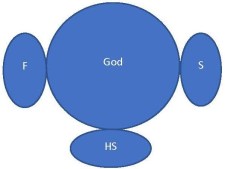
No. The three persons are not added on to God’s essence or being, as if they are tacked on to the outside of God. Rather, all three persons share the same essence, fully God in one being, in total and perfect unity.
10. Sharp divisions of the essence or substance, split into thirds
This image is defective because the divisions are too strong.

In reply, God’s essence is not divided equally into three parts; it is not one-third, plus one-third, plus one-third. The divisions show no interpenetration between the persons of the Trinity and an equal sharing of God’s being. Instead, Each person shares the divine essence fully and equally.
The above illustrations are adapted from Wayne Grudem (pp. 320-321).
VIII. Replies to Objections
A. Brief intro
The essence of the replies is that the tri-personal God living in complete oneness is the best description of God, the Triunity—three persons contained within one God.
1. Doesn’t this doctrine really come from later church fathers?
This doctrine is developed by great theologians like Athanasius (c. 296-373 AD) and Augustine (354-430 AD), but it was not invented by them. The New Testament was written to clarify pressing doctrinal and pastoral problems and issues that arose in the church.
Therefore, the New Testament authors, under the inspiration of the Holy Spirit, were not directed to develop the doctrine of the Trinity. Instead, they affirmed the full deity of Christ and the full deity and personhood of the Holy Spirit in verses throughout their writings, but not in a formal doctrine.
2. If there are three persons, why are there not three Gods?
The co-equal and distinct persons of the Father, the Son, and the Holy Spirit are not three Gods because they share the same essence in complete unity or oneness.
It is difficult for us humans to figure out because we do not share the same essence in unity.
For example, the patriarchs Abraham, Isaac, and Jacob are three distinct persons and beings. They do not share the same essence or being or divine attributes in close relations. Abraham may have been kinder than his son and grandson, and Jacob was more deceitful than Isaac. So they are not equal in their attributes.
However, the doctrine of the Trinity says that the Father, the Son, and the Holy Spirit share the same being or essence, and this is where the human example of the three patriarchs and the divine nature must part company. Picture the triangle (three persons) in the circle (one God)
Thus, basic Christian doctrine teaches that one God exists in three persons: the Father, the Son, and the Holy Spirit, not in three Gods, which is called tritheism. Christians reject this doctrine.
3. However, I read Christians writing, “God the Father, God the Son, and God the Holy Spirit.” Doesn’t that really say there are three Gods?
No, it is simply saying that the Father is fully divine (God), the Son is fully divine (God), and the Spirit is fully divine (God). Just because the same word God appears three times in one grammatical human sentence does not mean there are three Gods. However, the persons of the Father, Son, and Holy Spirit are three and distinct, expressed in three different words (Father, Son and Spirit!). I wouldn’t mind it if we dropped that way of writing and just say: “The Father is full deity, the Son is full deity, and the Spirit is full deity.”
But the same and one word God simply indicates the same and one “Godness” of the three persons.
4. Still, though, 1 + 1 + 1 = 3. So isn’t belief in the Trinity irrational?
Those digits can only refer to the three persons within the one being God (triangle in a circle, again); those numbers do not refer to his essence, which is one and unified.
Better:
One Father + One Son + One Holy Spirit = Three Persons
I don’t like the numbers game, but since the objector has taken us down the path of using numbers to refute the unity of God, let’s use them nonetheless, to clarify the simplistic addition model.
Multiplication works better with integers:
1 x 1 x 1 = 1
In other words, three persons are united in one essence.
The exponent comes out the same:
13 = 1
The conclusion is the same: Three persons are united in one essence.
How about an infinite number of sets of things? This works better:
Infinity + infinity + infinity = infinity.
It works out like this:
Infinite God the Father + Infinite God the Son + Infinite God the Spirit = One Infinite God
Three infinite persons are united in one infinite being called God, not infinite Gods (plural).
Let’s say that we add an infinite number of red books to an infinite number of white books, and still add an infinite number of blue books to the red and white books. Despite adding these three sets of infinite numbers of books together, we have not augmented or increased infinity by even one book. Such is the mystery of infinity; we cannot figure it out.
However, these three mathematical analogies of the Trinity ultimately fail because, among other reasons, the three infinite sets of books have different properties, because they do not exist in perfect unity in one essence, and because we do not “add up” or even “multiply” the three living persons of the Trinity.
It is now clear that belief in the Trinity is not irrational, but transrational — above our puny minds to figure out, ultimately.
5. Doesn’t the doctrine of the Trinity entail contradictions?
Mysteries are not contradictions. Here are two examples of contradictions:
There is one God and there is not one God;
God is three persons and God is not three persons.
But the claim that the one God exists in three persons who possess the same divine essence in perfect unity does not entail a contradiction (Grudem p. 256).
There is no contradiction in having three persons in one essence, for the terms are different. God is one and only one in relation to his essence, and God is three in relation to his persons. These two relations are two different senses (Geisler p. 550).
The Trinity ultimately is a mystery, but it is revealed in Scripture, so all Bible-educated and Bible-believing Christians believe in it, even though they may not understand it fully.
6. Doesn’t the doctrine of the Trinity ultimately come from pagan myths?
The doctrine of the Trinity, properly understood, is found nowhere in mythology – not even close. Zeus, Poseidon, and Apollo and any other trio of gods from around the Greek and Roman world do not share all of the same attributes in perfect unity as one God. In fact, Greek myths go out of their way to keep these gods distinct as three gods and beings with their own special attributes. The Trinity has nothing to do with a family or pantheon of squabbling gods or separate divine beings.
This is polytheism, and Christians reject it.
7. Isn’t the Islamic belief in a single, one-person deity the simplest and best way to go?
Islam (and Judaism) teaches strict monotheism, like so:
1 = 1.
At first glance that does appear simple and therefore the best option.
However, some Muslim sects believe the Quran is eternal and uncreated, and this poses problems for strict monotheism. But let’s set this issue aside.
Problems still emerge relationally.
1 = Lonely, isolated Allah
What was this Islamic deity doing all by himself in eternity past, before he made the heavens and the earth and the angels?
Louis Berkoff says this about isolated personalities, whether God or human:
Personality does not develop or exist in isolation, but only in association with other persons. Hence it is not possible to conceive of personality in God apart from an association of equal persons in Him. His contact with His creatures would not account for His personality any more than man’s contact with the animals would explain his personality. In virtue of the tri-personal existence of God there is an infinite fulness of divine life in Him. (pp. 84-85, emphasis original)
In other words, an isolated deity would have a deficient and short-changed personality. This is especially clear when we read in Scripture that humans are created in his image (Gen. 1:26-27). “It is not good for man to be alone” (Gen. 2:18). So living alone in isolation is not optimal for humans. Now what about God? No, we shouldn’t raise man up to the level of God, “but rather what appears as imperfect in man exists in infinite perfection in God” (Berkoff p. 84). God is not needy, but the living God existing in three persons is optimal, not a single-personal deity existing in lonely isolation.
8. Why didn’t Jesus or Paul or Peter just sit down and offer an extended teaching on the Trinity?
Let’s look at the beginning.
Deuteronomy 6:4 offers the famous shema: “Hear, O Israel, the LORD our God is one.” The Hebrew word for God is Elohim, and the -im ending indicates masculine plural. So it works out like this: Elohim (plurality) is one (unity). Plurality in unity is a perfect, boiled-down, beginning statement of the Triunity of God: Father, Son and Holy Spirit contained within one God.
Jesus repeats this phrase in Mark 12:29: “The Lord our God is one,” and Paul does the same in Gal. 3:20: “God is one.” Jesus said that affirmation in a Jewish context, and Paul in a polytheistic context. It makes sense that Jesus would wish to reach out to his fellow Jews, and Paul would wish to lead pagans away from their distorted view of the divine world.
Jesus did not even want some people to whom he ministered to know that he was the Messiah, by a formal announcement (Matt. 8:4; 12:16 // Mark 3:12; 7:36; 11:33 // Luke 5:34; 8:56). Even Peter had to receive special revelation to affirm that Jesus was the Messiah (Matt. 16:16; // Mark 8:29 // Luke 9:20). How much more would it have been difficult for the earliest Jews to accept his higher status, as God in the flesh? Also, the Gospel of John does show Jesus in his fullness (John 1:1-3; 8:58). Jesus said, “I and the Father are one” (John 10:30). That looks like a variation on the shema. And Jews found it difficult to accept, but his claims were true, nonetheless.
Paul writes that God was pleased have all his fullness dwell in Jesus (Col. 1:19) and the fullness of deity dwelled in bodily form (Col. 2:9). In Titus 2:13 Paul says the church is eagerly waiting for the appearing or the great God and Savior, Jesus Christ. There are other such passages.
Bottom line: Jesus and Paul and Peter had a more practical objective: proclaim the kingdom of God and salvation and solve church problems.
IX. Why Does God Seem So Complicated?
A. Answer from a popularizer of theology and philosophy.
C. S. Lewis encourages us not to wish and beg for a shallow religion. In his book Mere Christianity, in the chapter “The Invasion” he discusses the Incarnation (God the Son becoming man), which can also apply to the Trinity.
He writes:
It is no good asking for a simple religion. After all, real things are not simple. They look simple, but they are not. The table I am sitting at looks simple: but ask a scientist to tell you what it is really made of—all about atoms and how the light waves rebound from them and hit my eye and what they do to the optic nerve and what it does to my brain—and, of course, you find that what we call “seeing a table” lands in mysteries and complications which you can hardly get to the end of.
God is knowable as far as he has revealed himself through Jesus Christ, the Scriptures, the Holy Spirit who lives in us, and other avenues like the creation. However, no one has seen God in all of his full essence and being, except Jesus (John 1:18). We humans down here on earth are limited by our five senses and our finite minds, so how can we figure out and calculate the pure nature of God? “We can know God truly and sufficiently, but never comprehensively” (EDT, p. 343).
B. Incomprehensibility
The nature of God is ultimately incomprehensible. One reason that I believe in the Triunity is precisely because this doctrine is ultimately beyond my puny brain to figure out. I could never have invented it.
I simply have to accept Scripture as it is, even when I don’t understand all of it.
I trust God in the teachings I do understand (e.g. God loves me and saved me), and that leads me to trust him in the ones that I don’t understand completely (the Trinity).
It is best to go from known and simple things to the lesser known and difficult things. For example, it is best to study astrophysics and send out space ships over time before landing a human on the moon. Gradual. But unlike the moon landing, we will never understand the Triunity fully.
From simple and clear teachings to the deeper teachings is best the best route to travel.
C. Summary
The deepest relationship between the three persons cannot be known by us in its fullest sense—it is not possible to contain the ocean in a thimble. But we can know him sufficient for our salvation and we can know him in truly—we know him in truth. But we cannot know him exhaustively—it would take eternity to accomplish it!
You already relate to the Father and the Son and the Holy Spirit. The articles on the Trinity at this website will help you put the doctrine together. Our God is Triunity—three persons in one essence, one God.
Get to know each person of the Trinity!
X. Application
A. Practical application for the the laity and Sunday morning.
The Trinity has practical application, especially for your Sunday morning service.
1. Your deeper relationship with God
The more deeply your know God, the more you can develop a relationship with God in a deeper way. The doctrine of the Trinity is the fullest revelation of the living and personal and relational God. The one God exists in three persons, Father, Son, and Holy Spirit. You can now relate to each person.
God is your Father; you are his daughter or son—his child. Jesus is your elder redeemer brother, and he comes alongside and assists you. The Spirit actually lives in your awakened, reborn spirit and comforts, guides, advocates for, and communicates the Father and the Son to you. He also inspires Scripture to your spirit and mind, so you can understand it.
We have a fullest relationship with him thanks to his initiation through his grace.
2. Unity of God → Unity of people
The arrow means “leads to.”
God is a united being in one essence, so you must reflect this unity. Humans, especially you, must live in unity with other humans.
3. Recognizing diversity in creation
Knowing that God is diverse in his personality, you can recognize diversity in his creation. God living in diversity of three persons of the Father, the Son, and the Holy Spirit reflects this diversity of humans. Countless numbers of creatures live on this planet, and the highest creature is humankind. You can recognize many peoples as reflecting God’s own being and will.
4. Your redemption
In the bigger picture, the triune God redeems humanity in three persons, Father, Son, and Holy Spirit. God loves you so much that the Father sent his Son into the world to die for your sins. The Father and the Son send the Spirit into your heart to draw you to salvation and then to live in you forever.
5. Your justification
Without the Trinity our salvation goes down the drain. If Christ is not fully God, then how can we trust him to save us in his redemptive act on the cross? As a creature, he would need redemption too. We may as well do all kinds of good works, hoping against hope that we may get invited into heaven when we die, but not knowing for sure that God will let us in. Rather, since Jesus Christ was fully deity in human flesh, his salvation is divinely secure for us. We are justified (declared righteous) by grace through faith.
6. Your sanctification
You are sanctified (growing in holiness) through receiving his Holy Spirit. The Spirit is holy and personal. If he were an impersonal force, we could not relate to him, and he could not relate to us. Blessedly, he is fully God and utterly personal and relational.
7. Your meaningful worship
You can now worship God more fully and meaningfully. We now have a fuller revelation of who God is. Our worship can be full and meaningful, much more so than before we knew about the triune God. Scriptural revelation does that to us.
8. Diversity of gifts
In the bigger church, God distributes a diversity of gifts to his people, who are called to live in unity. Just as the three persons (Father, Son, and Spirit) have different roles, so the church is diverse and enjoys a variety of gifts, but no matter what, we must live in unity, just as the three persons do.
9. Your eternal life or death
Without the full deity of Jesus Christ, God the Son, our salvation or guarantee to get into heaven becomes shaky. Therefore, the doctrine of the Trinity is a matter of eternal life and death. We Christians must hold on to the Trinity, as we experience the Father, the Son, and the Holy Spirit in our daily life and in our creeds.
10. Jesus’s fuller identity
If we diminish Jesus to a mere messiah or an anointed prophet, then our experience with God is lopsided and incomplete. Why not just pray to another saint or biblical prophet instead of Jesus? Worshipping a creature is idolatry and forbidden. Jesus must be fully God if we wish to maintain our biblical worship.
11 The Spirit’s fuller identity
If we diminish the Spirit to an impersonal force or power, then I would not want it dwelling in me. I need to communicate with the Spirit, and I could not do that with an impersonal force or power that I might be able to boss around or who ignores me and cannot talk to me. I won’t pray to the wind!
12. Fuller knowledge of God
It is a blessing, rather, that I can experience the fullness of the three persons of God the Father, God the Son, and God the Spirit in all their deity. I can worship and pray to all three persons of the Trinity and have the fullest experience with God. Wonderful!
B. Summary
Let’s conclude with simple truths.
The Scriptures reveal the Father and the Son and the Holy Spirit, not to give us a headache, but so we can relate to them. We can have a personal relationship with the Father as intimately (and more so) as we have with our own father. And we can relate to the Son as the Messiah and Lord, who has a unique relationship with the Father. The Son reveals the Father. The title Father is more personal and revealing than “God.” The Spirit of the Father and the Son now lives in us so he can empower us to have a relationship with the Father and the Son.
May the grace of the Lord Jesus Christ, and the love of God, and the fellowship of the Holy Spirit be with you all. (2 Cor. 13:14)
In this next verse “him” is Christ. The Spirit gives us access to the Father through his Son. It is lovely Trinitarian verse.
18 For through him [Christ] we both have access to the Father by one Spirit. (Eph. 2:18)
Bottom line: let’s have a relationship with the Father and the Son and the Holy Spirit, since they are revealed in Scripture in those three persons, for our relational benefit.
On Sunday morning, it is best to teach the relationship aspect of the Trinity.
ADDENDUM ONE
Here is a table of attributes for further study:
|
ATTRIBUTES OF THE TRIUNE GOD |
|||
| Attribute | Father | Son | Holy Spirit |
| Life | Jos. 3:10 | John 1:4 | Rom. 8:2 |
| Omniscience | Ps. 139:1-6 | John 4:17-18 | 1 Cor. 2:10-12 |
| Omnipotence | Gen. 1:1 | John 1:3 | Job. 33:4 |
| Omnipresence | Jer. 23:23-24 | Matt. 28:20 | Ps. 139:7-10 |
| Eternity | Ps. 90:2 | John 1:1 | Heb. 9:4 |
| Holiness | Lev. 11:44 | Acts 3:14 | Matt. 12:32 |
| Love | 1 John 4:8 | Rom. 8:37-39 | Gal. 5:22 |
| Truth | John 3:33 | John 14:6 | John 14:17 |
| Glory | Ex. 16:7 | 1 Cor. 2:8 | 1 Pet. 4:14 |
| Wisdom | Job 9:4 | Col. 2:2b-3 | Eph. 1:17 |
| Graciousness | Is. 30:18 | Eph. 2:4-9 | Heb. 10:29 |
| Peacefulness | Rom. 15:13 | Eph. 2:14 | Rom. 6:6 |
| Goodness | Exod. 33:19 | John 10:11, 14 | Gal. 5:22-23 |
| Patience | Rom. 2:4 | 1 Tim. 1:16 | Gal. 5:22-23 |
| Faithfulness | 1 Cor. 1:9 | Rev. 19:11 | Gal. 5:22-23 |
| Righteousness | Rom. 3:21-26 | Acts 7:52 | Rom. 14:17 |
| Joy | Neh. 8:10 | John 17:13 | Rom. 14:17 |
In the right column, Galatians 5:22-23 speaks of the fruit of the Spirit. The main point is that if the Spirit produces those fruits, then he must have them in his person.
ADDENDUM TWO
Elmer Towns came up with this table too, which shows all three persons doing works that only God can:
|
THE WORK OF THE HOLY TRINITY |
|||
| Work | Father | Son | Holy Spirit |
| Creation of World | Ps 102:25 | John 1:3 | Gen 1:2 |
| Creation of Man | Gen 2:7 | Col. 1:16 | Job 33:4 |
| Death of Christ | Is 53:10 | John 10:18 | Heb 9:14 |
| Resurrection of Christ | Acts 2:32 | John 2:19 | 1 Pet 3:18 |
| Inspiration | Heb 1:1-2 | 1 Pet 1:10-11 | 2 Pet 1:21 |
| Indwelling of Believers | Eph 4:6 | Col 1:7 | 1 Cor 6:19 |
| Authority of Ministry | 2 Cor 3:4-6 | 1 Tim 1:12 | Acts 20:28 |
| Security of Believer | John 10:29 | Phil 1:6 | Eph 1:13-14 |
| This shows the unity of the Trinity. Each person of the Trinity contributed to each of these wonderful works, to God’s glory and for our salvation and redemption (Towns p. 100) | |||
BIBLIOGRAPHY
 Dr. Jim's Essential Bible Teaching